









Scram! Deep Dive
What the Community Thinks About Scram!
Scram! has emerged as a favorite among reviewers seeking quick, accessible team-based card play. Designed by Ted Alspach and published by Bezier Games, the game finds enthusiastic support for its ability to bridge traditional card games like Golf and Euchre with modern board game mechanics. The consensus centers on a game that is remarkably easy to teach to non-gamers while offering enough strategic depth to keep experienced players engaged over multiple rounds. Reviewers consistently praise how the team-based structure transforms what could be a simple push-your-luck card game into a social experience that encourages table talk and partnership strategy. The main point of divergence among reviewers concerns player count: while the game shines at four and six players, those with tables that consistently run two, three, or five players may find themselves searching for alternatives.
Core Mechanics That Define Scram!
Hand Management
Players start each round with five cards laid face-up before them: two visible and three face-down. On each turn, a player draws a card from either the deck or discard pile, then makes a critical decision about how to use it. They can discard it without playing its effect, play it for its special ability (such as flipping a card face-up to peek at hidden information), or swap it with a card already in their campsite. The power of hand management emerges when players find matching numbers among their own cards and their teammates' cards. When multiple cards of the same value are arranged correctly, a player can call them out and replace all of them with a single card, dramatically reducing the team's total score. This mechanic rewards timing and memory, as players must track which cards sit face-down across their entire team and coordinate their draws to enable these powerful clears.
Betting and Bluffing
The Scram call represents the game's high-stakes decision point. Once a player reduces their hand to two or fewer cards, they may declare Scram, asserting that their team currently has the lowest combined score. Every other player then gets exactly one more turn around the table before scores are revealed. If the team that called Scram indeed has the lowest score (or ties), they record zero points for the round and opponents record their combined card values. However, calling Scram while behind means accepting a ten-point penalty on top of the team's current score, turning a risky bid into a costly mistake. This mechanic creates a push-your-luck element similar to games like Silver, where confidence and card-counting intersect with the uncertainty of face-down cards and teammate coordination.
The Scram! Experience
Social Partnership Under Pressure
The team-based structure transforms Scram! from a solitary optimization puzzle into a shared experience. Teammates sit across from each other and can strategically combine their cards and special abilities, pooling their resources toward a common goal. Communication is constrained by the rules (players cannot directly tell each other which cards they hold), but reviewers note that the game actively encourages table talk and subtle coordination. Successfully eliminating cards through careful teamwork creates a shared sense of accomplishment, while failed Scram calls generate the kind of friendly groaning that defines memorable game nights. Players report that this variant is dramatically preferable to solo versions of similar games because the collaborative layer deepens engagement and creates moments where teammates must trust each other's reads and decisions.
Risk and Redemption
Every Scram call carries genuine consequences, making the decision to end the game feel weighty and memorable. The tension peaks as players weigh whether their combined hand is strong enough to win, knowing that one badly timed call locks in a ten-point penalty. Even after calling Scram, the game does not end immediately; teammates must endure one full round of additional play while sitting in limbo, unable to influence the outcome but hoping that their partners continue to improve the team's position. This creates a distinctive rhythm where confidence, vulnerability, and hope intertwine in a single turn structure.
What Makes Scram! Stand Out
Portability and Intuitive Design
Scram! fits in a jacket pocket yet teaches in minutes. Reviewers who brought the game camping found it easy to explain to players who had never encountered board games, attributing this to a rules set that builds logically on concepts people already know: matching cards, swapping values, and calculating totals. The compact card deck and small play area mean the game can be played on a picnic table, airplane tray table, or coffee shop counter without consuming valuable surface real estate. The thematic alignment between the camping setting and the mechanic of clearing critters from a campsite reinforces the learning process, making the flow feel natural rather than arbitrary. This combination of accessibility and portability makes it an exceptional game for travel and non-gamer introduction, a rare achievement in the push-your-luck genre.
Team-Based Strategic Depth
The team variant elevates Scram! beyond its spiritual predecessor Cabo by adding a layer of shared strategy. Players must consider not just their own cards but those visible to their partner, creating opportunities to coordinate plays that would be impossible in solo versions. Special card abilities, which allow players to exchange cards with opponents, peek at hidden cards, or manipulate the board state, offer tactical options that reward communication and forward planning. Reviewers consistently emphasize that partnering with another player to strategically use shared card values and special powers makes the game compelling enough to cycle back into rotation repeatedly over a single evening, suggesting that the team mechanic succeeds in creating replayability and sustained engagement.
Potential Drawbacks
Player Count Constraints
Because Scram! is fundamentally designed for team play, certain player counts create structural problems. With two or three players, only one team exists, eliminating the competition that drives much of the game's tension. Five players cannot be evenly divided into teams without creating imbalance or house rules. At these counts, the game feels either incomplete or requires awkward accommodations that undermine its elegance. Players in groups that frequently play at odd counts or favor two-player gaming may find themselves unable to access the experience reviewers praise, making this a genuine limitation for some households.
Luck as a Dominant Factor
Despite its strategic moments, Scram! remains influenced by card draws and the luck of hidden information. Players cannot control which face-down cards they will eventually reveal, and poor drawing sequences can lock a team into bad positions regardless of careful planning. Some reviewers note that special card abilities, while interesting, can swing outcomes unpredictably, and certain high-value cards can complicate strategy if they appear at inopportune moments. For players who prefer games where skill and decision-making completely dictate outcomes, Scram!'s reliance on chance may feel frustrating, though most reviewers treat this element as a feature rather than a bug, describing it as part of what keeps games fresh and prevents dominant strategies from calcifying.
If You Enjoy Scram!
Players drawn to Scram!'s team-based structure and push-your-luck tension will find similar satisfaction in Silver, the parent game from Bezier Games that uses the same core scoring system in a solo format. Those who appreciate the camping theme and critter-clearing narrative may connect with the humorous chaos of Cabin Fever or the pastoral strategy of nature-themed card games. The comparison game Cabo serves as Scram!'s direct mechanical ancestor, offering an excellent entry point for understanding the individual card game that inspired this team variant. Traditional card games like Golf, Hearts, and Euchre share Scram!'s use of matching, sequencing, and calculated risk, making them natural recommendations for those seeking similar decision-making structures. For players who love the push-your-luck decision of calling Scram, Carbo, the game from which Scram! evolved its core mechanic, offers comparable moments of high-stakes bidding with similar penalty structures and team coordination opportunities.
What Reviewers Are Saying
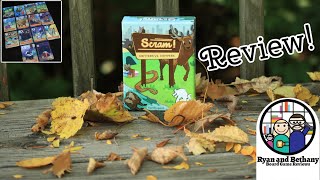
"I was able to teach it to a lot of people who weren't Gamers because the rules set was very intuitive and very simple, and at the same time the theming kind of caught on to what we were doing as we were camping all together, so it's a really fun experience playing this with those people."
— Ryan and Bethany Board Game Reviews
"When someone is down to two cards they can call Scram, but it comes at a risk. So do this only if you're confident you'll win, because it gives everybody else one more turn."
— Board With Steve
"One of my favorite parts of Silver was always the meanness of the game. It's not really mean, but I enjoyed that part of it, and Scram has that as well."
— Rolling Dice & Taking Names