
















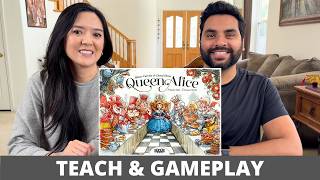
Queen Alice Deep Dive
What the Community Thinks About Queen Alice
Queen Alice has captured the board gaming community's attention with remarkable enthusiasm. Across multiple review channels, the consensus is clear: this is a beautifully executed mid-heavy euro that balances complexity with elegance. Board Gaming Ramblings calls it "addictive" and notes that "the game mechanisms blend perfectly together," while Meeple University praises its accessibility despite its apparent depth. The most striking pattern is that reviewers universally credit the game's elegant integration of disparate systems. As one reviewer puts it, players quickly realize that "everything just makes sense. Once in a while, it stops. I have to think about this thing. But most of the time, I'm going to be like, 'Oh, it's my turn. I'm going to do this.'" The game generates strong desire to replay; one reviewer declared, "I would easily play this again and again."
Core Mechanics That Define Queen Alice
Deck Building
Deck building sits at the heart of player progression in Queen Alice. Each player begins with an identical starter deck of basic cards representing chess pieces. Throughout the game, players acquire new cards by spending resources and books earned through their actions, layering bronze, silver, and gold cards into their evolving personal deck. The mechanism creates a compelling arc: early-game players recycle weak basic cards, but over time their hands fill with efficient upgrades. Board Gaming Ramblings highlights the elegance of this system: "the fact that the deck building is, I don't think I haven't seen a player not take any new card like you will get cards because the cards you get are better than the other cards but there are strategies in that." Players can also remove cards from their deck entirely, thinning it to improve consistency. What makes Queen Alice's deck building distinctive is that it runs parallel to the other four mini-games rather than being the sole strategic engine. One reviewer notes with satisfaction that they won a game by focusing almost entirely on card removal and discard, earning nearly half their points from that strategy alone, proving the system's flexibility.
Resource Management
Four distinct resource types create the engine of meaningful choice: cherry cake and buttered toast are the primary currencies for red and white actions respectively, tea can fuel either color, and time serves as both a limited currency and a universal wild resource. Players hold tokens on a limited platter, forcing them to constantly weigh spending decisions against future turns. Board Gaming Ramblings observes the brilliance of this constraint: "so much balance going on like both in do I want to move this, do I want to move that." The asymmetry of resource flows is no accident. When players execute white actions (using toast), they receive cake as their reward, naturally pushing toward cycling through both paths. Time creates additional texture: players can spend six time to repeat an action, unlock black resource cubes to expand capacity, or trade three time for one of any resource when desperate. This layered system means early-game scarcity feels like genuine constraint without becoming punishing once players understand the flow.
The Queen Alice Experience
Puzzle-Like Efficiency and Flow
Queen Alice creates a satisfying efficiency puzzle that resonates most after the first play. Board Gaming Ramblings describes the sensation perfectly: "trying to figure out as you said how to do it the more efficiently there's been so many times where I'm just like oh I see this great possibility on the board. Now I'm just moving this here and that no that was a white piece and I need to do the red action now." Players spend mental energy mapping futures and finding optimal paths through available resources and board positioning. The first game demands intense analysis as information overload settles in, but this transforms dramatically on replay. As one reviewer notes, the first time playing with two players took far longer than subsequent plays, which settled into a brisk hour, "and this is a lot of game in an hour." The shift from struggle to flow creates a profound reward cycle; players who push through initial complexity find themselves rewarded with a game that feels effortless once learned, where each turn becomes a satisfying arrangement of moving pieces, gaining resources, and advancing toward personal victory goals.
Tension in Competing Paths
The game generates constant low-level tension through the dual-Alice track system. Red and White Alice progress simultaneously based on which player actions occur, and only the one who advances furthest becomes queen at game's end. This creates a persistent push-pull: every action that advances Alice also provides immediate benefit to the acting player, but those benefits multiply at the end if Alice becomes that color. Players find themselves caught in strategic dilemmas. Board Gaming Ramblings captures this: "I really want to go here and get the gold card but then it moves the white queen Alice up and I don't want that to happen because you will get a lot of points for that at the end of the game. So I might do something else first." The tension is never adversarial or aggressive, but the constant awareness that your opponents might be better positioned than you creates genuine stakes without forcing conflict.
What Makes Queen Alice Stand Out
Sophisticated Chess-Powered Action Selection
Queen Alice takes chess, a game most players already know, and uses it as the elegantly simple skeleton for a complex action-selection system. Players move chess pieces across a central board following actual chess rules, and where those pieces land determines both the resource they gain and the mini-game action available that turn. The system is strong because it feels thematic, reduces rules overhead, and creates emergent positioning puzzles. Reviewers praise this constantly. Before You Play notes that "the mixing of like actually moving the pieces in chess like ways and you can capture other pieces" works wonderfully alongside the strategic layer. Capturing opponent pieces triggers bonuses, and feeding pieces into jail creates another decision point. Board Game Hangover echoes the sentiment: "I love the mix of like the chess board and the chess movement like card play. The art and stuff is really cool." Combo Games shows mastery here: the chess layer never feels pasted-on or forced, but rather grows organically from the game's theme of Alice in the Looking Glass world.
Viable Strategies Emerging from Four Distinct Mini-Games
Rather than building toward one dominant path, Queen Alice offers four semi-independent mini-games that feed into each other without requiring commitment to any single one. The Lovely Garden track rewards special powers; Humpty Dumpty's wall generates influence; the Spades track offers card upgrades; the Clubs tree yields knowledge for strong endgame scoring tools. Players can win by focusing deeply on one, spreading efforts across all four, or finding hybrid approaches. Board Gaming Ramblings celebrates this design choice: "everything feels like a viable strategy. Like for example these powers feel very good. That feels very powerful, but you can easily win the game without a single one." The reviewer even won a game by focusing almost entirely on removing cards from their deck, a strategy that bypassed the typical mini-game rewards. This flexibility is rare in euro games and explains the community's enthusiasm for replay.
Potential Drawbacks
First-Play Cognitive Load
The first game of Queen Alice is notably heavy on analysis paralysis. Board Gaming Ramblings is honest about this: "there's so much AP going on the first first game." The rules themselves are clean, but the decision space explodes immediately. Should you pursue a particular mini-game, hedge your bets across Alice colors, focus on deck improvement, or lock in resource generation? With four boards, chess positioning, resource trade-offs, and future planning all demanding attention simultaneously, new players often struggle. One reviewer admits that the first play simply felt too long given the learning curve. This is not a game to teach to a table expecting quick gratification. However, the silver lining is acknowledged: once learned, the complexity compresses into elegant efficiency, and subsequent plays resolve in reasonable time.
Presentation Complexity May Overwhelm Casual Players
While reviewers celebrate the visual design, the sheer number of components, boards, and icons can intimidate newcomers. The game requires tracking red and white sides for nearly every system, managing multiple resource types, understanding four distinct mini-game mechanics, and following the chess movement rules. Though Board Gaming Ramblings notes that "the icons are super clear," the visual density of the table state remains high. The learning curve is real: players need time to internalize not just the rules but the decision-making framework. This is not a casual game to pull off the shelf for a relaxing evening; it demands players who enjoy thinky, deliberate gameplay and who are willing to invest a first session in learning the interplay between systems.
If You Enjoy Queen Alice
Players drawn to Queen Alice's integration of chess movement with deck building might explore King's Crown, a game also built around reimagining a classic game as a modern euro. Those seeking a similar efficiency-puzzle satisfaction could look to games with tight resource management and multiple viable strategic paths. Buried Memories offers a comparable sense of discovery and modular progression, though its cover art draws a less favorable comparison from at least one reviewer. What unites Queen Alice with these titles is the philosophy of providing a familiar mechanical skeleton and asking players to build surprising strategies around it.
What Reviewers Are Saying
"This is one of those games where if you play this once and you feel like your brain is exploding, I'm pretty sure when you play it again, it's going to feel way easier. So after the first time with two players, every time we played after that was an hour. And this is a lot of game in an hour."
— Board Gaming Ramblings
I feel like the game mechanisms blends perfectly together. I really think that this is very interesting and unique. I haven't seen it done in I haven't seen chess like this done in a board game any any other time.
— Board Gaming Ramblings
It doesn't the cover is not as good as buried memories, but the gameplay looks like it's all there. And all of this madness cuz Allison got it. In less than 20 pages rule book at 26 pages, but there's tons of examples and stuff.
— Board Game Hangover