





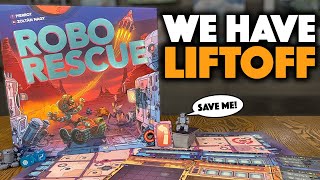
Robo Rescue Deep Dive
What the Community Thinks About Robo Rescue
Reviewers who have played Robo Rescue describe it as a thoughtfully designed programming game that punches above its complexity weight. The game presents itself as accessible and light, yet delivers meaningful strategic decisions beneath the surface. Player feedback centers on the elegant puzzle of navigating the Martian facility board, the variety of engine-building pathways, and the satisfying sensation of orchestrating multi-step robot turns that chain together perfectly. While enthusiasts of programming games appreciate the mechanical depth, those newer to the genre find Robo Rescue approachable without sacrificing engaging decision-making. The cute robot aesthetic and thematic story of homesick machines racing to escape a collapsing research station have also resonated well with players seeking games with both heart and puzzle-like challenges.
Core Mechanics That Define Robo Rescue
Light Programming Through Command Cards
Robo Rescue employs a command-card system that feels like programming but operates more intuitively than traditional simultaneous-programming games. On each turn, players play one or more command cards to direct their robots around the board. Rather than everyone revealing moves simultaneously, each player's commands execute in sequence, allowing for tactical spatial decisions. The system includes modifier tokens, such as stop, turbo, levitate, rotate, and blast, that let players chain actions together in increasingly complex sequences. As players collect tokens throughout the game, early turns can be resolved in seconds, but later turns become satisfying puzzles where players spend time planning multi-step maneuvers. This allows the programming depth to scale organically; newcomers experience streamlined turns while experienced players unlock sophisticated chains of actions that set up future turns perfectly.
Engine Building Through Cable Tokens and Oil
The four engines needed to win can be constructed through approximately six to eight different methods, creating a dynamic competitive landscape where players pursue divergent strategies. One path involves collecting oil; fill two barrels of oil across a turn and immediately claim an engine. Another route is the cable-matrix puzzle: gather cable tokens, place them according to specific connection rules, and unlock engine components. Players can also hunt hard-drive chips by landing on specific corner spots and executing blasts at precisely the right moment, or collect energy cubes through similarly tactical positioning. At the end of each turn, players may convert cards, tokens, or oil into other resources, though only one conversion of each type per turn, forcing difficult decisions about whether to keep flexibility in hand or commit resources toward a specific engine path. This variety ensures that two games of Robo Rescue rarely unfold identically; the robot adjacent to an oil source might pursue oil engines while another player designs a cable-collecting route and a third chases hard-drive chips.
The Robo Rescue Experience
A Puzzle of Spatial Navigation and Planning
The board itself becomes a puzzle that evolves as resources disappear. Action tokens and special elements are scattered across spaces, and as players claim them, the available options shift. Blocking becomes tactically important, not through direct player attacks, but through positional control. A robot stationed on a critical switch or valuable resource space denies it to opponents on their turn. Planning is bidirectional: players must think not only about their current turn but also how their final position and available resources will enable or constrain their next action. This creates a meditative, strategic feel where the game rewards forethought and punishes greedy short-term plays. Navigating around crates, switches, and other robots while managing a limited hand of cards and token supply creates natural tension; a robot might end a turn in a poor position simply for lacking the turbo token to push past an obstacle, forcing a wasted next turn drawing more cards instead of advancing toward victory.
Deeply Satisfying Turns When Everything Aligns
Among the most rewarding moments in Robo Rescue are the rare turns where multiple systems click into place. With the right combination of cards in hand, tokens available, and positioned robots, players can execute elaborate sequences: move forward, turn 90 degrees, blast a crate, move through the debris, activate a switch, and land on a new action space, all in one turn. These complex turns feel less like random card plays and more like carefully orchestrated maneuvers, which aligns perfectly with the theme of humans guiding homesick robots. Players report a palpable sense of satisfaction when a planned sequence executes flawlessly, collecting exactly the resources needed or positioning to claim a crucial board element ahead of opponents. The game creates natural pacing where turn structure accommodates both quick, simple plays for new players and elaborate multi-step puzzles for those optimizing their moves.
What Makes Robo Rescue Stand Out
Programming Made Approachable Without Losing Depth
Programming games often intimidate players unfamiliar with simultaneous action revelation or simultaneous execution. Robo Rescue subverts this by using sequential card play and optional modifier tokens, allowing new players to grasp the system instantly while offering surprising strategic layers as play deepens. Early games may feel like a straightforward "play a card, move two spaces" experience, but as players collect ability cards and tokens, the mechanical landscape expands. This gentle onboarding, combined with the thematic resonance of programming robots to escape a doomed facility, makes Robo Rescue a rare gateway into a genre that many players want to enjoy but find intimidating in other implementations. The design respects both groups: those seeking a breezy 60-minute race and those hunting for intricate spatial puzzles.
Multiple Viable Paths to the Same Goal
Few race games offer as many legitimate strategies for reaching victory. The existence of six to eight distinct engine-building routes means players are not competing for identical resources or following identical blueprints. One player might pursue cable-driven engines, another prioritizes oil accumulation, and a third focuses on hard-drive chips, all starting from the same setup and all capable of winning. This design choice eliminates the common race-game trap where the first player to identify the optimal path wins handily. Instead, Robo Rescue rewards reading the board, understanding your hand, and committing to a coherent strategy rather than chasing whatever the leader is chasing. Ability cards, starting positions, and early token draws create natural asymmetry, inviting each player to lean into their unique advantages rather than mimic a single dominant approach.
Potential Drawbacks
Limited Long-Term Replayability Without Expansions
Players who invest deeply in Robo Rescue note that the core game can feel exhausted after three to five plays. Once the board layout, token placements, and engine-building paths have been internalized, the game's puzzle begins to resolve predictably. The thematic charm and satisfying turn structure maintain enjoyment throughout the early plays, but without additional content, the game may not sustain long-term interest as a repeated feature on the table. The designers appear aware of this, as reviewers emphasize that an expansion would naturally extend replayability, but purchasers should view Robo Rescue as a focused medium-term experience rather than a perennial campaign or evergreen filler.
Complexity Hidden Beneath Accessible Presentation
The game's light appearance and welcoming theme mask a surprisingly intricate ruleset. Several mechanics, including token placement rules for the cable matrix, conversion restrictions, switch activation logic, and the specific modifiers each token provides, introduce friction that newcomers don't anticipate from the cute-robots-escaping-Mars pitch. Players unaccustomed to spatial-puzzle games or games with layered token economies may struggle to grasp the strategic depth initially, leading to turns that feel confused or overly lengthy while options get parsed. This is not a defect so much as a reminder that Robo Rescue is a puzzle game masquerading as a light race game. Groups comfortable with teaching lighter Eurogames will find the ruleset manageable; groups seeking an ultra-accessible game that plays smoothly from turn one may find themselves frustrated during the learning phase.
If You Enjoy Robo Rescue
Robo Rescue is built for players who appreciate programming games but want them to feel immediate and spatial rather than abstract. It rewards spatial visualization and forward planning without requiring simultaneous-action anxiety. For anyone who enjoys the theme of coordinating autonomous agents, appreciates accessible but meaty puzzles, and has patience for a game that yields its depth gradually, Robo Rescue delivers a thematically cohesive, well-paced experience. The cute robot aesthetic and Mars-escape narrative add emotional resonance absent from many puzzle races. Expect a game that scales beautifully with player count, encourages distinct strategies, and offers enough decision-making density to engage both newcomers and puzzle enthusiasts, albeit with a shelf-life measured in several plays rather than years of campaigns.
What Reviewers Are Saying
"is competitive. It is a race. It is the first person to completely power up their rocket by powering up these four engines that literally do like snap into place. If you're the first one to do that, you automatically win the game."
— Watch Review
"I really I really dug what this game is. I'm always interested in programming games because they're not that common."
— The Brothers Murph
"while at first it feels like, and they even use the word programming, feels like a programming game. It's not a programming game in the traditional sense where not everyone are placing cards face down and then reveal it and then they're all executing sort of simultaneously. On your turn, you're going to be using command cards to command your robots around this board to do a number of different actions."
— Watch Review