






Seagrass Deep Dive
What the Community Thinks About Seagrass
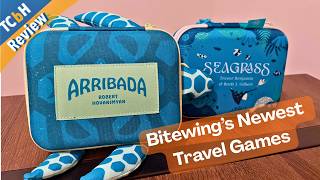
Seagrass arrives as a refined reimplementation of Maya with a complete thematic reskin. Designed by Trevor Benjamin and Brett J. Gilbert and published by Bitewing Games, the game has earned respect from reviewers who see it as part of Bitewing's consistently strong travel game line. The consensus leans toward enthusiasm tempered with specific reservations about longevity. Before You Play and The Dice Tower celebrate the designers and the production quality, particularly the charming turtle-shaped box for the travel edition. The Cardboard Herald offers the most substantive analysis, praising the design's elegance while raising questions about whether the game sustains engagement beyond a handful of plays. One playthrough reviewer worked from a prototype copy with creature tiles that would change before the final release, so early impressions about legibility have been addressed in production.
Core Mechanics That Define Seagrass
Area Control and Majority Scoring
The heart of Seagrass centers on area control. Players place tiles representing four sea creature types (jellyfish, starfish, crabs, and turtles) around shared reefs to establish presence. When a reef becomes completely surrounded by creature tiles or board edges, scoring occurs immediately. The player with the most creatures adjacent to that reef earns the higher score; the player with the second-most presence earns a smaller reward. Reef size determines the point values, and larger reefs pay significantly more. This asymmetry drives the game: every placement decision must consider not only personal scoring potential but also how the move affects the board state for rivals. Players actively race to surround reefs they dominate while simultaneously blocking opponents from accumulating easy majorities on contested reefs.
Tile Placement and Hand Management
On each turn, players choose one of two actions: place tiles into a colony or expand a reef. Placing tiles from hand into a colony scores immediately (one point per creature shown on the tiles), and the group must all be the same creature type placed into a single contiguous colony. Alternatively, players can expand a reef by placing a tile face down to explore new reef territory. This action draws three new tiles, providing access to more options. The tension emerges because placing tiles depletes hand size gradually and unpredictably. When a player's hand runs low, they must choose between placing the few tiles they hold strategically or spending a turn expanding reefs to refill. The Cardboard Herald reviewer found that a naive strategy of placing animals on one turn and refilling on the next led to suboptimal play, requiring adjustment and adaptation based on anticipated opponent board states.
The Seagrass Experience
Tight, Tactical Decision-Making
Reviewers emphasize that despite only two available actions, every turn feels weighted. Each decision ripples across the board, affecting which reefs can score, how many creatures surround them, and what options remain for opponents. The limited action pool paradoxically creates richness because players must deeply consider the consequences of expansion timing. The Cardboard Herald noted that the constraint of two actions meant each felt very powerful; there is no throwaway turn. Players experience genuine tension about when to expand territory versus when to commit creatures to scoring majorities.
Emerging Narratives of Board Control
The game generates dynamic narratives as the map unfolds. Reviewers describe watching players maneuver reefs, sometimes accepting suboptimal personal scores to deny opponents larger majorities. The board itself becomes a battleground where the layout gradually determines scoring outcomes. Creatures do not simply score in isolation; they interact with reef boundaries, opponent presence, and emerging patterns. This creates a rhythm of exploration followed by conflict, giving the game a natural arc that builds engagement over its 45-minute playtime.
What Makes Seagrass Stand Out
Elegant Special Tiles That Break the Rules
The game includes four special creature tiles that introduce asymmetric exceptions without complicating the core ruleset. The jellyfish special tile allows a player to place four creatures on a single tile. The starfish tile permits splitting a placement across two separate colonies instead of one. The crab tile grants the ability to place a tile atop an already-placed opponent tile, removing it from the game and potentially shifting majority control at a critical moment. The turtle tile grants an immediate bonus action: the player takes both a colony-placement action and a reef-expansion action in sequence. These tiles appear face up at the start of the game, so all players know when each is available and can see which have been spent. Reviewers found these additions gave the game meaningful decision branching and let clutch plays shift the outcome without making the game feel swingy or unfair.
Bitewing's Refined Production and Travel Format
Reviewers consistently praise Bitewing Games' commitment to elegant, portable designs. The Dice Tower team highlighted the turtle-shaped box in particular, noting that it transforms a travel-line game into something charming and distinctive. The Cardboard Herald reviewer mentions receiving notification that legibility issues identified in the prototype were solved in the final production, with tokens redesigned to be more visually distinct. This attention to clarity and production quality reflects designer philosophy: rules remain light, but physical presentation supports both ease of play and aesthetic appreciation. The game comes in both a standard box and a special travel edition, acknowledging different player needs without compromising either format.
Potential Drawbacks
Uncertain Long-Term Replayability
The Cardboard Herald raises the most specific concern: whether Seagrass retains engagement across 20 or more plays. The reviewer reports enjoying 10 plays and feeling satisfied with the money's worth but expresses doubt about legs for significantly more playtime. The mechanic repetition and limited board configurations may eventually exhaust novelty, particularly for players seeking high variation. This is not a dismissal but a measured observation that Seagrass may serve better as a solid occasional game rather than a perennial favorite for some groups.
Limited Actionable Depth in Shared Tile Drawing
While the two-action system creates tight decision-making, the draw mechanism introduces randomness that can occasionally feel constraining. Players sometimes find themselves with a hand of tiles unsuited to their strategy, unable to pursue the majorities they planned because the tiles they draw do not align with their intentions. The game compensates through reef expansion, which refills hand size but requires committing turns to that single objective. For players preferring crunchy decision-making with minimal luck, this randomness in tile draws can feel frustrating, particularly in the late game when each tile matters significantly.
If You Enjoy Seagrass
Seagrass is a direct reimplementation of Maya, so players already enjoying that design will recognize the core strategy, now wearing a marine theme that genuinely enhances thematic coherence. Bitewing's companion release, Arribada, shares similar production values and elegant rule simplicity, though it employs different mechanics (runs and sets scoring with capture-based interaction). The Dice Tower reviewers note that if players enjoy Gingham, another Bitewing collaboration, they will likely appreciate both Arribada and Seagrass. Gazebo, the earlier title in Bitewing's travel line, appeals to players seeking portable abstract games with straightforward rulesets and rich tactical play. All four titles prioritize clarity and portable presentation without sacrificing strategic depth.
What Reviewers Are Saying
"These two actions, while limiting, provide a large amount of player interactivity, which meant I had to adjust what I was doing on my turn to best take advantage of any anticipated board states. I had to keep tabs on what my opponent had in their hands, and if they were likely to expand a reef this turn, and if so, how best to surround the reef with my animals."
— The Cardboard Herald
"Once a reef has been completely surrounded, either by animals or by the edge of the board, it gets scored. Bigger reefs score you more points, so you're going to want to expand out these reefs so that they're touching more of your animals and fewer of your opponents, and also trying to box in reefs that your opponent is trying to expand for themselves."
— The Cardboard Herald
"I have a lot of trust in what Bitewing does. I haven't gotten to try these. I haven't tried the finalized version of Arribada or anything, but I haven't played Seagrass."
— The Dice Tower