





Shrine: Duel of Light Deep Dive
What the Community Thinks About Shrine: Duel of Light
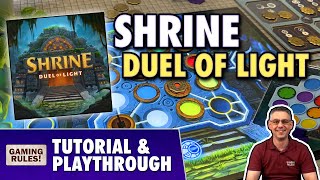
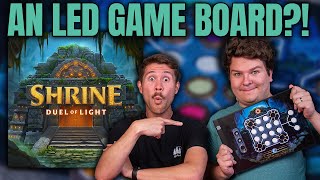
Reviewers agree that Shrine: Duel of Light is a clever two-player game built around a striking illuminated board. The kovray channel called the board the standout of the box and was surprised by how thin and unobtrusive the lighting panel is compared with the large light-up display they had imagined. Gaming Rules! host Paul Groen covered the game in a rules teaching video and then in a two-player playthrough, and found it engaging for gamers. Both Gaming Rules! videos were sponsored by the publisher, which the host disclosed, and both channels stressed that the copies shown were prototypes with lens colors expected to look more vivid in the final version.
Opinions diverge mainly on accessibility. The kovray hosts described the game as rewarding once its timing clicks, while Paul Groen questioned whether its cleverness would appeal to the same audience that normally plays two-player abstract games. The host was more direct that the game may be too involved for a family table, even though it works well with experienced players.
Core Mechanics That Define Shrine: Duel of Light
Dials and Lens Placement
Each turn begins by refilling the offering, so that one arcane lens drawn from the pouch is ready to play. The player then chooses an active dial, which points at a specific field, and places the offered lens there if the arrow reaches a legal space. Each field can hold up to two lenses, and blocked fields are off limits. Every dial allows one free step of rotation before placement, which gives the decision some aiming. Once a lens is placed, the dial flips to its inactive side. When every dial is inactive, all of them reactivate except the one just used, so the board cycles through play and recovery. A dial with no valid fields left is removed and added to a progress track, and the game ends when a third dial has been removed.
Scoring rewards stacking. The kovray hosts explained that a single matching lens is worth one treasure, a stacked pair of matching lenses is worth two, and a stacked mix of two colors counts as a complex color worth three. Fields marked as targets on a secret code card add two more. The player with the largest contiguous area receives a four-treasure bonus at the end, so central placement becomes a contest. Gaming Rules! confirmed that contiguity only counts through orthogonal connections.
Treasure Powers and Loans
Each player board carries six treasure powers, and all of them start locked. Unlocking a power means returning the treasure on it to the supply, and a power can be reused by paying treasure each time it is activated. The kovray hosts listed the set: rotating a dial, refreshing the offering with a chosen color, placing a lens on an inactive dial, blocking a field to claim it permanently, overwriting a lens, and relocating a lens already on the board. Blocking a field that matches your code pays out immediately, which makes it one of the most tempting uses of treasure. Gaming Rules! called overwriting and relocation the most powerful abilities, because they change the board without adding a new lens.
When treasure runs short, players can take a loan that provides treasure now and costs points at the end. Gaming Rules! showed a loan that gained two treasure while costing three points at the end of the game. The kovray hosts described debt as very detrimental to the end game but sometimes a lifesaver. Passing is the third option, limited to two uses per game, and extra passes carry an end-of-game penalty.
The Shrine: Duel of Light Experience
Reactive Timing and Head-to-Head Tension
Reviewers describe a constant pull between acting on your own plan and waiting to see what the opponent does. Because each player holds a hidden code card, neither side can fully read the other's goals, so the hosts wondered whether an opponent's move was aimed at them or was simply that player's own plan. The kovray hosts called this timing decision the real core of the game and warned that overreacting to every opponent move can make a player forget their own objective. They also described a light conflict that sometimes turns into direct interference, which keeps the two-player contest lively.
Tight Resources and Brain-Stretching Complexity
The treasure economy adds a second layer of tension. Because treasure serves as both currency and score, every power has a real cost, and the kovray hosts said their first game ended with them running dry, a mistake they advised new players to avoid. The expansions add mental load. The hosts described Eternal Glyphs as a noticeable step up in complexity, with glyph and color scoring competing for attention while the board is already crowded. Overall, the feel is of a tightly managed puzzle that asks for constant calculation.
What Makes Shrine: Duel of Light Stand Out
The Illuminated Board
The LED board is the element reviewers return to most often. The kovray hosts praised how well the light works while taking up little visual space, and they noted that the glow helps distinguish colors that are otherwise close. Gaming Rules! pointed out that the lighting has several brightness settings, so players can tune the glow to the room they are in. The host used the first setting in a bright studio and found it worked well.
Hidden Codes and Expansion Layers
Each player receives a secret code card that defines which colors they want and which fields are targets. Gaming Rules! explained that the dealing system means no two cards are the same, which keeps each game's goals distinct. The kovray hosts were enthusiastic about the expansions. Radiant Shapes adds shape cards that reward players who complete patterns of lenses, and the hosts described finishing a difficult shape as a satisfying payoff. Eternal Glyphs adds glyphs to lenses and code cards, and the hosts considered it a clear step up from the base game, though one that makes the game more demanding.
Potential Drawbacks
The most consistent caveat is that the game is a prototype. Gaming Rules! showed lenses that looked faint and pale, and the host repeatedly said the final production copy will look more vivid. The kovray hosts also stressed that everything they showed may change. The kovray hosts noted that a couple of the base colors were tough to tell apart without the light, which suggests the lighting is important for players with color vision differences. The hosts did not go further than that observation. Gaming Rules! also warned that the game may be too much for a family audience. The Gaming Rules! playthrough showed that heavy loan use can drag a score into negative territory. Finally, the kovray hosts said some goals on the board were hard to reach, although the payoff was strong when they were achieved. Whether the expansion layers are too heavy for casual players is this article's inference from these remarks, not a point any reviewer stated directly.
If You Enjoy Shrine: Duel of Light
The source material does not identify a close comparison title for Shrine: Duel of Light, so this article does not name one. The kovray hosts did note that the game is not based on another game. Readers who want to judge whether it suits their table should watch the kovray and Gaming Rules! videos, which show the board, the rules, and full playthroughs in detail.
What Reviewers Are Saying
"It is very innovative and I think this is what this company is about is trying to create and throw some innovation in the board game industry."
— kovray
"But it's all about the player powers. And this is where things come in interesting."
— Gaming Rules!
"I quite like two-player abstract games, and this one is very clever."
— Gaming Rules!