

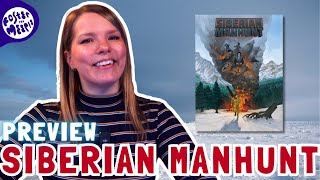

Siberian Manhunt Deep Dive
What the Community Thinks About Siberian Manhunt
Siberian Manhunt is a two-player asymmetric hidden movement game published by Dangerous Games. One player takes the role of a downed American pilot who must cross Siberia toward the Chinese border, while the other commands the Soviet government and its agents in an effort to capture or kill the fugitive. Reviewers describe it as a focused, tense contest of wits that asks a lot of both sides, and they tend to frame it as a game for players who already enjoy war games, history, and stressful strategy.
The reviewers came to the game from different directions. Foster the Meeple covered it in a Kickstarter preview that the publisher sponsored, and the host walked through both factions in detail before concluding that the game is a strong fit for cat and mouse fans. Before You Play placed it on a year-end list of favorite releases, and the hosts noted that the game was unusual in that its Kickstarter campaign launched and fulfilled within the same year. One of that channel's hosts admitted to not usually being a fan of hidden movement games, which makes their enthusiasm a notable point in the game's favor. The Discriminating Gamer included it among honorable mentions in a top 30 list of 2025 releases and described it as a hidden movement experience built around a fictional version of the Gary Powers incident.
Core Mechanics That Define Siberian Manhunt
Hidden Movement Tracked on Private Notes
Hidden movement is the foundation of the design. The fugitive does not use a pawn on the map. Instead, each location visited is written on a secret notepad, while only the number of moves made is publicly recorded on the hidden movement track at the bottom of the board. Foster the Meeple explained that if the fugitive's position is ever discovered, the fugitive must declare the location and reset the track to zero, which is a serious setback. Everything else in the game, including the cards played and the actions declared, is open information, so the government player always knows the state of the board except for the fugitive's route.
The hunters have to reason backward from limited evidence. The KGB officers can detect the trail of the last four locations visited, while the more senior yaket agents can read the last six. Interrogating local residents can force the fugitive to reveal one of their last three locations, and sneaking into a town risks drawing two tokens from the Manhunt bag. Foster the Meeple summarized the resulting pressure on the fugitive as a need to make good decisions at every encounter, from whether to sneak away to whether to fight, while staying alive long enough to make progress.
Asymmetric Roles With Different Tools
The two sides are built to be unequal, and reviewers paid close attention to how the design balances them. The fugitive has six actions to choose from, including movement, rest, searching the wilderness and towns, using and crafting items, attacking, and performing good deeds that add silent citizens to the Manhunt bag. The government player works through hunting, purchasing assistance cards, interrogation, and placing Red Army tokens that permanently block locations. Foster the Meeple noted that the government's Red Army blocks can significantly disrupt the fugitive's plans, and that each side's energy is capped at five, which forces both players to plan turns in advance.
The Manhunt bag ties the two sides together. Loyal communist tokens, drawn by the government, expose the fugitive, while silent citizen tokens protect them. Both players add tokens through their actions, so the bag shifts over the course of a game as the public opinion of the fugitive changes. Before You Play highlighted the sense that each role has its own goals and its own way of reading the situation, describing the experience as one that rewards playing both roles.
The Siberian Manhunt Experience
Stress and Exhilaration in the Chase
Reviewers repeatedly describe the chase as stressful in a good way. Foster the Meeple called hidden movement one of the most exhilarating mechanics available and framed the game as a challenging, stressful contest in which the fugitive has to avoid starvation, freezing, and predators while also avoiding the hunters. The government player feels a parallel pressure, since each move has to be made with incomplete information about where the fugitive has been. The host added that the game is a serious one-to-one brain puzzle, and that players who enjoy that kind of tension are likely to find it rewarding.
Before You Play also praised the sandbox-like unpredictability of the fugitive's journey. Because the fugitive can find items, craft tools, and encounter people and animals along the way, each run tends to feel different, even when the overall goal stays the same. The reviewers noted that the random encounter deck introduces moments that can change a plan in an instant, which keeps both players alert.
Immersion in the Survival Story
Immersion is one of the qualities reviewers mention most often. Before You Play said the game does things that other games do not, especially in the hidden movement category, and described the experience of playing the downed pilot as very thematic. The reviewers stressed that the fugitive is not only trying to escape but trying to survive the Siberian winter, eat regular meals, and keep warm. The Discriminating Gamer described the game as a real immersive experience, and the rulebook includes historical background that Foster the Meeple said helps set the mood before play begins.
What Makes Siberian Manhunt Stand Out
A Survival Layer Beyond the Chase
Many reviewers were struck by how much the fugitive role goes beyond running away. The fugitive must recover energy in the wilderness or fully restore it in towns, eat one meal per quarter to avoid starvation, and wear warm clothing or keep a fire going in winter. Before You Play observed that the fugitive is not just trying to escape but is trying to survive and feed themselves, and that the crafting and item system gives the role a sandbox quality that most hidden movement games lack. Foster the Meeple also highlighted the seasonal track, which makes movement costlier in winter and shifts the balance of the entire chase as the year turns.
Playing Both Sides in About Ninety Minutes
Foster the Meeple pointed out that the game runs around 90 minutes, which is a far more manageable length than many war games in the same space. The host compared it with Kubla Libre and explained that Siberian Manhunt is not the same kind of war game, since it is shorter and the rules are straightforward, supported by reference guides for each faction. Before You Play said the experience of playing both roles is one of the reasons the game stood out to them, and the Discriminating Gamer called it great fun as a riff on a real Cold War episode that gives the chase a clear narrative purpose.
Potential Drawbacks
The Historical Subject Will Not Suit Every Table
Foster the Meeple was direct about the theme. The host noted that the game deals with war-sensitive topics and that some players are more comfortable with this kind of theme than others. Although the host and their partner enjoy war games, the reviewer said plainly that the game is not for everyone, and that the government's goal of killing or capturing the fugitive is the central premise. Groups that are uneasy with a Cold War manhunt set in a real historical context should weigh that before buying in.
Rules Refinements and Crowdfunded Origins
Before You Play said the game is not perfect and that some of its rules could be improved upon, adding that an errata exists for the produced version. Foster the Meeple made a related point during the preview, noting that the copy shown was a prototype and that anything could still change before release. Because the game began as a crowdfunded project, players who buy an early copy should check the rulebook and any official updates carefully, since the reviewer who raised the issue did not specify which rules needed work.
If You Enjoy Siberian Manhunt
Foster the Meeple offered the most direct comparison, pointing to Kubla Libre as an example of a war game that is a very different experience. The host implied that Kubla Libre takes considerably longer to play, while Siberian Manhunt is built around a single hidden chase that finishes in about ninety minutes. Players who enjoy the strategic depth of Kubla Libre but want a shorter, more focused game may find that Siberian Manhunt fits between a war game and a hidden movement game.
For players who want more of the pure hidden movement experience, Before You Play mentioned Fury of Dracula and Spectre Ops as hidden movement games. The reviewers noted they were not fans of those titles, but the comparison is useful because it highlights what Siberian Manhunt does differently: the Siberian chase adds a survival economy, a restricted set of government tools, and a theme that gives every movement a clear narrative weight. Anyone who finds the hidden movement genre appealing, and who wants a tighter two-player contest with a thematic story, should consider this game as a strong next step.
What Reviewers Are Saying
"This is a game for people who enjoy hidden movement, war games, history, and challenging, stressful games."
— Foster the Meeple
"It does things that other games don't, especially hidden movement games."
— Before You Play
"Imagine if Gary Powers didn't get caught by the Soviets but he actually escapes and he is trying to make his way to the Chinese border as the KGB is hunting him down."
— The Discriminating Gamer