






The Lord of the Rings: The Fellowship of the Ring – Trick-Taking Game Deep Dive
What the Community Thinks About The Lord of the Rings: The Fellowship of the Ring – Trick-Taking Game
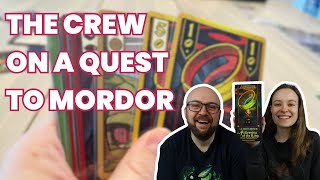
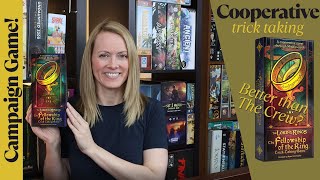
The Lord of the Rings: The Fellowship of the Ring – Trick-Taking Game has struck a strong chord with the cooperative board gaming community. The game stands out as a campaign-driven trick-taking experience that melds the beloved fantasy epic with a carefully designed cooperative card game. Reviewers who embrace campaign-style play consistently praise the game's thematic integration and satisfying progression through Middle Earth's story. The cooperative trick-taking experience generates particular enthusiasm when players value immersive themes, with some finding it significantly more engaging than other trick-taking games in its genre. That said, the campaign structure itself divides opinions: players who prefer non-campaign cooperative trick-taking games have found the base mechanics less innovative compared to established alternatives in the space.
Core Mechanics That Define The Lord of the Rings: The Fellowship of the Ring – Trick-Taking Game
Hand Management and Trick-Taking at the Foundation
The game's core rests on a elegant trick-taking framework layered over hidden information and severe communication restrictions. Players hold twelve cards in the base game across four suits: Hills, Mountains, Forests, and Shadows, each ranked one through eight. A fifth suit, Rings, contains only five cards (ranked one through five) and serves as the game's only trump element. The One Ring card occupies a unique position: when played, it can either win the trick immediately or be played as a standard one-value card, giving players tactical agency in a moment that matters. The limitation on leading with Ring cards until someone first plays one into a trick creates a natural pacing mechanism and another layer of inference.
Communication among players is forbidden entirely. This restriction forces players to transmit information through card play alone, through the timing of exchanges, and through which tricks they pursue. Reviewers note this constraint transforms every card played into a signal, every exchange into potential coordination, and every decision into a puzzle of what teammates can infer from your actions. When players complete their individual character goals, they place a token on their card to signal completion to the group, which adjusts focus and coordination without a spoken word.
Character Goals and Asymmetric Objectives
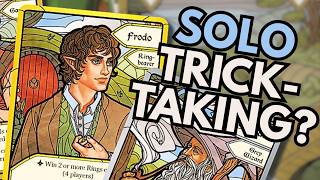
Every chapter assigns characters to players, and each character holds a distinct win condition. One player must win a specific number of Ring cards; another must win a set number of tricks; a third might need to win the fewest tricks, or to capture specific cards from particular suits. These asymmetric goals create a cooperative puzzle where every player pursues both their own objective and the group's collective success. The character draft happens after the One Ring is revealed: whoever holds the One Ring becomes Frodo and must win a majority of the available Ring cards. Other players then draft their characters in turn order, knowing the goals each character must meet. This draft element transforms hand strength into character selection strategy, as a player with weak cards might deliberately choose a character designed for minimal tricks, while a player holding many high-value cards might take on a demanding role.
The The Lord of the Rings: The Fellowship of the Ring – Trick-Taking Game Experience
Thematic Immersion and Character Connection
The game's greatest strength emerges from how thoroughly its theme penetrates its mechanics. Each chapter opens with a passage from Tolkien's narrative, and the characters available, items introduced, and mechanical restrictions all anchor to the story of the Fellowship's journey. Reviewers consistently highlight this thematic integration as substantially richer than what pure trick-taking mechanics alone could provide. One reviewer noted feeling like a valuable member of the team, picking a character goal that aligned with the cards they'd drawn and the role the group needed filled. This emotional connection deepens replayability: players want to discover what comes next in the campaign, what new character will join, and what new twist will reshape the game's puzzle. The campaign structure means losses don't feel like defeats but like invitations to replay a chapter until the group triumphs and earns the story's next installment.
Tension and Collaborative Problem-Solving
The no-communication rule generates constant low-level tension. Every card play reveals something about a player's hand, forcing teammates to read intent into what was played, when it was played, and what wasn't played. Over a campaign of eighteen chapters, players develop intuition for their teammates' styles and begin to second-guess themselves: is that card play a signal, a necessity, or a bluff? Reviewers emphasize the satisfying moment when a chapter comes together, when everyone completes their goal despite no one speaking, because the group learned to think as one through card play alone. Losses hit harder not because of randomness but because they prompt reflection on what signals were missed, what inferences were wrong, and how to coordinate better next time.
What Makes The Lord of the Rings: The Fellowship of the Ring – Trick-Taking Game Stand Out
Campaign Progression and Story Investment
The game offers eighteen chapters that gradually introduce new mechanics, new characters, and new challenges. The base game provides chapters one through twelve, and then a second campaign section extends into the final chapters. Each chapter card clearly lists which characters are required, which are optional, and what special mechanics, items, or restrictions apply. After completing all chapters, players can unlock an open-play mode where they select any combination of characters and replay chapters freely. This progression transforms what could be a single scenario-based experience into something with lasting arc: players discover new characters as they unlock them, see how the rules evolve to reflect the deepening complexity of the journey, and develop personal investment in the Fellowship's success. Reviewers who engaged with campaigns expressed genuine excitement about returning to the game night after night to advance another chapter or two, knowing each played a distinct role in the larger narrative.
Accessibility and Scalability Across Player Counts
The game accommodates one to four players, and the rules scale intelligently across player counts. In a three-player game, Frodo requires four of five Ring cards; in a four-player game, Frodo needs only two, balancing the difficulty. Two-player games introduce a third fake player controlled by face-up and face-down cards in a pyramid formation, adding an unpredictability element and a human opponent's partner to navigate. Solo play follows similar logic. The rulebook thoughtfully explains variants for each player count and even provides solo strategy advice, making the game accessible whether someone is playing alone or with a full table. This flexibility means the game remains relevant across different gaming contexts, and reviewers noted appreciation for not needing multiple versions to enjoy it properly.
Potential Drawbacks
Campaign Commitment and Narrative Dependency
The campaign structure, while praised by many, is a significant commitment: completing all eighteen chapters at roughly twenty minutes per chapter means thirty to forty hours of game time to see the story through. Players who do not enjoy campaign-style games or who prefer their cooperative games in disconnected scenarios may find the constant narrative wrapping frustrating rather than engaging. One reviewer, despite loving Lord of the Rings and trick-taking mechanics, found themselves unengaged by the campaign structure itself, noting that core mechanics felt less innovative than alternatives and questioning whether the theme justified the commitment. For this subset of players, the game's strongest asset becomes a liability.
Mechanical Innovation and Design Comparison
Reviewers familiar with The Crew and its sequels noted that The Lord of the Rings trick-taking game, while thematically superior, does not introduce a mechanically innovative core concept on par with The Crew's moon token system. The core trick-taking framework is solid but relatively orthodox, and the special mechanics introduced chapter by chapter enhance rather than revolutionize the game's spine. Players seeking a mechanically daring cooperative trick-taking experience may find the game competent but conservative in its innovation, a choice that prioritizes thematic integration over experimental game design.
If You Enjoy The Lord of the Rings: The Fellowship of the Ring – Trick-Taking Game
Try The Crew and The Crew: Mission Deep Sea if you want pure trick-taking sophistication with a moon-token innovation that sets them apart mechanically. Both are non-campaign cooperative trick-taking games that earn high marks for design elegance and replayability without narrative dependency. For those drawn to the theme but wanting variety, War of the Ring offers a different angle on Lord of the Rings gameplay, though it is a competitive area-control game rather than cooperative. Fox in the Forest provides a lighter trick-taking experience centered on a Grimm fairy tale, and Quest for Planet Nine extends The Crew's lineage with a space theme. If you love campaign games with cooperative play, Gloomhaven: Jaws of the Lion and other legacy titles offer similar chapter-by-chapter unlocks, though in different mechanical genres. For those who appreciate immersive, character-driven campaigns, explore other trick-taking variants or consider cooperative deduction games like Infiltrators or Rosetta: The Lost Language, which similarly marry narrative progression with collaborative puzzle-solving and limited communication.
What Reviewers Are Saying
"I compare this to the crew because I love the crew I had so much fun with the crew both Crews but the thing about this is it has the theme it has more of a anchor to a character to a person to a story and and it just feels more rich and it feels more satisfying I think that this and the connections that you make with the characters following along in the story with the Fellowship of the Rings it's just Fellowship of the Ring it's just so much more engaging than the crew games were."
— Tabletop Tolson
"What I found that was so enjoyable about this compared to the crew is that the theme was much much stronger and the cards you're playing with feel more engaging so when you play a character you're not just playing one of your scientist's team that wants to get a goal of a certain number or a certain suit you want to win certain things that are related to your character and it's always in this comparison too and so it feels so like much better it feels more satisfying."
— Rahdo Runs Through
"Very much enjoy working through the missions, it's a terrific cooperative trick taker for one to four players, and it was one of our most played games of last year because we really enjoy working through the missions. The missions are basically each person has a character who has a specific kind of like win condition, but you all obviously have to win in order to complete the mission and it is just very satisfying to figure out how to complete that challenge because you obviously can't talk to your teammates."
— Board Of It