/pic8573238.png)
Welcome to the captivating world of Synchro Horizon: A Tapestry of Myths and Realms, a board game that takes you on an epic journey across magical landscapes and through ancient legends. In this game, you are not just a player but a master storyteller, shaping a saga where every choice weaves into the fabric of a universe filled with rich history and diverse cultures. From the celestial skies of Luminaria to the mystic depths of Elilyze, your adventures span continents filled with heroes, villains, and complex challenges.
Gameplay Overview: Synchro Horizon combines strategic exploration, role-playing, and tactical combat in a vibrant fantasy setting. Players choose characters with unique abilities and embark on quests across various realms like Igniscaelum and Solara. Through battling fierce monsters, managing resources, and uncovering hidden lore, players develop their characters and strategize to overcome both cooperative and competitive challenges. The game evolves through dynamic phases—Journey and Tournament—each requiring different approaches to succeed.
Objective: The ultimate goal in Synchro Horizon is to become the most renowned adventurer by accumulating fame points. Fame points can be earned by winning battles, completing objectives, amassing wealth, and exploring new territories. Whether you’re outsmarting opponents in a high-stakes tournament or teaming up to defeat a powerful boss, every action contributes to your legend.
You can discover your legendary quest in Synchro Horizon and prove your prowess across the fantastical realms. Will you rise as the most celebrated hero in this tapestry of myths and realms? The journey is yours to command, and the tale yours to tell.
—description from the publisher
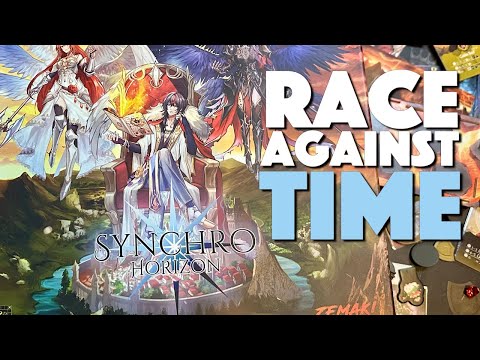

Images


- Embraces JRPG tropes with character recruitment and synergy.
- Time pressure adds a strategic layer.
- Deep character building with flexible enhancement options.
- Challenging and engaging combat system.
- Tactical positioning is important.
- Unique initiative system adds replayability.
- Resource management of shards is crucial.
- Cooperative team building is a core element.
- Fun and thematic.
- Standees serve a practical purpose for identifying positions.
- Can have a bad run, similar to Slay the Spire.
- Losing fights costs time.
- First fights can be difficult due to starting with nothing.
- Randomness in initiative can be a factor.
- May not be representative of the final product as it's a prototype.
- Video game/JRPG roots, Roguelike progression towards an ultimate enemy.
- Slay the Spire
Mechanics (from transcript analysis)
- Action Point Allowance System — Players have a limited amount of time units per season to spend on moving, choosing locations, and taking actions.
- boss battle — The ultimate goal is to reach and defeat a final boss, with the game providing four seasons to prepare for this encounter.
- Card Drafting — Skills are drawn from a bag, and players start with one skill, aiming to acquire more as they level up.
- Character progression — Characters level up and can be enhanced by slotting in abilities from other characters, allowing for deep customization and synergistic team building.
- cooperative play — Players can choose to play cooperatively as a team or solo, making decisions about paths and rewards together.
- Dice Rolling — Dice are rolled to determine monster actions and initiative, and players can choose to go first or second, which affects shard acquisition.
- Initiative tracking — An initiative tracker uses marbles to determine turn order for players and monsters, adding an element of chance to combat.
- Modular Board — The game features a giant map with locations and paths that are randomized to a point, with color-coded locations indicating potential benefits and challenges.
- Positional combat — Character and enemy positions on the battlefield are crucial, affecting attack targeting and defensive capabilities.
- Resource management (shards) — Colored shards (red, green, blue) and clear (wild) shards are used to trigger abilities and level up characters. Shards are discarded after use and replenished each round, requiring careful management.
- Set Collection (implied) — Collecting specific combinations of characters, skills, and items seems to be a key part of developing effective strategies.
- Variable player powers — Each character belongs to one of three classes and has unique skills and abilities linked to colors, influencing shard usage and synergy.
Video topics + discussion points
Quotes (from this video)
- The entire goal and the reason it kind of feels like that Roguelike is you are trying to tackle a boss.
- The time of time is of the essence aspect of this game is significant.
- The game does not just have sort of like one option when you're doing things it gives you some flexibility to like really try to build up that synergistic team.
- The fun of these games to me is how you get there which characters are you going to build into finding those combos knowing if I have this item and this character I can do some neat things that I wasn't able to do last run.
References (from this video)

Mechanics (from transcript analysis)
Video topics + discussion points
Quotes (from this video)
- In Synchro Horizon, the evil Celestial threatens the balance of the land.
- You'll travel the lands, battle hordes of monsters, and level up your heroes with new items and with the essence of magical shards, higher levels, and new skills.
- To win the game, the party must defeat the celestial before reaching winter 12.
- Your hero party will travel from Luminaria in the top left of the board to Stellaris in the bottom right, visiting cities where you'll battle monsters and level up in villages and other landmarks.
References (from this video)
- Assemble a band of heroes to stop a celestial threat and restore balance
- Fantasy land across magical realms with cities including Luminaria and Stellaris
- Heroic fantasy quest with monster battles and landmarks
Mechanics (from transcript analysis)
- city, landmark, and village progression — Players choose cities, landmarks, and villages to visit for rewards and upgrades across six cities.
- Combat: Damage Based — Damage is tracked using red dice; shields absorb damage before health; heroes can have shields up to max health.
- Combat: Dice — Monster actions are determined by dice and the first round actions are visible before decisions.
- damage, shields, and health — Damage is tracked using red dice; shields absorb damage before health; heroes can have shields up to max health.
- hero turns — On a hero turn you may take multiple actions by spending shards, including skills, basic attack, shift, level up, or reserve shards.
- leveling and upgrades — Heroes level up to increase health, rewards, and shard gain; upgrades unlock new skills and improve combat capabilities.
- monster action dice and sequencing — Monster actions are determined by dice and the first round actions are visible before decisions.
- resource sharing and item exchange — Coins and items can be exchanged among heroes during battle; party coins are shared.
- shards management — Shards are spent to pay action costs; new shards are gained and spent shards are discarded each round.
- Time Track — A time tracker with a season wheel controls timing; battles consume time and winter ends the game if not won.
- time tracker and seasons — A time tracker with a season wheel controls timing; battles consume time and winter ends the game if not won.
Video topics + discussion points
Quotes (from this video)
- In Synchro Horizon, the evil Celestial threatens the balance of the land.
- You'll travel the lands, battle hordes of monsters, and level up your heroes with new items and with the essence of magical shards, higher levels, and new skills.
- To win the game, the party must defeat the celestial before reaching winter 12.
- Your hero party will travel from Luminaria in the top left of the board to Stellaris in the bottom right, visiting cities where you'll battle monsters and level up in villages and other landmarks.