


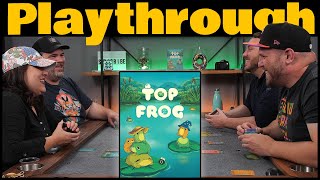


Top Frog Deep Dive
What the Community Thinks About Top Frog
Top Frog has earned consistent praise from reviewers as a charming, fast-paced game with surprising tactical depth beneath its whimsical frog-stacking premise. The community views it as a lighthearted experience that delivers genuine strategic engagement through simultaneous action selection and careful frog management. Reviewers consistently highlight the game's fun factor and cute presentation, though some note that certain mechanics require closer attention to the rulebook and that player count significantly affects the experience. The consensus is that Top Frog fills a niche for groups seeking a competitive yet amusing game with meaningful decisions.
Core Mechanics That Define Top Frog
Simultaneous Action Selection
Top Frog eliminates turn order entirely by having all players simultaneously choose and reveal action cards each round. This core mechanic creates a layer of tactical bluffing and prediction: you must commit to your action without knowing what opponents will play, making timing and reading the table essential skills. Each action card carries strategic weight. Leap cards allow movement around the pond, rest cards retrieve discarded cards and potentially earn gnats (the currency for refreshing your hand mid-round), and catch cards let you claim frogs. The simultaneous nature means everyone is constantly making split-second decisions about when to commit to capturing a frog or when to rest and recover resources, creating a rhythm of tension and resolution that keeps all players engaged every turn.
Stacking and Balancing with Weight Rules
At its core, Top Frog is a dexterity mechanic wrapped in a card game. Each player builds up to three stacks of frogs, but there is one critical rule: every frog placed on top of another must have equal or lower weight than the frog beneath it. This weight restriction forces thoughtful sequencing and rewards players who plan several moves ahead. Some special frogs break this rule in creative ways, allowing you to place them underneath existing stacks even after they have received hats, or enabling them to count as multiple weight values. The mechanic transforms what could be a simple collection game into a puzzle of stack management, where catching the wrong frog at the wrong time can leave you with pieces that cannot be placed without significant rearrangement.
The Top Frog Experience
Chaotic Charm and Simultaneous Comedy
Reviewers describe Top Frog as a goofy, amusing game where the unpredictability of simultaneous reveals creates comedy. When multiple players target the same frog, the catch squanders and nobody gets it, a moment that produces laughter and table talk as players debate whether they should have risked it or played it safe. This mechanic generates the kind of prisoners-dilemma moments that fuel memorable gameplay: you know an opponent probably won't compete for the frog you want, so you commit. But sometimes everyone thinks the same way and chaos erupts. The game builds momentum as more frogs are captured, hats are earned, and gnats accumulate, with the energy rising naturally from the pressure of impending end-game conditions.
Satisfying Frog Aesthetics and Fiddly Pleasure
The physical act of stacking and placing frog cards is deeply satisfying. Reviewers consistently praise the artwork, calling the frogs beautifully artistic and cute. There is genuine delight in placing a hat token on top of a stack, locking in scoring multipliers and capping the stack against further additions. The tangible nature of building stacks, the pleasure of organizing pieces into three distinct towers, and the visual progression of the game state all contribute to an experience that feels tactile and rewarding even when you lose.
What Makes Top Frog Stand Out
Hat Placement and Bonus Scoring Strategy
Hats are the linchpin of Top Frog's scoring system and what elevates it from a simple frog-collection game. When you use a hat coupon to place a hat on a stack, that stack is immediately capped and generates endgame points based on the specific hat's objective. Each hat scores for different frog color combinations or weight ranges, forcing players to evaluate which hat will synergize best with their current frogs or which they can still acquire. The tension comes from deciding when to place a hat: too early and you miss the chance to add high-value frogs; too late and you miss the scoring multiplier. Reviewers found this decision point to be the most strategic and satisfying moment in each game.
Frog Powers and Bonus Action Cards
Beyond raw point values, each frog carries a special power that either activates when played, when another frog lands on it, or remains passively available as long as it sits on top of a stack. These powers range from retrieval abilities to weight-flexibility tricks to gaining extra gnats. Some frogs grant you bonus action cards that modify your standard movement or grant additional actions, opening up creative plays and second-order decisions. The diversity of powers ensures that every game presents different frog combinations, encouraging varied strategies and keeping the puzzle of stack-building fresh across multiple plays.
Potential Drawbacks
Rules Clarity and Learning Curve
The game's rule set is dense, with multiple simultaneous action types, frog powers that trigger under different conditions, and edge cases around squanders and hat placement. Reviewers noted some confusion about card retrieval rules, particularly around the interaction of leap cards with rest and catch card retrieval, and how certain frog powers interact with the stacking weight system. The rulebook requires careful reading and reference during early plays, which can slow down the first few rounds. Introducing new players requires patience and willingness to clarify mechanics on the fly.
Hat Timing and Two-Player/Six-Player Imbalance
While the hat system is strategic, getting a hat too early can feel like a setback. Once a hat is placed, you cannot add more frogs to that stack, which can leave you with fewer options and a smaller stack than planned if the timing is wrong. At two players, reviewers felt there isn't enough direct interaction and competition for cards to maintain engagement; the game shines with three to five players. At six players, the game can become overwhelming in terms of board state tracking and the chaos can overshadow strategy, leading some to question whether the game truly works at the highest player count.
If You Enjoy Top Frog
Players who enjoy Top Frog's simultaneous action selection and tactical decision-making will find similar satisfaction in games that emphasize bluffing and predicting opponent moves. The game's emphasis on building and organizing pieces into efficient stacks appeals to those who enjoy puzzle-like spatial reasoning. Top Frog's lighthearted tone and table interaction make it a great fit for groups seeking a competitive yet fun experience without the heavy ruleset or lengthy playtime of heavier strategy games. The beautiful artwork and satisfying component work will appeal to players who appreciate the tactile pleasure of managing a physical board state across multiple rounds of play.
What Reviewers Are Saying
"This game is a goofy game. This game is a game that has some moments because we're both on that same hat, and I'm like, well, okay, listen, we're both in the same hat."
— Watch Review
"I love the really cute artwork of the frogs. I love the frogs stacked on top of each other. I like putting the little hats on the frogs, but the gameplay behind it is also fun."
— Watch Review
"What we are doing is taking these beautifully artistic frogs and we are making stacks of them. We are stacking them yay high and triggering various powers. Some of them are going to be when you place a frog. Some will be when a frog is placed on top of that frog, and various things trying to accumulate as many points."
— Bros Murf