





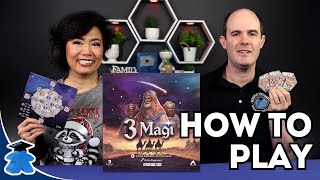
3 Magi Deep Dive
What the Community Thinks About 3 Magi
Three Magi has earned consistent praise from reviewers as a competent, well-crafted lightweight Euro game that executes its core ideas solidly. Rahdo emphasizes that the game "does everything that it does very solidly and introduces some interesting mechanisms," while acknowledging that it is "not groundbreaking by any stretch." The religious theme (drawn from the biblical story of the Three Wise Men's journey to Bethlehem) sits comfortably in the game without feeling preachy or heavy-handed. Rahdo notes: "While it does have this religious setting, it is absolutely not heavy-handed with religious themes. It doesn't feel like it's preaching in any way." This balance has made the setting accessible to players of various faith backgrounds. Across all reviews, the consensus centers on clean mechanics, strategic depth despite the game's lightweight nature, and an elegant movement system that creates meaningful decisions without overwhelming players.
Core Mechanics That Define 3 Magi
Track Advancement: The Celestial Bodies System
Players advance their pieces along three celestial tracks (sun, star, and moon) by playing cards during day and night phases. Each track progression unlocks rewards and, once fully advanced, generates a flipped bonus token that grants a free action or card draw each subsequent night phase. This creates a satisfying snowball effect: early-game investment in track advancement pays compound dividends by mid-game. Reviewers highlight this mechanic as driving a core tension of the game; you must decide whether to lock up cards for track advancement or spend them on immediate crafting. As the game progresses and unlocked bonuses accumulate, the passive economy of rewards grows stronger, incentivizing players to accelerate the game's end rather than play indefinitely.
Multi-Use Cards: Resource Cards as Decision Points
Every resource card in a player's hand serves dual purposes: it can be spent during the day phase to craft gifts (permanent resources for end-game points), or played on the board to advance a celestial track and trigger an ability. This forces a constant push-pull: should you preserve the card to craft a valuable gift later, or play it now for the immediate track advancement and combo potential? Reviewers describe this as the engine of the game's decisions, creating what Rahdo calls "a great decision point even though this is still a very lightweight game." The tension between these two uses ensures that resource management remains challenging despite the game's ease of learning.
The 3 Magi Experience
A Meditative Caravan Journey
Playing 3 Magi feels like an orderly progression across a desert, with each round marking incremental progress toward Bethlehem. Players move one caravan piece forward per turn while keeping all three adjacent, creating a steady, contemplative rhythm. The biblical setting reinforces this sense of pilgrimage: rather than competitive scrambling, the game feels like a deliberate, guided journey. Reviewers praise how the movement system provides this calm structure without demanding intensive calculation or causing analysis paralysis.
Satisfying Incremental Engine Building
The night-phase bonus tokens, once unlocked, transform the feel of subsequent rounds. Early rounds are lean, with limited actions and passive income. By mid-game, as more celestial bonuses activate, players gain extra card draws, merchant actions, and navigation advances without spending resources. This escalating passive income creates the satisfying feeling of building a functional engine: a core appeal of Euro games that 3 Magi delivers cleanly. Reviewers emphasize that this mechanic keeps the game fresh across multiple rounds, preventing mid-game stalls.
What Makes 3 Magi Stand Out
The Movement Puzzle With Caravan Constraints
Unlike standard worker placement where pieces move freely, 3 Magi's three camels must remain adjacent to each other, forming a connected cluster on the map. This single constraint transforms movement into a lightweight puzzle. To access certain board locations, players must choreograph their caravan's advance carefully, planning moves several turns ahead to avoid dead ends. Rahdo notes that "you have to plan out your moves a little bit ahead of time because you might think like, if I go here, it's going to help me out, but it's going to limit my options for the next movement," yet emphasizes this "does present that little extra layer of strategy" without demanding heavy calculation. The constraint creates interesting choices without complicating the rules, making 3 Magi feel more intentional than a straightforward linear path.
The Astronomy Track as Escalating Advantage
The three celestial tracks represent the game's most distinctive feature. Beyond merely scoring points, advancing these tracks unlocks persistent bonuses that grow more valuable as more tokens flip. Reviewers consistently highlight this as a clever twist on passive income: you cannot focus exclusively on the tracks without neglecting gifts, yet investing early pays real dividends. Rahdo appreciates that "the astronomy track... while you can't focus 100% on the astronomy tracks, I really enjoyed that element of it" and notes that it "drives other players to be like, maybe we need to end this game quicker," creating dynamic tension between rushing and building.
Potential Drawbacks
Rulebook Clarity Issues in Prototype Phase
Reviewers flagged some confusion around the timing of certain scoring effects and the specific mechanics of card abilities. Rahdo mentions: "While there are a few things that I think need to be hammered out a little bit in the rule book um just in terms of the presentation of these games they have plenty of time to uh fine-tune the how some of the specific mechanics work." This is presented as a prototype concern that will likely be resolved in the final published version, and should not deter interest in the final game.
Familiar Mechanical Foundation
While well-executed, 3 Magi does not introduce revolutionary new mechanics. Reviewers describe it as blending known Euro game elements (resource management, track advancement, worker placement) in a coherent way rather than breaking new conceptual ground. Rahdo succinctly states: "It's not groundbreaking by any stretch," though this is framed as a feature rather than a flaw; the game's strength lies in clean execution rather than innovation for its own sake. Players seeking pure mechanical novelty should calibrate expectations accordingly.
If You Enjoy 3 Magi
3 Magi appeals most to players who enjoy lightweight Euro games with meaningful resource decisions and tableau-building elements. If you appreciate games built around track advancement and satisfying engine escalation, this game will resonate. The movement puzzle appeals to players who like spatial constraints and planning. The biblical theme, presented tastefully without doctrinal weight, adds character without gatekeeping; even non-Christian players report comfort with the setting. Players who enjoy games like Sagrada (co-designer Adrian Adamescu's previous work) or similar gateway Euro games with structural clarity will find much to appreciate. Those seeking 30-45 minute games with medium weight decisions and elegant mechanical cohesion should add 3 Magi to their watch list.
What Reviewers Are Saying
"This is a really solid lightweight Euro game. And while it does have this religious setting, it is absolutely not heavy-handed with religious themes. It doesn't feel like it's preaching in any way. I personally don't think that most people would have any kind of issue with the setting if they are not themselves Christian."
— Rahdo Runs Through
"There's a constant push and pull of like, do I want to play this card in order to get the immediate benefit of what it provides and a scoring opportunity or do I want to hold on to it to craft those big point getting gifts and that is a great decision point even though this is still a very lightweight game."
— Rahdo Runs Through
"So it's a game of trying to chain cards together largely. So most of you've got a little movement puzzle where you've got three camels and you always have to move one of them forward into a new space and its own space, but you have to keep them together in a cluster. So you have to work out how gives you some flex for how quickly or slowly you move across the map."
— Meeple University