




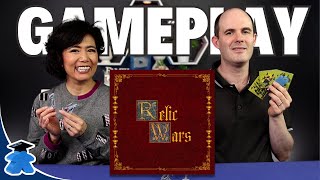
Relic Wars Deep Dive
What the Community Thinks About Relic Wars
Relic Wars has impressed reviewers across multiple play-through videos with its fast-paced tactical energy and accessible approach to tactical combat. The community response highlights a game that captures the intensity of combat-focused play without requiring extensive rules overhead. Zilla Blitz praises the game's accessibility, noting the complexity sits comfortably at 2.5 out of 10 on a wargaming scale, making it easy to teach and learn. Maven University emphasizes the game's pace and excitement, describing rounds that can play in 15-20 minutes when players know the rules. Shelfside showcases the dynamic player interactions, with reviewers pointing to the strategic depth that emerges from character asymmetry and item economy. Across all coverage, a consistent theme emerges: this is a game that plays quickly, encourages aggressive competition, and delivers memorable moments through chaos and comeback potential.
Core Mechanics That Define Relic Wars
Tile-Based Exploration with Fog of War
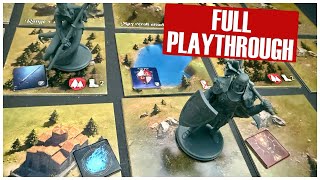
Denver Walker's design places exploration at the heart of Relic Wars. Players do not begin combat fully equipped. Instead, characters enter a tile-based map unknown to them and must explore to survive. As a character moves into an unrevealed tile, the tile flips over to reveal the terrain, and a token is drawn from the bag containing weapons, spells, shields, chalices, and portals. This fog of war mechanic creates replayability, since each game the map looks and plays differently. Terrain types including forests, monasteries, hills, lakes, and clear fields each carry different tactical properties. Forests provide defensive bonuses, monasteries allow healing, and lakes block movement unless traversed by special characters like Lacrimosa. The exploration element means players are constantly making tactical decisions about which items to pick up and which paths to take, layering strategy onto the simple act of movement.
Divine Intervention Cards and Swingy Chaos
At the end of each player turn, the deck of Divine Intervention cards introduces unpredictability that keeps games dynamic. These cards can heal all players in a terrain type, trigger attacks on specific tiles, move chalices back into the bag, flip map tiles, change win conditions mid-game, or even allow a knocked-out player to revive. Reviewers consistently highlight how these cards keep matches from becoming stale or predictable. The Divine Intervention system ensures that no two games feel identical and that a player who is behind can catch back into the race through fortunate card draws. Shelfside's playthrough features several dramatic moments where a Divine Intervention card dramatically shifts the board state, prompting the players to call out the chaos. This intentional randomness is central to the game's personality, transforming Relic Wars from a pure tactical challenge into a more inclusive game where luck and smart play both matter.
The Relic Wars Experience
Fast-Paced Tactical Tension
The mechanical elegance of Relic Wars lies in its simplicity and efficiency. Each turn, a player takes exactly two actions from a small set: move, attack, or pick up an item. This constraint creates tense decision-making despite the brevity. A player might need to choose between defending themselves, moving toward a chalice, or pushing a rival off their current objective. Reviewers note that the two-action economy prevents lengthy downtime and keeps all players engaged. Maven University points out that even with random Divine Intervention cards, the pacing never drags, and games can finish in 15-20 minutes for experienced players. The modular two-action system also means that players rarely feel locked into one strategy, encouraging tactical improvisation and adaptation to the evolving board state.
Chaotic Endgame Pursuits and Swingy Comebacks
The moment a player collects three chalices, the hunt intensifies. That player must survive one full turn for everyone else to have a chance to act, and every other player will attempt to intercept them, steal from them, or knock them out. This creates a tense chase sequence where the leader becomes a target. Alternatively, a player who is facing defeat can engineer a sudden comeback by finding powerful spells, securing a weapon upgrade, or benefiting from a well-timed Divine Intervention card that removes all chalices from play. Maven University and Shelfside playthroughs both feature moments where a seemingly defeated player stages a dramatic recovery or where a player on the verge of victory is suddenly knocked back by hostile Divine Intervention cards. This swingy nature is not a bug but a feature: it keeps everyone invested until the final turn.
What Makes Relic Wars Stand Out
Asymmetric Character Design with Meaningful Differences
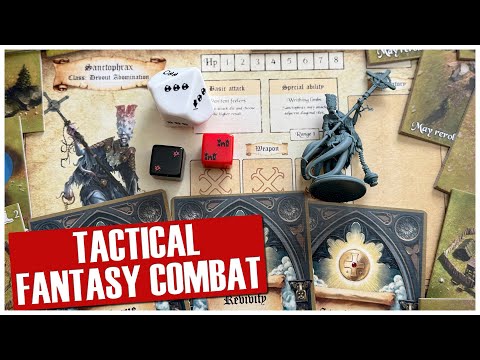
Each of the four base characters brings a fundamentally different play pattern to the table. Saikari Lionheart is a slow brawler with high HP and the ability to retaliate when attacked at close range, discouraging melee engagements. Sanctifra cannot equip weapons or shields but rolls two attack dice and picks the higher result, plus can attack diagonally where others cannot. The Veil Walker can pickpocket a single adjacent item per turn, turning theft into a viable strategy. Lacrimosa can fly over lakes and use city tiles as portals, opening movement paths others cannot access. Zilla Blitz explicitly highlights these asymmetries as a strength: each character is slightly different, making team compositions matter and rewarding players who understand their character's strengths. An expansion adds a second set of characters, further deepening the roster.
Accessible Entry Point with Hidden Depth
Despite its 2.5 out of 10 complexity rating on a wargaming scale, reviewers note that Relic Wars contains more tactical nuance than its accessible rules suggest. The combination of character asymmetry, spell mechanics, terrain interactions, and Divine Intervention cards creates layered decision-making. Players who invest time in the game discover combos: chaining spells for extra actions, positioning for defensive terrain bonuses, timing item pickups to deny opponents resources, and reading opponent tendencies to predict behavior. Zilla Blitz notes the game is easy to teach (roughly 30 minutes) but rewards repeated play as players internalize strategy. This balance makes Relic Wars appealing both to casual groups and to experienced tactical gamers seeking a shorter experience than traditional wargames.
Potential Drawbacks
Prototype Component Quality and Visual Presentation
Reviewers are unanimous in noting that the prototype components under review are not representative of final production quality. The miniatures are locally printed and will be replaced with injection-molded versions. Tiles and counters are proto-quality. Zilla Blitz emphasizes multiple times that viewers should judge the gameplay and design, not the current material presentation. This is a standard caveat for prototype coverage, but it is worth noting that the final version will deliver a different tactile experience. Flying Pig Games has experience producing high-quality wargame components, so the expectation is that production standards will reflect that pedigree.
Solo and Two-Player Experience Less Optimized Than Multiplayer
Zilla Blitz rates solo play 5 out of 10, noting that while nothing mechanically prevents solo play, the game is designed around human interaction, alliance-making, and betrayal. With two players, the game is playable but lacks the emergent chaos of three or four players. The reason is structural: the Divine Intervention card system and the ability to target specific opponents create rich dynamics when multiple competing factions are present. Solo players can play two-handed, but the negotiation and uncertain-opponent-behavior that makes Relic Wars memorable in multiplayer is absent. This is not a flaw in the design but a reminder of the game's intended context: a social, competitive experience with live players.
If You Enjoy Relic Wars
For players drawn to Relic Wars' combination of exploration, tactical combat, and chaotic comebacks, several related titles offer complementary experiences. Hunger Games-style elimination and chalice-hunting creates thematic overlap with party games centered on last-one-standing survival. Old School Tactical, another Flying Pig Games release, delivers the wargaming pedigree with deeper complexity for those ready to level up after mastering Relic Wars. Most Fearful Sacrifice, also by Flying Pig Games, offers similar tactical depth in a different thematic context. For those who appreciate the Lego Racer inspiration, games with powerup-driven gameplay and rapid-fire turns provide a mechanical echo. The broader lesson from Relic Wars' design: a game can be accessible, fast-paced, and tactically rich if the designer respects player time and focuses every rule on creating meaningful decisions.
What Reviewers Are Saying
"I think it's a, you know, a game that you do not want to let the complexity scare you off. It's going to be fairly easy to pick up and fairly easy to teach."
— Zilla Blitz
"It plays quickly. You get your items, there's all sorts of combos you can do with your spells to try to win the game in a big explosive creative combo. And that's what really makes this game so exciting, and you'll always have a new map because the tiles always come out randomly."
— Maven University
"But I think the pacing here works works really well. Sometimes it's quicker because it's easy to heal. Sorry, because it's harder to heal. Sometimes it takes longer. But you got to respond to that and you have these really quick snappy turns. I think that's what I like. You've got two actions."
— Meeple University