


Long Dark Sea Deep Dive
What the Community Thinks About Long Dark Sea
Long Dark Sea is a cooperative, card-driven campaign game with a modular board from Lucio Games, and it reached players through crowdfunding. The Dice Tower's Tom Vasel met the box during an unboxing and described it as a deck-building game that can be played solo or cooperatively, either as a standalone game or as part of a campaign, with a powerful final boss to face. The first reaction from the unboxing was cautious interest rather than certainty.
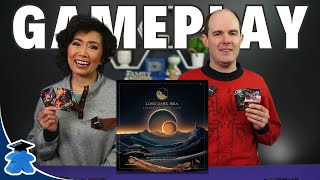
The fuller picture comes from a hands-on playthrough by hosts Stella and Taran, who walk through the core Raid stage of Act One and explain how the game plays. Their overview frames Long Dark Sea as a campaign in which each act ends with a card battle toward an objective or a side quest, and in which players level up their decks and characters between scenarios. The transcripts contain little explicit criticism of the game, so the praise and concerns below come mostly from what the hosts found compelling or difficult while playing.
Core Mechanics That Define Long Dark Sea
Track Advancement on the Quest and Threat Tracks
Progress in Long Dark Sea runs along two tracks. Exploring locations and rolling the X symbols on their dice advances the Quest Track toward the main quest, while the skulls rolled during the same explorations push the Threat Track. The hosts played in easy mode, which they noted makes the Quest Track short and the Threat Track long, so quests come more easily and fewer threats land. Once skulls push a threat off the end of its track, the threat deck is drawn and negative effects follow. Secrets add momentum as well: one Secret Three the hosts revealed placed a Quest counter on the main quest and gave each player 10 experience points.
Cooperative Play With Shared Resources
Each character has a personal deck, a leader, and a companion, but the raid belongs to the whole table. The hosts showed that teammates can block attacks for one another, that gear such as the Sand Kibas, which gives plus one block, can be handed to a partner, and that companion cards can support the rest of the group. Helping has a cost, however. A player who discards a card to protect a teammate has fewer cards for the rest of the round, because hands are only discarded and redrawn at the end of a turn. The game is lost only when both characters run out of lives, so the team rises or falls together.
The Long Dark Sea Experience
Mounting Raid Pressure
The raid board is the emotional center of the game. Face-down cards advance toward the players each scenario phase, and revealing them early is a deliberate trade-off. A distant card is expensive to explore, but the hosts stressed that waiting carries its own risk: "if you reveal them when they're close to you obviously you've got a lot less time to resolve them." Enemies that enter close range reveal automatically and become far more dangerous. Sandstorms add to the strain by blocking the reveal of adjacent hidden cards and attacking at close range, so the battlefield keeps shifting underfoot.
A Story Told Through Chapter Cards
Each act opens with a chapter card read aloud, such as the one describing the lost desert capital of Sandar and the three signals pointing toward a relic of great power. Quest, chapter, and secret cards then give the act its direction, and players choose explorations that will reveal the cards that move the story forward. The hosts felt that pull directly, saying "we need to start exploring we need to get into this story." Choices made during an act can lead to different conclusions, and those conclusions change the benefits players carry into deck building afterward.
What Makes Long Dark Sea Stand Out
Range and Strength Exploration
Revealing a raid card requires matching both range and strength. The raid row is divided into short, mid, and long ranges, and an explore icon must show enough stripes to reach the target row. The hosts noted that a long-range reveal needs three stripes and that they could not manage it with their starting cards. Strength is then built by chaining boost values from other cards, so a basic two-strength action can be lifted to five with two boosts. Epic actions initiated from a leader card offer a second route, and interact actions reveal the next chapter. The system rewards planning, and the hosts deliberately held cards back for the next turn when a known enemy was coming.
Locations, Secrets, and Dice Rolls
Revealed locations are a reliable source of resources and progress. The Solar Observatory was immovable, so it stayed in place while enemies advanced past it, and exploring it rolled dice that produced credits, an energy resource, Quest X results, and threat skulls. As long as the Observatory remained, it could be revisited as often as the player liked. The board is not permanent, however. A later Secret One dropped the Observatory into a sinkhole, which the host called "so sad," showing that a feature players rely on can be lost to the story at any time.
Potential Drawbacks
Difficulty Depends on the Chosen Mode
The featured playthrough used easy mode, and the hosts were explicit about what it changes. Cycling through the deck and reshuffling the discard pile carry no penalty, and the Threat Track is longer while the Quest Track is shorter. The hosts noted that hard mode adds a penalty for cycling too much. Because the video shows only the easy settings, its tension is softer than the full game, and players who remove those allowances should expect a considerably tougher campaign.
Dense Symbols and a Layered Turn Structure
Much of the video goes to explaining symbols, stripes, boosts, and the turn sequence before the first meaningful action resolves. Each turn has a character phase, a scenario phase, and a second character phase, and the hosts walked through each step in turn. Players who are new to this rhythm should expect a learning curve before the campaign's narrative and deck building begin to pay off. The hosts also observed that the threat deck was not shown in the video, so the full consequences of letting threats through remain outside this playthrough.
If You Enjoy Long Dark Sea
Long Dark Sea suits players who want a sci-fi cooperative campaign in which a story unfolds across acts and the deck changes between scenarios. The transcripts do not name specific comparison titles, so these recommendations rest on shared genre traits rather than explicit comparisons.
- Cooperative campaign deck-builders: Look for games where the team shares a single win-or-lose outcome and carries progress from one scenario to the next, the way Long Dark Sea links acts through chapter cards and deck upgrades.
- Real-time pressure on a shared board: Games that advance threats toward the players each round echo the raid board, where distant enemies draw closer and must be dealt with before they arrive.
- Tactical card-range puzzles: Titles that require matching action strength and reach to resolve an effect fit the appeal of chaining boosts to meet a location's requirement.
What Reviewers Are Saying
"This actually looks pretty interesting actually. Face a powerful final boss."
— The Dice Tower
"If you reveal them when they're close to you obviously you've got a lot less time to resolve them."
— Watch Review
"We could share gear between each other we can block for each other and we can use our companions like our companions cards to support each other."
— Watch Review