



Tibetana Deep Dive
What the Community Thinks About Tibetana
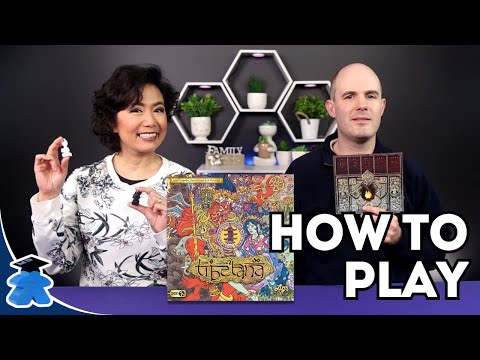
Tibetana is a tactical board game published by Gen X Games, according to Meeple University. Coverage so far comes from two channels, Meeple University and Board Game Sanctuary, and both present the game as a race to build pagodas in a Buddhist Tibetan setting. Players compete for control of the landscape by placing Guardians, moving Priestesses, and drawing energy from the board.
The overall tone is enthusiastic but cautious. Both reviewers are drawn in first by the look and theme of the game, and both approach it as a game still in development. Meeple University gives a full walkthrough of the rules, while Board Game Sanctuary covers the game briefly as one entry in a list of anticipated 2024 releases. The two perspectives complement each other: one explains how the game plays, and the other explains why it caught attention.
Core Mechanics That Define Tibetana
Tutorial Onboarding
The game is built to teach its own rules. Meeple University explains that for the first few games the board should be laid out exactly as the rulebook shows, with the deserts, forests, and mountains arranged in a fixed pattern. The reviewer also notes that players can start playing right away and learn about the demons as they go, while anyone who wants to study ahead of time can turn to the demon section. This sequencing means the more intricate demon effects can be deferred until the basic actions of training, moving, and building feel familiar.
Pagoda Building Through Energy and Priestesses
The central engine is the build action. A player chooses an origin territory that contains one of their Priestesses and at least one energy, then a destination territory that also holds a Priestess and either a pagoda shorter than five stories or an empty pagoda space. Meeple University explains that a Priestess becomes pressured when the opponent has more Guardians in its territory and adjacent territories. A pressured Priestess cannot serve as an origin or destination, although it can still be a link in a chain. Board Game Sanctuary describes the same core loop as channeling the energy of each terrain type to build pagodas, with the first player to build three five-story pagodas winning the game.
The Tibetana Experience
Tactical Tension
Meeple University describes the game as a tactical battle for control, and the feeling of play comes from constant calculation. Moving into a contested territory requires gathering enough adjacent Guardians to clear the opposing pieces, and a pagoda counts as a piece for that purpose. Every training, movement, and build decision therefore has to be weighed against what the opponent can threaten next. The demons add a further layer of volatility. The reviewer's phrase "the sometimes volatile powers of the Demons" captures the sense that a board position can shift sharply when the summoning die completes a lap.
Immersive Cultural Atmosphere
Board Game Sanctuary's host, Danny, is most struck by the presentation. The Tibetan art style and the culture expressed through the game were the first things that drew the host in, and the cover is described as beautiful. The hand-drawn look is compared to Cosmic Frog, and the host also points to Inish, a game in the host's own collection that shares the same sort of hand-drawn quality. Meeple University reinforces the sense of place by framing the contest as one between tribes in Buddhist Tibet, with the Demons drawn from Tibetan culture. For players who value the look of a table as much as its mechanics, the atmosphere is a major part of the appeal.
What Makes Tibetana Stand Out
Art and Cultural Theme
The visual identity is the feature that Board Game Sanctuary returns to most. The host says the game evokes Cosmic Frog and Inish in its hand-drawn art, and the reaction to the cover is one of plain admiration. Meeple University ties the theme into the rules themselves, since the pagodas, Guardians, Priestesses, and Demons all come from the Tibetan culture the game celebrates. Because the art and the mechanics reinforce each other, the theme feels integral to the design rather than applied on top of it.
Shared, Asymmetric Demon Powers
The demons are the game's most distinctive system. Meeple University explains that each of the five demons has three summoning states, natural, agitated, and exploding, and each state applies a different effect that can favor the active player or affect both players. The effects vary widely. The Death Dancer clears figures from its territory, while the Mind Ruler removes Priestesses and grants energy for each one removed. Board Game Sanctuary highlights the shared nature of these powers from another angle, noting that the deities "can be used by either player." Whoever activates one can use its asymmetric power to gain an advantage, which makes control of the summoning moment a meaningful contest.
Potential Drawbacks
Prototype Components and Rules
Meeple University is explicit that the copy used in the video is a prototype. The resin pieces shown will be replaced by more flexible and durable plastic, and the rules components may not be final. Readers should treat specific rule details and component quality as provisional until a finished edition ships, and the reviewer points viewers to the project page for updates.
Dense Rules and Demanding Territory Clears
Meeple University presents a rules set with many interacting layers. Clearing a territory that holds a single enemy piece requires three adjacent Guardians, and a territory with two opposing pieces requires five. A territory with three opposing pieces requires seven, which the reviewer notes is not achievable without expansion modules. The demon effects add further detail to track on top of the core actions. Neither reviewer treats this as a flaw outright, but the layered rules are the kind of weight a new player may need to absorb gradually, which is why the tutorial approach matters.
If You Enjoy Tibetana
Board Game Sanctuary names Cosmic Frog and Inish as the closest visual touchstones, so players drawn to the hand-drawn art may want to explore those titles. Meeple University's description of the game as a tactical contest for territory control and pagoda building points toward other positioning and area-control games, although the transcript does not name a specific title for that comparison. Players who enjoy the shared and unpredictable effects of the demon system may also appreciate games where the whole table can change a position, which is the kind of interaction both reviewers highlight.
What Reviewers Are Saying
"In Tibetana, players are competing tribes in Buddhist Tibet, competing against each other to control the landscape and to build pagodas. It is a tactical battle for control as players will place and move Guardians for protection and priestesses for worship."
Meeple University
"I was immediately drawn to the Tibetan art style as well as the Tibetan culture that is expressed through the game. And once you see the cover of this game, oh my goodness, it looks so beautiful."
Danny, Board Game Sanctuary
"We are using a prototype copy of the game so the rules components may not be final."
Meeple University