





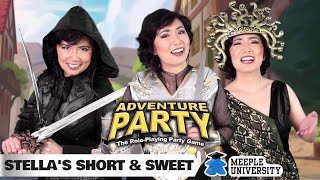
Adventure Party Deep Dive
What the Community Thinks About Adventure Party
Adventure Party divides reviewers in a telling way. Most reviewers recognize it as a clever entry point into role-playing games and a genuinely inventive party game hybrid. Meeple University, The Cardboard Herald, and other channels celebrate it as an accessible, creatively liberating experience that appeals to both board gamers curious about RPGs and seasoned adventurers looking for lightweight storytelling fun. However, at least one reviewer found the core concept less compelling, dismissing it as "not cool" in its current form. This split reflects the game's most fundamental quality: it succeeds or fails entirely on player investment in shared storytelling, with little mechanical scaffolding to fall back on if the group is not engaged.
Core Mechanics That Define Adventure Party
Guest Master Role and Scenario Setup
One player takes the role of Guest Master, setting a scenario card before the group and narrating the scene. Unlike a traditional Dungeons and Dragons Dungeon Master, the Guest Master does not guide an ongoing campaign, but rather frames a discrete, self-contained encounter: a Medusa's lair, a dark wizard's castle, a tense negotiation. This player then judges the outcomes of others' rolls and manages the pacing of each round, distributing feedback and describing how the world responds to players' actions. The Guest Master role rotates each round, so every player experiences both the narrative autonomy of setup and the collaborative constraints of participation.
D20 Roll and Storytelling Guessing Game
Once the scenario is set, the player to the Guest Master's left rolls a twenty-sided die in secret and must tell a story describing an outcome that matches their roll's position on a spectrum from total failure (1) to perfect success (20). If a player rolls a 10, they narrate a barely-successful outcome; a 15 represents a more impressive win; a 20 is the best possible result. Importantly, failures do not kill the story or the player character, allowing the narrative to continue seamlessly to the next player's turn. After hearing the story, all other players secretly guess the rolled number. Players earn shared experience points if the group guesses correctly (up to five points for an exact match, minus one for each number away), and individual glory points only if they match the roll exactly or are within one. This dual-scoring system creates tension between collaboration and individual achievement.
The Adventure Party Experience
Creative Storytelling Freedom
Adventure Party cultivates an atmosphere of deliberate creative permission. Reviewers emphasize that the game actively encourages players to invent, to bend the rules, and to disregard strict mechanics in favor of fun. One scenario might prompt combat; another might call for negotiation or deception. Characters are not bound to classes or archetypes, and players can describe a rogue that heals, a monk raising the dead, or any hybrid that fits their imagination. Because scenarios reset each round, players do not carry failure or success across turns, so they are free to experiment without long-term narrative consequences. This liberation is the game's emotional core: the pleasure is in making something up together, not in executing a flawless strategy.
Light, Social Party Atmosphere
Adventure Party is fundamentally a social glue game. Reviewers consistently note that the point totals matter far less than the stories told and the laughter shared. The game supports three to eight players, accommodating large groups and keeping everyone involved in every turn. Because each player narrates and each player guesses, there are no sideline moments where some players wait passively. The lightweight rules mean the game moves quickly, avoiding the analysis paralysis that can bog down heavier strategy games. The result is a game that feels more like structured improv than a game with victory conditions, one where the journey of collective creativity matters more than the destination of tallying points.
What Makes Adventure Party Stand Out
A Novel Hybrid of Role-Playing and Guessing Games
Adventure Party's core innovation is its blend of two distinct play experiences. It takes the core loop of role-playing (rolling a die, telling a story) and transforms it into a guessing game where hidden information becomes the puzzle. This is not Dungeons and Dragons with a simpler referee, nor is it merely Wavelength dressed up in fantasy clothes. Instead, it is a new structure that captures the narrative pleasure of RPGs (imagining characters, describing action, building tension) while maintaining the social deduction and information-exchange dynamics of party games. Reviewers describe it as an "entry point to RPGs" for board gamers who have been RPG-curious but intimidated by the commitment, rules density, and time investment of a full campaign. The game distills the essence of collaborative storytelling into a thirty-minute play session with minimal rules to internalize.
Designed for Maximum Player Agency and Flexibility
Adventure Party explicitly permits rule-bending and encourages players to tailor the experience to their group. The rulebook instructs players that they can skip components they do not want, change rules mid-game, and modify scenarios to suit their tone or interests. This flexibility is rare in modern board games, which typically enforce their rules strictly. The philosophy is: if you are having fun, you are playing correctly. Reviewers praise this design stance as liberating, especially for casual groups or families where players have different appetites for complexity. The game also scales gracefully across player counts and time constraints: players can complete one scenario for a short evening activity or chain three scenarios together for a longer session.
Potential Drawbacks
No Deep Mechanical Scaffolding
Adventure Party is explicitly not a game with intricate mechanics, interesting economic systems, or layered strategic depth. Reviewers directly acknowledge this as a design choice, not a flaw: "There's no deep mechanics to this game. It really is a party game and a storytelling game." For players who come to board games seeking optimization puzzles, resource management challenges, or tight competitive systems, Adventure Party offers none of these. The dice roll and guessing mechanic are simple enough to learn in five minutes. If a group's engagement is low or players are distracted, the lightweight structure provides no mechanical fallback to carry the game forward. Success depends almost entirely on player enthusiasm and creative willingness.
Variable Experience Based on Player Creativity and Group Chemistry
Because Adventure Party lives or dies by the quality of the stories players tell, the game experiences significant variance in quality depending on the table. A group of experienced improvisers or passionate storytellers will find the game delightful; a group of reserved players or those uncomfortable with creative narration may find it awkward or uneven. The Guest Master's scenario card provides a frame, but it is not a detailed script. A skilled GM can turn a prompt into a hilarious or suspenseful scene; a disengaged GM might deliver a flat description. This variance is especially pronounced with new players unfamiliar with role-playing or improvisation, for whom the blank-canvas approach may feel less like freedom and more like pressure. The game assumes and relies on a certain baseline of social comfort and creative confidence that not all groups possess.
If You Enjoy Adventure Party
Consider exploring Wavelength, which shares Adventure Party's party-game roots and emphasis on social deduction without mechanics. In Wavelength, players guess where a team member is on a spectrum between two extremes; like Adventure Party, the game creates hilarious moments when guesses reveal how differently people think.
Try Dungeons and Dragons (or other tabletop RPGs) if you want to extend the collaborative storytelling of Adventure Party into a deeper, campaign-spanning experience. D&D offers rules structure, character progression, and long-form narrative arcs that Adventure Party deliberately avoids, making it a natural next step for groups who fell in love with the role-playing aspect but crave mechanical depth.
Explore Scroll of Heroes if you want a game that also blends light role-playing with scoring systems. Adventure Party itself references Scroll of Heroes as a comparison point when tallying group experience points, suggesting thematic kinship in how these games measure success across both collaborative and individual goals.
What Reviewers Are Saying
"I think the simplest way to describe this game is it's a mix between role playing and wavelength. You'll be given a scenario, a role-playing type of scenario, you'll secretly roll a D20 which gives you a scale between complete failure and complete success. And then everyone else is trying to guess what number you roll. I think it's a really clever different little party game idea, I do quite enjoy it as well."
— Meeple University
"I love it as an entry point to RPGs. I am a board gamer first and I've always been RPG curious, but it's not a world that I necessarily grew up in. I've played a lot of RPGs at this point. However, this was maybe the most accessible to dipping that I'd ever done, and has since become something that I've been able to introduce other non RPGers into the overall concept. I love that the focus is still the beating heart of role playing."
— The Cardboard Herald
"Adventure party is a party family like RPG guessing game where you and your fellow adventurers are facing different scenarios. Roll your dice and describe how you face the challenge to give clues so others can guess your number from 1 to 20."
— Meeple University