




Encounters Shattered Wastes Deep Dive
What the Community Thinks About Encounters Shattered Wastes
Encounters Shattered Wastes stands out as a thoughtfully designed cooperative boss battler that reviewers praise for its mechanical depth and video game sensibility. The game has impressed multiple channels with its ability to deliver strategic puzzle-solving within the boss battler format. While most reviewers emphasize the game's strength in party composition and tactical decision-making, a few point to dice variance and the sometimes-frustrating stamina-based progression system as points of friction. Across reviews, the consensus emerges that this is a game built around meaningful player choices and JRPG-inspired aesthetics, though it demands careful attention to synergies between characters.
Core Mechanics That Define Encounters Shattered Wastes
Resource Management and Threat Tracking
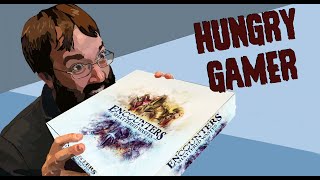
At the heart of Encounters Shattered Wastes sits a delicate dance between magic points, health, threat, and corruption. Players must carefully allocate their actions to manage multiple resource pools simultaneously. Each attack increases threat on the character, making future hits harder to land. Magic points fuel the special abilities that turn the tide in combat. The Hungry Gamer reviewer captures this dynamic perfectly: players are constantly asking themselves, "If I attack this card here, I'm going to get this much threat that's going to put me at risk of having a hard time to hit, so instead I'm going to use this ability, then I'm going to use this item to get rid of my threat." This layered resource puzzle creates moments of genuine tactical depth where the "right" move is not always obvious.
Boss Battler with Phase Progression
Like a video game raid, the bosses in Encounters Shattered Wastes evolve through recognizable phases. The game uses a stamina-based system: players must first break through the boss's guard by depleting its stamina pool, moving threat cards into a "staggered" state. Only in the staggered phase can players deal meaningful damage to the boss. Once sufficient damage is dealt, the boss transforms into a final form with new abilities, stats, and renewed stamina, forcing players to adapt their strategy. This two-phase structure creates emergent tension; Stella from Maple University notes the parallel to classic 16-bit RPGs: "When the boss opens its mouth showing its weakness for three seconds, that is the best time to attack. It feels like that when the boss is at staggered base, attack with all your might." The progression feels deliberate and video-game inspired.
The Encounters Shattered Wastes Experience
A JRPG Party Raid Feel
One Stop Co-op Shop's Mike identifies the game's strongest thematic anchor: "It models a JRPG party with all these interesting class combos and abilities you can put together with cool builds." Each character carries a distinct toolkit. Players select three ability cards at the start of the game, and that selection determines their role in the party. Some combinations create healing-focused support, others heavy damage output, and still others control or mitigation. The variety is deliberate enough that choosing complementary abilities becomes the first strategic layer before a single die is rolled. This mirrors the party-building systems in Final Fantasy and Super Mario World, where character selection shapes the entire playthrough. The game rewards synergy and punishes careless combinations.
Cooperative Puzzle Solving Under Pressure
Beyond the boss's stats and abilities, Encounters Shattered Wastes consistently delivers moments where players must think several turns ahead. The Hungry Gamer reviewer describes a "good puzzle vibe" to the game, where the challenge is not just rolling well but planning the sequence of actions to maximize impact while minimizing risk. If a player mistimes when to push through the stamina phase versus when to recover resources, they can waste turns. Stella reinforces this theme of cooperation: "It's very important for each character to work well together right from the start. If you can get them to complement each other well, surely you can beat the boss in no time." The game creates a space where communication and forward planning matter as much as luck.
What Makes Encounters Shattered Wastes Stand Out
Exceptional Boss Variety with Multiple Forms
Reviewers consistently praise the breadth of boss encounters in Encounters Shattered Wastes. Mike notes that "the bosses themselves are really varied and interesting with multiple forms and abilities to face off against." Each boss presents a distinct puzzle. Some rely on specific activation patterns, others on resource drains or status effects. The transformation mechanic reinforces the video game parallel: the boss doesn't just get stronger; it becomes a different encounter with new rules to learn. Stella points to the thematic satisfaction of this design: "I love the final form of the boss, that is so video game. You can just imagine on the video game screen flipping back and forth, and suddenly it looks like this other bad guy with new abilities." This variety ensures that no two games feel identical, even when fighting the same boss multiple times.
Meaningful Character Synergy and Build Depth
The game's character selection system creates genuine replayability. Each hero enters play with unique stats (magic points, hit points, damage output, dice count, critical value) and a distinct innate power. From there, players select three ability cards from their available pool, each with different resource costs and effects. This simple framework produces surprising depth: the Hungry Gamer reviewer observes that "the characters play really differently even though at the core you're just getting different cards. A lot of the abilities let you cycle the deck, use it, lose it, get something new, and that keeps the game fresh." The shatter mechanic amplifies this; when a character's threat maxes out, they transform and gain access to an entirely new set of abilities, creating a second act to individual character play within a single game.
Potential Drawbacks
Dice Luck in the Recovery Step
While the Hungry Gamer reviewer generally appreciates the role of dice in Encounters Shattered Wastes, one specific mechanic frustrates: the recovery action. When a player rolls to regain magic points or reduce threat, rolling a one feels particularly punishing because it forces the player to "waste your entire turn and do it again" the next round. The reviewer acknowledges that mathematically rolling a critical success balances the losses, but emotionally, a string of low rolls in recovery actions can drain satisfaction: "The negative feeling of getting a one, especially getting a one twice in a row, far outweighs the benefit and the good feels of rolling the crit." This asymmetry in emotional impact is a genuine friction point for some players.
Timing Frustration in the Stamina Phase Loop
The game's core loop of depleting boss stamina before damage becomes available creates an interesting tension, but Mike points out it can also frustrate: "The core loop of the game where you have to go through the boss's stamina to stagger them and only then can you actually damage them and if you mistime it, you'll waste tons of turns. Can be a little frustrating." Similarly, some character combinations simply don't work well together or create such a slog that victories feel hollow. The Hungry Gamer reviewer mentions trying "a very unoptimized combo just to see how it would work" against the first boss. It took much longer than expected. While this reinforces the puzzle element, it also means not all party combinations are viable, which may disappoint players looking for complete freedom in their choices.
If You Enjoy Encounters Shattered Wastes
Boss battler enthusiasts will find natural homes in similar cooperative raid games. The JRPG party-building angle connects Encounters Shattered Wastes to games that emphasize class synergy and emergent team composition. Fans of tactical puzzle games with dice elements and variable boss mechanics will recognize the design lineage. The emphasis on meaningful character synergy and forward planning appeals to players who enjoy table talk and cooperative strategy over pure chance. For those drawn to the video game theming and the staggered boss progression, games in the boss battler genre that similarly feature multi-phase encounters and hero-variety systems offer the closest mechanical and thematic parallels.
What Reviewers Are Saying
"Remember those 16-bit retro video games with pixel art, like Final Fantasy 6 or Super Mario World. This one reminds me of those games. How about when you're at one stage fighting the boss, when it opens its mouth or something like that for three seconds showing its weakness, that is the best time to attack. Well, this feels like that: when the boss is at staggered, attack with all your might."
— Stella, Maple University
"The game itself has a good puzzle vibe to it because there's a lot of, okay, if I attack this card here, I'm going to get this much threat that's going to put me at risk of having a hard time to hit. So instead, I'm going to use this ability, then I'm going to use this item here that's going to get rid of my threat and then next turn I'm going to do this."
— Hungry Gamer
"It models a JRPG party with all these interesting class combos and abilities you can put together with cool builds to fight the bosses. The bosses themselves are really varied and interesting with multiple forms and abilities to face off against."
— Mike, One Stop Co-op Shop