




Aelderman Deep Dive
What the Community Thinks About Aelderman
Aelderman stands as one of board gaming's most uncompromising Euro experiences. Reviewers consistently describe it as a dry, complex economic simulation set in the Hanseatic League, but beneath the austere mechanics lies a game with genuine strategic depth and surprising satisfaction. The consensus is clear: this is not a game that softens its design for accessibility, yet those who embrace its demands find a rewarding puzzle in resource scarcity and economic planning. While acknowledging its complexity and demanding nature, reviewers speak of Aelderman with genuine admiration, calling it "super clever" and "super satisfying" despite, or perhaps because of, its unrelenting Germanic rigor.
Core Mechanics That Define Aelderman
Resource Management and Trading
Aelderman's economy rests on controlled scarcity. Players acquire ten different resources organized into three categories: building materials (wood, glass, hammers, stone), food (meat, beer, fish, wheat), and luxury goods (spices and pelt). Reviewers note that getting access to the specific resources you need requires careful planning. The genius of the design by Johannes Rogal lies in forcing players to make hard allocation decisions. You cannot simply buy what you need; instead, the market wheel determines which goods each city offers, and your own position on the board determines which cities you can reach. This means players frequently must journey across the entire Baltic map to secure crucial goods for their engine-building plans. The game makes clear that resource acquisition is rarely convenient, yet this friction creates the entire strategic puzzle.
Action Points and Influence Bidding
Each of Aelderman's five rounds is divided into four "quarters," and in each quarter, players receive a random allotment of action points ranging from two to five. These points are your lifeline for taking meaningful actions in the cities you visit. You must carefully spend them on sailing, trading, placing influence, or upgrading resources. Once per round, players enter the Council phase, where they spend their accumulated influence cubes to blind bid on cards that grant victory points and ongoing benefits. The influence you gather through the round becomes your voting power, and this creates a beautiful symmetry: the same cubes that control area majorities on the map also determine your political influence. Reviewer discussion emphasizes how this dual-use mechanic rewards foresight across an entire round.
The Aelderman Experience
Relentless Economic Puzzle
Aelderman feels like stepping into a historical ledger that came to life as a board game. Every action has a cost, including actions that generate income. Buildings you construct give you production bonuses, but the city charges you to maintain them each round. This economic tension runs through the entire game; players describe feeling the weight of every decision. The game creates what reviewers call a "dry" experience not because it is joyless, but because it refuses ornament. There are no random breaks, no moments where chaos overrides planning. Instead, you face the iron logic of a medieval merchant economy where managing cash flow, timing your trades, and planning three turns ahead separate success from ruin.
Tension of Constrained Choices
Because action points are randomized each round and resources are scarce, Aelderman generates genuine tension from scarcity rather than direct conflict. You are not battling opponents; you are competing for the same finite resources on a shared map. A reviewer at Kublacon noted that Aelderman rewards meticulous planning while remaining "super satisfying" because your careful setups actually pay off. The game respects player intelligence and preparation. If you lock in area control early, positioned your buildings to generate the resources you need, and timed your trades correctly, the engine you built will carry you to victory. This creates an experience where mastery feels earned through cunning play rather than lucky dice rolls.
What Makes Aelderman Stand Out
The Market Wheel and Timing Mechanism
The rotating market wheel is more than a theme delivery system; it is a elegantly economic constraint that forces players to think about positioning and timing. Which city you visit determines which goods you can acquire, and the wheel rotates constantly, changing availability. Reviewers praised this mechanism as clever and core to the game's identity. You cannot simply sail to your favorite city whenever you want to restock; instead, you must either wait for the wheel to rotate into your favor or navigate across the map to access what you need. This single system creates the majority of Aelderman's interesting decisions without adding fiddly complexity.
Engine Building Through Property Investment
Rather than building engines through card combos, Aelderman lets you build production engines through property ownership in the central city of Lubeck and through area control on the Baltic map. You buy properties, construct buildings, and earn production income from your holdings. This mirrors the historical theme of merchant houses building wealth and influence through real estate. Reviewers noted that the satisfaction of watching your engine come online, producing the exact resources you need at the exact moment you need them, is the reward for enduring the game's complexity. Building in Aelderman is not a side activity; it is the backbone of economic victory.
Potential Drawbacks
Severe Complexity and Accessibility
Aelderman makes no apologies for its complexity. The interplay between action points, resource types, the market wheel, area control, building income, maintenance costs, and council bidding can overwhelm new players. Reviewers acknowledge that this is simply not a game for everyone. Teaching it requires patience and clarity, and a first play will feel overwhelming even to experienced gamers. The full five-round game is a substantial time commitment, though a shorter two-round introductory variant exists. A player who enjoys the genre will appreciate the depth, but those seeking elegance or quick teach times should look elsewhere.
Scarcity as Double-Edged Sword
While resource scarcity creates meaningful decisions, it can also create frustration. If the market wheel rotates poorly for your strategy, or if the randomized action points align badly with your needs, you may find yourself unable to execute your plan. Reviewers noted that sometimes crucial resources are simply unavailable in the quantity or cities you need. For some players, this is the game's genius; for others, it can feel punitive. Bad luck combined with poor planning can leave you stranded without options, unable to generate the resources necessary to maintain your buildings or advance your engine.
If You Enjoy Aelderman
Players who love Aelderman's rigorous economic puzzle will find similar satisfaction in other Rogal designs and the broader tradition of heavy European economic games. Games like Mombasa and other publish-and-produce designs that reward careful planning and resource optimization offer comparable mental engagement. The Hanseatic League theme also connects to other trading games set in medieval Europe: Hansa Teutonica mines the same historical trade network through area control, Le Havre delivers a comparably unforgiving resource-conversion economy, and Trajan channels its own mancala-driven action selection into a similarly demanding engine-building puzzle, though few match Aelderman's economic severity. If you appreciate games where scarcity breeds interesting decisions, where your engine-building pays off through careful positioning, and where the economy itself becomes the primary challenge, Aelderman will reward your investment of time and mental energy.
What Reviewers Are Saying
"Alderman is the most German of Euro games I can imagine. So complex with the economy and how it works and the limitations of how you get things. It's real clever, though. It is a super clever, super dry, but super satisfying Euro."
— Hungry Gamer
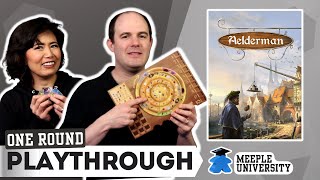
"The timing is a major part in this game. You want the wheel to be in the right position for you to take the action that you're targeting. One way that I can manipulate that is with this action here, up the top, this is a two action point action and it lets me rotate my wheel twice."
— Meeple University
"The area control side of this becomes a much bigger element as the game goes on and you've got resources to throw around. So say you're well set up here you know win area control here I'm already ahead in some jacket buyer so 10 potential points for me there."
— Meeple University