




Holotype: Mesozoic North America Deep Dive
What the Community Thinks About Holotype: Mesozoic North America
Holotype: Mesozoic North America occupies a distinctive place in the board gaming landscape as a hidden gem that bridges casual and experienced players with surprising elegance. Reviewers across the board emphasize this game as an underrated introduction to worker placement mechanics, though they diverge on how successful its paleontological theme ultimately lands. Board Game Dad highlights it as a "fantastic entry-level game" that plays with the accessibility of Catan, while Rahdo emphasizes its placement in the middle ground of gateway design, comparing it favorably to Lords of Waterdeep. Meanwhile, Meeple University provides meticulous rules clarity, treating the game as a sophisticated production despite its modest profile. The consensus is clear: Holotype works exceptionally well as a teaching tool for worker placement and displacement mechanics, delivering consistent fun without taxing players mentally or socially. Reviewers describe playing sessions as uniformly positive, though they note that the dinosaur theme functions more as window dressing than as a meaningful driver of gameplay decisions.
Core Mechanics That Define Holotype: Mesozoic North America
Worker Placement with Displacement
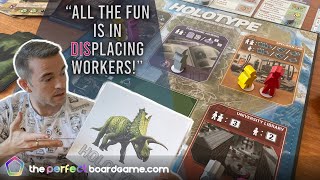
At its heart, Holotype employs a continuous worker placement system where players send team members to action spaces on the shared board to resolve their effects. What makes this mechanic distinctive is the displacement system: a hierarchy of worker ranks creates strategic tension. Players start with field assistants and archaeologists; after publishing three dinosaur holotypes, they unlock a grad student with intermediate power. Field assistants can only displace other field assistants, grad students can displace field assistants or other grad students, and paleontologists (or archaeologists in the Board Game Dad review) can displace anyone. When a worker is displaced, it returns immediately to its owner's pool, becoming available for placement again. This mechanic transforms turn order from a simple sequential affair into a constant calculus of which spaces to occupy, which opponents to help by displacing their workers, and how to position yourself to become a target worth displacing. The genius of the system, according to Board Game Dad, lies in how it flattens the board: even when every action space is occupied, a player holding a high-ranking worker can still act, forcing meaningful choices about whose worker to bump and who benefits as a consequence.
Resource Management Through Fossil Cubes
The resource engine revolves around fossil cubes representing three geological periods: purple (Triassic, most valuable), blue (Jurassic, mid-tier), and green (Cretaceous, least valuable). Players gather these resources through two primary mechanisms. The museum collections action allows direct trading between colors at fixed ratios, creating economic flexibility. The field expeditions action introduces randomness: players draw expedition cards, reveal dice symbols, roll to determine fossil yields, and gain cubes matching the results. This luck element is substantial, as reviewers note. Board Game Dad observes that Field Expeditions stacks "luck on top of luck" with card draws, dice rolls, and potential re-rolls, though Rahdo emphasizes that this randomness sits within an overall framework elegant enough to absorb it without derailing strategy. Players then spend accumulated fossils and research cubes to publish specimen cards (the dinosaur holotypes), with higher-rank workers unlocking stronger acquisition rates and additional choices across all actions. The asymmetric power progression ensures the game builds momentum: early turns feel constrained, but progressive unlocks accelerate gameplay toward its climax.
The Holotype Experience
Accessible Puzzle Solving Without Overthinking
Reviewers consistently praise Holotype for delivering strategic depth without creating analysis paralysis or decision fatigue. The game operates at a tempo that keeps turns brisk. Actions are straightforward to resolve: collect cubes, trade cubes, or spend resources to publish. The actual complexity emerges from positioning and reading the table rather than from complicated rules. Board Game Dad notes that players typically move through turns quickly and that the game maintains this brisk pace throughout, evolving from a slower opening into an increasingly exciting endgame. This accessibility translates to a relaxed, social table experience. All reviewers emphasize that Holotype plays best as a convivial game where players remain engaged even on others' turns, watching for opportunities to create advantageous bumps or defend valuable positions. The game rewards tactical observation and friendly table politics without requiring deep mathematical calculation or heavy rule lookups.
Dinosaur Theme as Charming Flavor
The paleontological setting offers rich flavor without enforcing thematic immersion. Each specimen card features a unique dinosaur species with period, archaeologist credit, and publication era, grounding the game in genuine natural history. Meeple University and Rahdo emphasize that this detail is thoughtfully embedded in the rules and card design. However, all three reviewers note that players experience the game more through abstract cube colors than through dinosaur species names. Board Game Dad candidly observes that mid-game, players default to discussing "purple, blue, and green" rather than referencing the Triassic, Jurassic, and Cretaceous periods. Rahdo frames this as intentional: the dinosaur theme provides an entry point and intellectual hook ("I like that") without demanding thematic engagement throughout play. This divorcing of theme from mechanics allows Holotype to function as a pure worker placement puzzle game while offering visual and narrative richness for those who want to engage with the paleontological setting.
What Makes Holotype Stand Out
The Displacement Mechanic Creates Natural Table Interaction
The displacement system stands as the signature mechanic differentiating Holotype from other worker placement titles. Rather than creating kingmaking scenarios or mean-spirited blocking, the bump mechanic incentivizes thoughtful player interaction. Board Game Dad articulates the appeal: the question shifts from "which action do I want" to "which opponent do I feel like helping right now?" This framing recontextualizes displacement as a gift that saves the bumped player from burning a turn to retrieve their worker. Rahdo describes this elegance in terms of upscaling: simple worker placement spots (grab cubes, spend cubes) are made sophisticated by the bumping system and the asymmetric worker powers. The result is a mechanic that feels fair and creates moments of genuine fun rather than frustration. Players actively position their workers where they suspect opponents need to go, setting up satisfying power plays.
Elegant Progression Without Heavy Teaching Overhead
Holotype builds mechanical complexity gradually through upgrades and unlocks that enter play as the game progresses. Players begin with only the field assistant and archaeologist; the grad student remains locked until a player publishes three holotypes. Throughout the game, checkpoints on the research track trigger milestone moments where all players simultaneously select from six different power tiles, granting permanent bonuses to specific actions. Rahdo emphasizes that this progression approach solves a classic teaching challenge: players learn the base game with only five actions, then asymmetrical powers organically add depth without requiring a lengthy rulebook preamble. By the time a new power arrives, the table has internalized the core systems and can immediately understand and leverage the upgrade. This design philosophy makes Holotype exceptionally effective as a gateway experience. Reviewers consistently highlight its utility as a first worker placement game or as an entry point to slightly more complex euros.
Potential Drawbacks
Heavy Reliance on Luck in Resource Acquisition
The field expeditions mechanic introduces substantial randomness into fossil gathering. Players draw cards, roll dice, and accept or re-roll based on the card's symbols. Board Game Dad notes that this layering of chance effects can feel oppressive to players seeking deterministic strategy. The mechanic operates at odds with the precision of the worker placement puzzle, as you may place a high-ranking worker at field expeditions only to roll poorly. Rahdo acknowledges "a little bit of randomness" as a design feature, implying it is balanced within the overall experience, but for hobbyists seeking deep strategic plays, the dice rolling may prove frustrating. The museum collections action provides partial mitigation through trading, but cannot eliminate the randomness entirely.
Theme Integration That Skews Toward Mechanical Abstraction
Despite the rich paleontological setting and careful card design, Holotype's theme remains secondary to its mechanics. Board Game Dad explicitly critiques this misalignment, noting that the game could substitute recipes for cookbooks in place of dinosaurs without altering the experience; the theme functions as window dressing rather than as a meaningful driver of decisions. Players reference colors rather than periods, and the artwork, while praised for quality, competes visually with overwhelming iconography. Board Game Dad observes that the density of symbols and colors, while serving clarity and accessibility, creates an aesthetic that can feel "almost like you're staring at street signs." For players seeking thematic immersion or games where flavor deeply informs play experience, Holotype delivers lightweight integration. The paleontology remains charming but fundamentally optional.
If You Enjoy Holotype: Mesozoic North America
Players captivated by Holotype's worker placement structure should explore Lords of Waterdeep and Catan, both of which anchor the gateway tier with similar accessibility-to-depth ratios. Rahdo explicitly positions Holotype in the middle ground between Catan and Lords of Waterdeep, suggesting it occupies a sweet spot for first-time euro gamers. Lords of Waterdeep shares the cube-pushing abstraction and asymmetric worker powers but drops the displacement mechanic, making it a slightly heavier, more strategic option. Catan established the accessible euro template Holotype refines; if you loved Catan's negotiation and resource trading, Holotype tightens those elements into a more structured puzzle. For those seeking to go deeper, the displacement mechanic suggests investigating games that reward table positioning and tactical bumping mechanics. Holotype proves that elegant worker placement need not demand heavy rules overhead, opening pathways into richer euro designs without requiring months of play to internalize.
What Reviewers Are Saying
"This game is very much driven by the worker placement mechanic. The fun in this game comes from choosing who you're going to displace and how you're going to position yourself so that an opponent is compelled to displace your worker."
— Board Game Dad
"You have a big worker and a small worker. The big worker gets to do the better version of all the spots. And also, you can bump your height or lower."
— Rahdo Runs Through
"How do you block actions from other players, how do you get yourself in a position where your worker gets displaced, that is where all of the fun is. For mechanics, I give this game a nine."
— Board Game Dad