/pic4555626.jpg)
In the near future, entertainment will have changed. It will have evolved beyond traditional sports in stadiums and into a larger than life spectacle where digital warriors will compete against one another inside the cyberspace arena in bloodless conflict sports.
In this futuristic environment is where Fired Up is set. In the game the players are not the fighters! They are spectators with premium seats to the largest spectacle of all time. Their premium seats make it possible for them to influence the digital athletes in the Arena and bet on their champions in the fight.
Each round the players roll dice to determine how best to influence the warriors and will secretly bet on specific highlights they would like to see happening, thus having the best time ever! During the course of the game, each player roll their action dice which can be used to influence the fighters. After the action selection phase, the fighters are going to attack each other when the combat phase is going to be resolved.
In the end, the person who had the most fun will win this game of futuristic sport!
The game ends when at most one fighter is left in the arena!
—description from the designer

Fired up in about 3 minutes
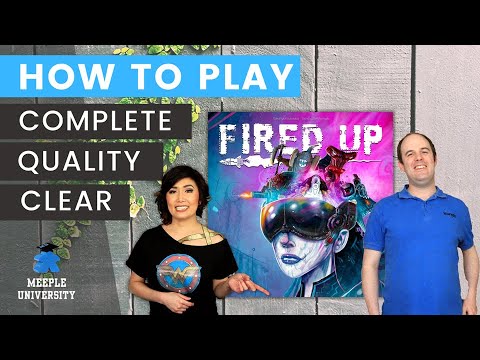
Fired Up Board Game - How to Play
Images


- Novel game concept
- Neat layer of gameplay
- Short and fun
- Quite good
- Too damn big (box size)
- Takes too long to set up
- Takes up too much space
- Giant robots fighting.
- Terraforming Mars
- Superb
- Castles of Burgundy
Mechanics (from transcript analysis)
- Betting on outcomes — Players influence and bet on the outcomes of robot fights.
- Indirect control — Players influence robots rather than directly controlling them.
Video topics + discussion points
Quotes (from this video)
- role players are deeply frustrating game for me uh for many reasons
- the thing that sort of causes me a bit of I don't know dissonance with the game is the whole narrative that it's about making up a character because for me the important part of making up a character are you know who they are their identity their motivations their drive it's not the six stats they get and that's what this focuses on
- to me that's not character creation uh that's just rolling numbers
- Santa Monica is another pretty yet ultimately forgettable game that I just kind of got rid of because didn't really do much to justify its existence
- I found this a very cynical and very tepid game
- very very forgettable and just totally uninspiring
- Thunderbirds danger zone is a game that makes me a bit sad because Thunderbirds 50th anniversary is one of my all-time favorite games
- with parts it's just not good it's just not a good game
- it's just a waste of a really cool IP
- there were just models were backing up
- most of them are pretty pretty average
- weights Knights post-apocalyptic game it's got some really good writing in it too
- the problem is the mechanics are really arbitrary
- weight nights in particular it just felt so arbitrary who was having a good game and doing well and who wasn't
- core mechanics of the game were just a crap shoot and not that much fun if you ended up on the bad side of it
- and the final game on here is welcome to the Moon the big sequel to welcome to which is like a 10 part rolling right game with a whole bunch of different games in it
- if I'm not enjoying a rolling right game
- was I too harsh on some games uh I probably was but you know this is my opinion
- if you did hear me talk about something and go actually I think you would like this game really interested to know about that sort of stuff
References (from this video)

Mechanics (from transcript analysis)
Video topics + discussion points
Quotes (from this video)
- fired up is a game of betting and neutral character influence
- set in a futuristic arena combat
- the players will collect points on any bets that were successful
- each betting card depicts a fighter
References (from this video)
- Clear rules and phases explained
- Combination of betting and in-game actions creates tension
- Varied actions and dice faces add strategic depth
- betting and neutral character influence
- set in a futuristic arena combat
Mechanics (from transcript analysis)
- Asymmetric Player Powers — Some fighters have asymmetrical powers shown on their boards.
- asymmetrical powers — Some fighters have asymmetrical powers shown on their boards.
- Battle resolution — Attack and defense dice determine damage and wounds with blocks and counter-attacks.
- betting on fighters — Players bet on fighters using betting cards and the betting board, earning points for successful bets.
- Combat: Dice — Attack and defense dice determine damage and wounds with blocks and counter-attacks.
- dice faces with actions — Influence dice faces provide buffs, morale, sprint, target, and social actions.
- highlight cards — Highlight cards are played during battles to gain points.
- influence phase — Players roll and spend influence dice to modify fighters’ stats and configuration.
- Influence Points — Players roll and spend influence dice to modify fighters’ stats and configuration.
- late bets — Late bets are resolved at the end of the game.
- Morale checks — After rounds, morale is adjusted based on thumbs up/down and affects fighter stats.
- round structure — Each round has an influence phase and a battle phase.
- speed/sprint — Sprinting changes fighter speed order by swapping speed tokens.
- Variable Phase Order — Each round has an influence phase and a battle phase.
Video topics + discussion points
Quotes (from this video)
- fired up is a game of betting and neutral character influence
- set in a futuristic arena combat
- the players will collect points on any bets that were successful
- each betting card depicts a fighter
References (from this video)
- Unique premise: crowd-manipulation across a combat sport creates a fresh social dynamic
- Clear goals via the highlight system that scale in reward with difficulty
- Strong group interaction: players tussle with each other's plans while chaotic dice decide outcomes
- Visually distinctive look and a sense of being different from typical combat games
- Action die system adds complexity and can feel esoteric
- Combat is very dice-heavy and randomness dominates outcomes
- Not ideal for players uncomfortable with dice-driven results
- Fan engagement and manipulation in a gladiatorial setting
- A rowdy combat sports arena where fans jeer and influence the fighters’ behavior through bets and morale shifts.
- Observational, meta-commentary with crowd-driven incentives
- Blood Bowl
- GKR Heavy Hitters
Mechanics (from transcript analysis)
- Action dice pool — A set of six action dice (attack/defense, morale, speed, target, 2x, social) drive what can be done each turn.
- Betting and Bluffing — Players spend social dice to place bets and influence scoring across rounds.
- betting on fighters and categories — Players spend social dice to place bets and influence scoring across rounds.
- card management — Four highlight cards in hand; players choose two to attempt to score this round.
- combat resolution — Red attack dice vs blue armor dice; damages and wounds determine eliminations.
- Combat: Dice — Some dice allow changing which fighter acts and who others target; more dice needed if affected.
- Compound Scoring — Four full rounds where points are earned through goals and highlighted actions.
- dice banking and currency — Social dice can be banked up to two for later use and can be combined to form other dice via two-die rules.
- Influence Points — Each use of a die to influence a fighter moves a track down; reaching zero ends manipulation.
- morale phase — Thumbs up or down affect maximum attack/defense by shifting morale disc.
- movement and targeting restrictions — Some dice allow changing which fighter acts and who others target; more dice needed if affected.
- permanent pipeline of influence — Each use of a die to influence a fighter moves a track down; reaching zero ends manipulation.
- round-based scoring — Four full rounds where points are earned through goals and highlighted actions.
Video topics + discussion points
Quotes (from this video)
- fired up is something a little bit different, a game that replicates a group of jeering manipulative fans at a combat sport event egging the fighters on to bigger and bolder exploits
- the highlight system means you always have goals and the harder they are to achieve the more points you will get
- the best thing about this game is it's something very different, from how it plays to how it looks it's unique
- however, i think the action die system needs to go in the bin there are enough variables in this game already that will screw with your plans
- the combat system is very dice heavy and very random as well, not a game for people who are uncomfortable with dice determining outcomes
- it's no busta rhymes but what is?
- for a more directly confrontational sports game try blood bowl
- and for a different take on future combat sports try gkr heavy hitters