




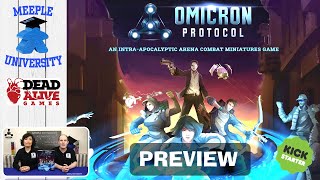

Omicron Protocol Deep Dive
What the Community Thinks About Omicron Protocol
Reviewers consistently recognize Omicron Protocol as a standout entry in tactical miniatures skirmish games. Evil University praises its thematic worldbuilding and mechanical innovation, while Brains On Games emphasizes the depth of its combat system and how it bridges the gap between accessibility and strategic complexity. The Board Games for One channel calls out the exceptional quality of its tutorial as a major strength, while Pair Of Dice Paradise highlights its innovative mechanics and exciting gameplay. The consensus emerges clearly: this is a game that rewards engagement and tactical thinking, backed by thoughtful design that helps players learn by doing.
Core Mechanics That Define Omicron Protocol
Action Store
Each round, players command their squad with a limited pool of action points, typically eight or nine, which must be distributed among four characters. This creates the constant pressure of budgeting decisions. Moving a character can be free if they walk, but costs an action point to run. Attacking, foraging for equipment, and using special abilities each carry their own action costs. Players alternate activating single characters, spending their pool strategically across their entire squad. This system creates meaningful tension between immediate tactical goals and long-term scenario objectives, forcing choices about when to push forward and when to conserve resources for threats ahead.
EM Noise (Electromagnetic Noise)
When characters perform actions involving technology, they generate electromagnetic noise that attracts the Sims (cybernetic mutants) swarming the city. Each character tracks a noise value that dictates how far away Sims can detect them. After a character activates, any Sims within that noise range move toward the character and attack adjacent targets. Crucially, the opposing player controls these Sims, turning them into a tool for tactical harassment. This mechanic creates a push-pull dynamic: powerful actions are noisy and invite enemy attention, while stealth builds stay quiet but potentially less effective. The Sims scale throughout the round, spawning additional threats as noise accumulates, forcing players to balance offense with the consequences of drawing reinforcements.
The Omicron Protocol Experience
Tactical Depth
Playing Omicron Protocol feels like executing a heist under pressure. Every movement matters because positioning determines whether a character can target an enemy, whether they will trigger attacks of opportunity, and whether they will end their turn near spawn points for incoming Sims. Reviewers note the spatial skills required, the constant mental budget of action points and dice results, and the short-term survival goals layered against long-term scenario objectives. Combat itself rewards careful planning; rolling handfuls of dice to hit an enemy, then spending those successes on damage, movement, status effects, or luck tokens gives players granular control over outcomes rather than binary success or failure.
Cyberpunk Immersion
The setting of San Lazaro in 2050, locked down during a viral outbreak that transforms people into violent cyber-enhanced mutants, creates a lived-in atmosphere. Each of the four survivor characters comes with a detailed 32mm miniature, personal history, and unique cybernetic abilities. Scenarios draw from a 120,000-word collection of background lore that players discover through play. The rules teach themselves gradually through scenario progression, letting players absorb mechanics in the context of their squad's desperate situation rather than through rote memorization. This combination of thematic depth, character flavor, and integrated tutorial creates a sense that players are genuinely inhabiting a dangerous, complex world rather than simply executing board game rules.
What Makes Omicron Protocol Stand Out
Exceptional Teaching Design
The Board Games for One reviewer describes the tutorial system as fantastic and walks through basics step by step in an enjoyable experience. Rather than overwhelming players with a rulebook, Omicron Protocol drips mechanics into early scenarios so that each chapter introduces concepts in play. The tutorial book itself receives praise for its clarity and structure, making the game accessible despite its depth. This approach honors both complexity seekers and newcomers; experienced players can engage with the full tactical layer while first-time players never feel lost because the game teaches as they play.
Asymmetric Faction Design
The two main factions, Peacekeepers and Survivalists, feel fundamentally different to play. Peacekeepers wield powerful weapons like lances and pistols but generate heavy noise, drawing Sims aggressively and requiring players to manage constant swarm threats. Survivalists deal less raw damage but operate more quietly and sneakily, enabling different tactical approaches to the same scenarios. This asymmetry ensures that squad composition and faction choice are meaningful strategic decisions, not cosmetic flavor. Each faction pushes players toward distinct playstyles and tactics, dramatically increasing replayability and allowing squads to feel truly different from one another.
Potential Drawbacks
Steep Learning Curve and Rules Density
Omicron Protocol brings together numerous interacting systems: action points, noise generation, line of sight, attacks of opportunity, cover mechanics, luck tokens, character abilities, and scenario-specific rules. A reviewer from Brains On Games notes there are lots of rules to keep track of and a significant memory component required to internalize how cover, line of fire, and engagement rules affect combat. While the tutorial scaffolds learning well, the total cognitive load remains substantial. Players new to tactical miniatures games may find the combination of spatial reasoning, resource budgeting, and rules recall challenging during their first few scenarios.
Rulebook Inconsistencies
The Brains On Games reviewer reports instances where the rulebook contained errors, such as cross-references pointing to pages that do not contain the promised information. A specific example: looking up a rule, finding a reference to page 20, checking page 20, finding nothing, then checking the table of contents which also incorrectly referenced page 20. These inconsistencies create friction during play when players need to resolve questions or confirm how a mechanic works. While the information exists somewhere in the rulebook, typos and mismatched references force players to search or consult external resources like playthrough videos to clarify edge cases.
If You Enjoy Omicron Protocol
If the tactical squad-based gameplay appeals to you, consider exploring other miniatures skirmish games that emphasize scenario-driven campaigns and asymmetric faction design. Games with robust solo modes and tutorial systems that teach through play share Omicron Protocol's accessibility-within-depth philosophy. For those drawn to the cyberpunk theme and high-lore setting, narrative-rich skirmish games with detailed character backstories and modular campaign structures offer similar immersion. The action point economy and push-your-luck decision-making also appear in euro-style strategy games focused on resource management, should you prefer games without the miniatures component.
What Reviewers Are Saying
"Rolling handfuls of dice is fun, let's face it, and then you get to spend those dice, you're not wasting your successes, so that's something else that I really thought was cool about this game."
— Brains On Games
"So you've got these peacekeepers, the police kind of, and often they've got powerful weapons, but the their weapons are quite noisy, and so they're going to attract a lot more attention from those Sims whereas the survivalist maybe they don't do as much damage but they tend to be more sneaky in in terms of how how you're going to play through the game so you're going to use very different strategies and there are a variety of characters in the box."
— Brains On Games
"What I like most about this is it has a tutorial book and it's a good tutorial book. It really walks you through how to play the game step by step. The tutorial is fantastic, it's an enjoyable experience to learn the game."
— Board Games for One