


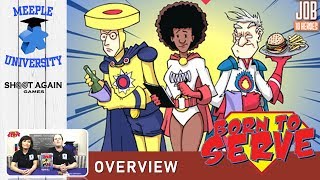


Born to Serve Deep Dive
What the Community Thinks About Born to Serve
Born to Serve draws reviewers in with an irresistible premise: a group of down-on-their-luck superheroes competing for a single waitstaff position at a local diner after their government funding was cut. The game successfully translates that comedic scenario into engaging, interactive gameplay. Reviewers appreciate the way the theme drives the mechanics rather than feeling tacked on, and the asymmetric superhero powers ensure each player has distinct strategic tools at their disposal. The game occupies a sweet spot for players who want light worker-placement strategy paired with strong comedic flavor.
Core Mechanics That Define Born to Serve
Service Markers and Table Control
The foundation of Born to Serve revolves around placing service markers on tables to earn tips. Each player draws five service markers per round and places them on available tables, with the goal of controlling a table by having the most markers there when it fills. The strategic depth emerges from when and where players place their tokens. Placement order matters critically: when a table is tied between two players, whoever placed their marker in the highest-numbered slot wins, rewarding patience and careful positioning. This creates a cat-and-mouse game where players must balance aggressive tipping early versus holding back tokens for higher-value tables later in the game. Winners of a table score the full tip value; players who contributed but didn't win still receive half the tip, rounded down, making participation valuable even in defeat.
Superhero Powers and Staff Abilities
Beyond the table-placement core, each player wields two unique superhero abilities per round, representing their special powers in a way that directly impacts strategy. These powers allow for special or additional token placements, bonus money, scoring manipulations, or even adjusting tip cards themselves. The game also includes eight staff members that players can activate by spending service markers. Staff abilities introduce high variability into gameplay: some activate immediately when placed, others trigger at the end of the service phase, and others activate during scoring. These abilities can boost table tip values, allow players to rearrange their markers strategically, modify scoring conditions, or grant extra money. The washroom attendant, who always appears in every game, serves a crucial role: placing a marker there retrieves one token from the "Phantom Realm" (the game's term for permanently lost tokens), ensuring players can manage their resource pools.
The Born to Serve Experience
Comedic Theme Meets Tactical Gameplay
The core charm of Born to Serve lies in how perfectly its theme aligns with its mechanics. Reviewers note that the asymmetric superhero powers and the competition for a single job neatly represent the fantasy of these powered-up characters reduced to competing in a restaurant. The game never abandons its humor in service of complexity; instead, the mechanics themselves reinforce the comedic scenario. Players are genuinely making tough decisions about token placement, timing, and power usage, but every decision carries the weight of the theme: these are superheroes desperate enough to fight for a waitstaff gig. That thematic coherence makes the strategic tension feel earned rather than arbitrary.
Risk and Reward Through Token Loss
The Phantom Realm mechanic introduces meaningful resource tension to every decision. When players win a table, they must lose at least one of their service markers permanently; they can choose to lose a second one to score a higher tip value, but this decision reverberates through the game. Lunch tips are modest (green cards worth 5-6 dollars, yellow cards ranging from 3-9), while dinner tips are considerably higher (green cards 8-9 dollars, yellow cards 6-12 dollars). Savvy players must manage their token pools carefully to ensure they have enough markers left for the dinner phase when the stakes and payouts are higher. This creates compelling push-your-luck moments and forces players to weigh immediate scoring against future opportunity, making every round consequential.
What Makes Born to Serve Stand Out
Placement-Based Tiebreakers
Born to Serve uses position on the table track as its tiebreaker, rewarding players who place later in a round. This simple rule creates sophisticated gameplay: players must think not just about whether to serve a table, but when to serve it. Placing your marker last on a contested table can secure control even if you're not ahead on count. This mechanic encourages players to hold tokens and make their moves thoughtfully, rather than rushing to place early. It also creates memorable moments of strategic audacity, where one well-timed marker swing changes table outcomes.
Variability Through Hidden Information
The game uses two types of tip cards to modulate certainty and risk. Green tip cards are face-up, so players know exactly what a table is worth and can plan accordingly. Yellow tip cards are face-down, adding variance of up to three dollars above or below an expected value at lunch, and up to three dollars at dinner. This asymmetry means players face a genuine unknown: do they invest markers in a potentially high-value mystery table, or stick with a known quantity? The hidden information also ensures that even across multiple plays, the decision calculus shifts, keeping the game fresh and preventing dominant strategies from calcifying too early.
Potential Drawbacks
Phantom Realm Pressure and Token Scarcity
The Phantom Realm mechanic, while strategically interesting, can create resource starvation problems, particularly at higher player counts. Each player starts with 13 service markers, which sounds like plenty until tokens begin disappearing permanently to the Phantom Realm. Managing token scarcity becomes the dominant puzzle in the game, and for players unfamiliar with the rhythm of token loss, the dinner phase can arrive with insufficient markers to capitalize on the higher payouts. The washroom attendant mitigates this but does not eliminate it entirely. Players who make early-game mistakes with token placement can find themselves unable to recover, leading to foregone conclusions in the final rounds.
Analysis Paralysis and Placement Order Sensitivity
The strength of position-based tiebreakers also introduces a weakness: placement order within a round can feel disproportionately powerful, and the optimal play often hinges on reading opponents' intentions and guessing when they will act. Analytical players may get bogged down in considering all permutations of marker placement timing, particularly in the middle rounds when tokens are scarce and every decision feels life-or-death. Additionally, players who go late in the turn order gain a significant advantage each round, always able to see most opponents' moves before committing their own markers. This turn-order dependency can feel frustrating to players in early positions, though the rotating first-player marker does eventually distribute the advantage.
If You Enjoy Born to Serve
Born to Serve suits players who relish light to medium worker-placement games with a comedic edge. If you enjoy games that blend resource management with asymmetric powers and appreciate strong thematic flavor that drives the rules, this game delivers. It works well for groups who value humor and playable complexity over deep tactical puzzles or heavy economic engines. The game thrives with players who can appreciate the risk-reward calculation of token placement without overthinking every move, and who find the fallen-superhero scenario charming rather than distracting. Fans of games with hidden information and catch-up mechanics will appreciate Born to Serve's tip-splitting rules, which ensure that even the leader faces meaningful competition right through the final round.
What Reviewers Are Saying
"It's this interesting comic book about it's a whole group of superheroes who have no government funding and are forced to wait tables at a local restaurant and they're all trying to get the most tips this is actually also a game."
— Meeple University
"This introduces a tactical take that element to the game which neatly represents the theme of superheroes competing against each other for the same job."
— Meeple University
"Players need to be careful to keep enough tokens left for the dinner phase where they can score the higher value tips."
— Meeple University