/pic4561918.png)
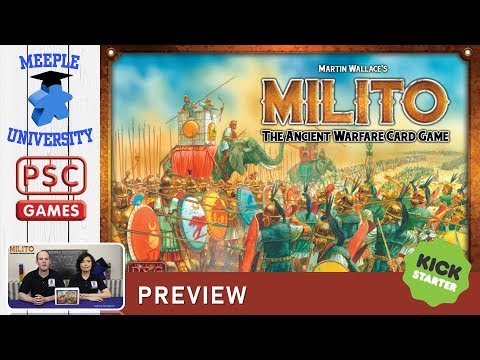
Refight battles between the greatest armies of the Ancient World: Republican Roman, Carthaginian, Alexandrian Macedonian, Achaemenid Persian, and more!
Milito is a card-based, diceless wargame by Martin Wallace that puts you at the head of an Ancient army, making the key tactical decisions that will win or lose you the battle. Commanding a combination of troops unique to your own army, you'll play unit cards to take control of the battlefield. Skirmish with light troops to hold the enemy at bay, use your cavalry's maneuverability to your advantage, and advance your units of well-armored infantry to drive the enemy away. Flank attacks and army-specific leaders provide further tactical depth. Choose the right moment to commit your best units into the battle line, and capture three terrain areas to win the game.
Each card in your hand represents one of your army's units, which has the same strengths and weaknesses as its historical counterpart. Units are rated for speed, attack strength, defense strength, and other modifiers based on battlefield performance. Leader cards offer combat bonuses and have their own unique abilities — but be warned that not every leader card is an Alexander or Hannibal!
—description from the publisher
Images


Mechanics (from transcript analysis)
Video topics + discussion points
Quotes (from this video)
- this is military how does it play in this video we're going to show you an overview of this game and if you stay tuned until the end you can decide whether or not this game is for you
- Militō is a short car driven two-player war game designed by Martin Wallace and published by PSC Games
- The game re-implement s-- the mechanics of Wallace's 2013 game field of glory the card game and updates it to include new armies modeled on historical armies from the age of classical antiquity
- The majority of the game is played in two types of actions deploying units and attacking
- Deck management is a key element of the game
- this is the main tactical reason for fleeing from battle instead of fighting as any units which flee from a battle are discarded rather than destroyed
- Militō is an asymmetrical game which comes with six different period armies each with its own unique deck and strengths and weaknesses
References (from this video)
- Asymmetrical game with six different period armies, each with unique decks, strengths, and weaknesses.
- Playing too many cards at once will leave a player weakened in the short term.
- greatest armies from the ancient world
- ancient world
- Field of Glory the card game
Mechanics (from transcript analysis)
- Area Control — Players win by controlling three of the five terrain cards.
- asymmetrical gameplay — Features six different period armies, each with a unique deck, strengths, and weaknesses.
- Card-driven war game — The game is card-driven and players use cards for actions like deploying units and attacking.
- combat resolution — Attacker and defender compare combat points from played cards to determine the winner of a column.
- deck management — Managing cards in hand and deck is crucial, as deployed units are discarded and defeated units are removed from the game entirely.
Video topics + discussion points
Quotes (from this video)
- this is military how does it play in this video we're going to show you an overview of this game and if you stay tuned until the end you can decide whether or not this game is for you
- Militō is a short car driven two-player war game designed by Martin Wallace and published by PSC Games
- The game re-implement s-- the mechanics of Wallace's 2013 game field of glory the card game and updates it to include new armies modeled on historical armies from the age of classical antiquity
- The majority of the game is played in two types of actions deploying units and attacking
- Deck management is a key element of the game
- this is the main tactical reason for fleeing from battle instead of fighting as any units which flee from a battle are discarded rather than destroyed
- Militō is an asymmetrical game which comes with six different period armies each with its own unique deck and strengths and weaknesses