



Lying Pirates Deep Dive
What the Community Thinks About Lying Pirates
Reviewers who have covered Lying Pirates present it as a race for the pirate throne, where captains bet on hidden dice, sail around a shared map, and play action cards to slow down their rivals. Meeple University introduces the game as a teaching video and credits its designers as Misha Arari, Michaela Hord, and Lucas Vagner, with publication by Nordic Pirate Games. The video is a rules walkthrough rather than a verdict, but its explanation of each round makes clear that bluffing and luck sit at the center of the game.
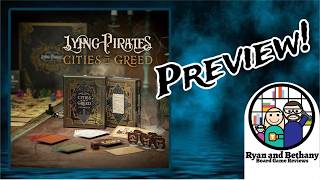
Ryan and Bethany Board Game Reviews approach the game from the other direction. They focus on the Cities of Greed expansion, also published by Nordic Pirate Games, and treat the base game and expansion as one high-energy experience. Their praise centers on chaos: they call the mini-games hilarious and terrifying, and they say the expansion adds more of the moments that make a table erupt. Both channels describe Lying Pirates as a game of controlled tension rather than a precise strategy puzzle, though Ryan and Bethany are far more openly enthusiastic about the social side of play.
Core Mechanics That Define Lying Pirates
Betting and Bluffing
Every round opens with a betting phase that plays as a full game of Liar's Dice. Each player shakes their crew dice under a cup, looks only at their own roll, and makes increasing bids about how many of each face appear across every cup on the table. Ones are wild, and each new bid must either raise the quantity or raise the face value. Meeple University explains that a player can end the bidding by calling the previous bid a lie, or by locking an exact bet, which carries higher risk and grants a new crew die from the bag if correct. Every betting phase produces exactly one winner, with the others split into losers and survivors, and those results decide who moves on the map.
Sailing and Tile Battles
Once the betting phase resolves, the winner and survivors move along the route using a sail die that shows either one or two spaces, while losers stay put. Everyone who moved then rolls battle dice, where a double sword beats a single sword and a skull is the weakest result, to decide who resolves the tile they landed on. Meeple University notes that tiles sit in safe, uncharted, or treacherous waters, with safe tiles tending toward positive effects and treacherous tiles almost always bad. Ryan and Bethany describe the tiles in similar terms, as events that are sometimes good, sometimes bad, and sometimes decided by a die roll or a coin flip. Meeple University also points out that some tiles carry negative effects, so winning the tile battle is not always the goal.
The Lying Pirates Experience
Controlled Chaos
Ryan and Bethany return to the idea of controlled chaos more than any other theme. They describe a table where dice are everywhere and no one can predict the result, yet players still make real choices, such as whether to trigger an influence card now to get ahead or hold it to disrupt someone later. The reviewers say the adrenaline stays high even though everyone is seated and no real-time pressure applies, which they see as a good fit for players who enjoy high-energy games without a timer.
Playful Rivalry
The second feeling reviewers describe is a friendly, teasing meanness at the table. Ryan and Bethany say the game rewards players who can laugh off being attacked by a card or losing a die to a rival's trick, and they advise bringing a group that does not take the fallout personally. The expansion's mini-games, which include stacking dice in a reverse Jenga style, are singled out as moments that are funny and tense at once. The result is less about winning cleanly and more about the reactions that ripple around the table.
What Makes Lying Pirates Stand Out
Liar's Dice as One Engine in a Larger Race
Ryan and Bethany praise the design decision to take the Liar's Dice mechanism and use it as one part of a broader race game. Rather than making bluffing the whole experience, the betting phase feeds into movement, tile resolution, and card play. They say the game really shines with five or six players, and they suggest it works well for a game night when a group wants to run around and be a little crazy.
Influence Over the Cities
Ryan and Bethany highlight the influence cards from the Cities of Greed expansion as the feature that adds the most decisions. A player who is the only one on a relevant part of the board can gain extra money, while opponents standing on the same spots can be made to lose cargo, which Ryan and Bethany define as a crew die, coins, or an action card from their hand. Becoming the mayor of a town grants a mayor die with extra abilities and extra risk. Meeple University explains the same town system in detail, noting that influence cards can either attack everyone in a town or give a bonus to players on matching spaces. The video is clear that it was played with a prototype copy of the expansion.
Potential Drawbacks
Layered Rules Raise the Learning Curve
Meeple University spends a long stretch on exceptions such as the cursed crew die, variant cards, player powers, and the multi-stage final battle. Those layers add depth, but they also raise the learning curve, so a first game needs some care. The video points to a simplified setup on page 18 of the rulebook as a way to ease in.
Chaos Can Crowd Out Strategy
Ryan and Bethany describe the game as constant chaos, with dice everywhere, and say that real decisions have to be added on top of it. They point to the timing of influence cards as one of the few places where players steer the outcome. Meeple University adds that treacherous tiles are almost always bad and that some tiles come down to a die roll or a coin flip. For players who want more control over their plans, chance can take over from the decisions that make a win feel earned.
If You Enjoy Lying Pirates
Ryan and Bethany tie Lying Pirates directly to Liar's Dice, and Meeple University describes its betting phase using the same bidding rules. Players who enjoy the bluffing and probability in this game may want to try Liar's Dice itself to see how the core bidding loop works without the sailing and card layers. Players who enjoy the bluffing and social tension will likely enjoy other games built around a similar mood, where table talk and playful attacks drive the fun.
What Reviewers Are Saying
"Round by round players will engage in betting under the classic rules of liars dice to determine who does and doesn't get to move. They'll battle to determine who resolves the tile they land on and will purchase and play action cards to try to get an edge."
— Meeple University
"I feel like this game and this expansion are constant Controlled Chaos. I like that a lot."
— Ryan and Bethany Board Game Reviews
"I like that this took a mechanism like the Liars of dice game and kind of use that as a one mechanism within a bigger broader game kind of turn it into a race game."
— Ryan and Bethany Board Game Reviews