/pic6683206.png)
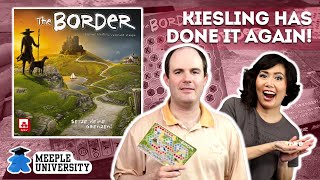
Your goal in The Border is to surround as many areas as possible as quickly as you can.
Each player has an erasable game board that features nine areas, with each area being surrounded by a path of hexagons and with these hexagons being grouped in six colors. Most of these paths border two areas. Two hexagons are white and contain an X mark.
On your turn, you roll five dice up to three times, keeping and re-rolling dice as you wish. Each die has a different color on each of its six sides. Once you stop, you can use the die results to X spaces on your game board, but only if you can X off all the spaces in that group. If you roll four orange and one red, for example, you can X off a group of two, three, or four orange hexagons, but not a group of five orange hexagons since you have only four orange on the dice.
After you take your turn, each other player can X off one space on their game board for each die that you didn't use on your turn — but only if those spaces are adjacent to ones that are already Xed. If you marked off a group of three orange hexes, for example, then each opponent could mark off one orange and one red, assuming they are adjacent to previously marked spaces.
When you mark off the final hex that borders an area, you score that area, earning 4-12 points depending on its size. Any other player who surrounds that area on a later turn receives only half as many points.
As soon as a player completes their sixth area, you finish that turn, then everyone sums their points to see who wins.

Images



- clever roll-and-write variant
- asymmetric boards
- inactive player downtime
- dry-looking visuals
- could run a bit long
- roll-and-write with asymmetric boards
Mechanics (from transcript analysis)
- area closure — Active player attempts to close off an area using dice
- Asymmetric Boards — Each player has a unique board with different color regions
- Flip/Roll and Write — Active player rolls to fill regions; inactive players use leftovers
- roll-and-write — Active player rolls to fill regions; inactive players use leftovers
Video topics + discussion points
Quotes (from this video)
- this is a game called ecosphera rewilding the world
- it's language independent
- the transparent is not just a gimmick it's actually part of the mechanics
- Great Western Trail Argentina compared to the previous versions
- my number one for both of us was Great Western Trail
References (from this video)
Mechanics (from transcript analysis)
Video topics + discussion points
Quotes (from this video)
- I quite like it
- this is a very dry game
References (from this video)
- Surprising amount of strategy in using leftover dice
- Simple to learn and quick to pick up
- Interactive and engaging decisions
- Endgame tension and strategic depth near the end
- Compact box/production
- Can feel dry or plain to some players
- May be tad long for the pacing
- encircling landmarks to score points
- map with landmarks
- Copenhagen
Mechanics (from transcript analysis)
- Adjacency restriction — inactive players must place markers adjacent to existing crosses
- Cross-off colored segments — players cross off a number of colored spaces on their map corresponding to dice results
- End condition and scoring — game ends when someone completes six segments; scoring based on colors completed and border progress
- Leftover dice sharing — inactive players use leftover dice to extend their areas adjacent to crosses
- Race — players race to complete the border to gain higher points
- Race to complete the border — players race to complete the border to gain higher points
- Yahtzee-style dice roll — lead player rolls dice and uses results to cross off segments on their map
Video topics + discussion points
Quotes (from this video)
- I quite like it
- this is a very dry game