




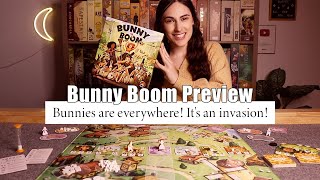
Bunny Boom Deep Dive
What the Community Thinks About Bunny Boom
Bunny Boom presents a curious case of community disagreement, with reviewers divided sharply on whether its clever design elevates it above a basic filler game. The Board Game Garden praises the game as a fast-paced tactical experience with creative mechanics and appealing aesthetics, describing it as "a great quick filler game" perfect for its 15-minute playtime. By contrast, The Dice Tower's Tom Vasel expressed profound disappointment, calling the game "pretty terrible" despite acknowledging its gorgeous artwork by Andry Bosley. Vasel's three-out-of-ten rating reflects deep frustration: Vasel was genuinely excited about Bunny Boom going in, making the letdown especially acute. This stark division suggests the game resonates strongly with players who embrace chaotic, high-interaction filler experiences, while others find the core gameplay fundamentally flawed or unsatisfying.
Core Mechanics That Define Bunny Boom
Card Layering and Suit Matching
At its heart, Bunny Boom uses an elegant card-layering system that evolves as the game progresses. Early on, players place cards into empty spaces on the modular board. Once all spaces are filled, gameplay shifts to a "phase two" where cards must be layered on top of existing cards. This creates a suit-matching dimension: when you play a card with a matching suit atop another card's matching suit, you close that space (no more cards can stack there). Playing a card with a different suit leaves the space open for further stacking and costs you bunnies as a penalty. This mechanic drives tactical decision-making around risk and reward, forcing players to weigh whether they can afford the penalty or should risk closing spaces early to preserve their bunny count.
Movement Effects and Card Traversal
When players place a card, they must move their villager character directly to that card. Every other card their character passes through triggers that card's movement effect, usually adding bunnies to their home. This creates the game's core tension: playing a card far away from your current position risks accumulating bunnies along the path, while playing nearby cards limits your options and leaves you vulnerable to opponent tactics. The optional 15-second timer intensifies this pressure by penalizing indecision with additional bunnies, transforming the game into a real-time chaos experience where careful analysis becomes a liability.
The Bunny Boom Experience
Chaotic Tactical Screwover
The Board Game Garden describes Bunny Boom as a "fast-paced kind of card playing tactical game where you are pretty much trying to screw over your opponents." The game's mean-spirited core is intentional: players actively position cards to force opponents into unfavorable moves, hand them the carrot token (worth four bunnies at game end), or trigger card effects that dump bunnies onto their homes. The optional timer amplifies this chaos, making the game feel urgent and unpredictable. Players who thrive on confrontational filler games and embracing the mayhem will find this exhilarating.
Frustration and Mechanical Friction
For others, however, the experience becomes frustrating. The Dice Tower's review suggests that despite clever moving parts, the game fails to deliver satisfying gameplay once you play through its mechanical loops. The high interaction and moment-to-moment unpredictability that some find fun can feel overwhelming or arbitrary to players seeking logical decision-making or meaningful strategic control. Vasel's harsh rating reflects a game that seems promising on paper but disappoints in practice.
What Makes Bunny Boom Stand Out
Andry Bosley's Charming Artwork
Both positive and negative reviewers single out the artwork as genuinely excellent. The Board Game Garden specifically praises the game's "very unique player colors" (orange, yellow, purple, and gray rather than the typical red, blue, green, yellow combination), and The Dice Tower's Tom Vasel notes "great art from Andrew Bosley in this game." The cute rabbit theme married to Bosley's distinctive visual style creates an inviting aesthetic that draws players in, even if some later find the gameplay underneath disappointing.
Puzzle Board Design and Modular Layout
The Board Game Garden expresses genuine enthusiasm for the puzzle-piece board construction. Rather than folding out a flat board, players assemble the board from puzzle pieces before play. This design choice not only makes setup tactile and engaging but also allows the board to scale elegantly with player count: two-player games use left and right rows, three-player games add the top row, and four-player games activate all four directions. The Board Game Garden notes appreciation for this design: "I do love when board games have like that puzzle board instead of having to like fold it out."
Potential Drawbacks
Disappointingly Shallow Core Gameplay
The Dice Tower's harsh assessment reflects a significant risk with Bunny Boom: the game's mechanics, while creative, may not sustain satisfying decision-making over repeated plays. Vasel's surprise and disappointment suggest the game feels good in concept but fails to deliver engaging gameplay in practice. The modular content (burrow and fox modules) attempts to add replayability and strategic variation, but these feel like patches rather than fundamental improvements. For players accustomed to games with tighter reward systems and clearer strategic paths, Bunny Boom can feel hollow.
High Interaction as Liability
The game's mean-spirited, high-interaction design works against certain play groups. The optional timer mode pushes the game toward real-time chaos, which amplifies either fun or frustration depending on your table's preferences. Even without the timer, the core mechanic of forcing opponents into unfavorable situations can feel punishing or arbitrary rather than clever. Additionally, with decisions often made under time pressure and character movement paths largely determined by board layout, players may feel they have limited meaningful choices, leading to a sense of helplessness when the board conspires against them.
If You Enjoy Bunny Boom
Bunny Boom is built for players who love short, chaotic filler games with high interaction and mean-spirited player elimination mechanics. If you enjoy the rapid-fire decision-making of real-time games, the tactical screwover of games designed around blocking and interference, and the unpredictability that comes with shared board spaces and interlocking card effects, Bunny Boom offers the experience you're seeking. The game's 15-minute playtime makes it ideal for opening or closing a game night, and the modular ruleset lets you calibrate chaos with or without the timer option. However, if you prefer games with deeper strategic decision trees, lower player interaction, or outcomes that feel earned rather than lucky, other short filler options may serve you better. The divided reception suggests this is a game that will appeal intensely to some tables while frustrating others, making careful table assessment worth the effort.
What Reviewers Are Saying
"this is a fast-paced kind of card playing tactical game where you are pretty much trying to screw over your opponents trying to give them all the bunnies and avoid getting bunnies for yourself"
— The Board Game Garden
"Great art from Andrew Bosley in this game. Unfortunately, the game is pretty terrible. It's one of those games I was so excited about, very, very big disappointment, three out of 10."
— The Dice Tower
"I do love when board games have like that puzzle board instead of having to like fold it out it's really easy to just put the puzzle together"
— The Board Game Garden