






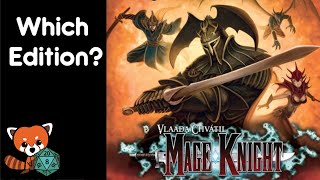
Mage Knight: Ultimate Edition Deep Dive
What the Community Thinks About Mage Knight: Ultimate Edition
Mage Knight: Ultimate Edition, from WizKids, collects Vlaada Chvátil's deck-building sandbox adventure and its expansions in one box, and reviewers treat it as a heavyweight classic. Board Games UnLocked puts it at number nine on a top 100 of all time, calling it "widely renowned as the best solo game of all time" and the heaviest game they have played enough of. Tyler Williams of Meeple Mountain, whose review copy came from WizKids, says the game "for its age, for how long it's been around, is incredible," and that it deserves both its complexity rating on BoardGameGeek and its overall rating. Nights Around a Table unboxes it with obvious glee. The shared caveats are time and weight: this is a long, dense game that asks a lot before it pays off.
Core Mechanics That Define Mage Knight: Ultimate Edition
Deck Building
Tyler describes the game at its core as a deck builder sandbox adventure for one to five players. Each player starts with a deck of 16 cards, relatively similar to everyone else's, and grows it with advanced actions, spells and hired units. Every card has several uses, and Tyler explains that you can always play one sideways as a wild card to add a base ability to another play. Nights Around a Table, reading the rules before a first game, likens this to Race for the Galaxy, where your handful of cards doubles as your resources.
Hand Management
Turns are about squeezing the most out of each hand. Tyler walks through the layers: mana crystals and mana tokens that power up your actions, reputation you have to manage carefully with the locals, armor that decides how much damage you can soak before you start taking wounds, and a wound deck that clogs your hand when you fail. Rounds alternate between day and night, which affects a lot of things, and the game ends after the number of rounds your scenario sets. Whoever has the most Fame wins.
The Mage Knight: Ultimate Edition Experience
A Sandbox Puzzle
You explore by revealing map tiles as you search for cities to overthrow, stopping at places like healing glades along the way. Board Games UnLocked calls it a massive sandbox narrative game and says very few games come close to it. They play it strictly solo, leaving it set up to run through a few scenarios, and say a game takes them almost three hours.
Combat as a Math Game
Combat is where the planning comes together. Tyler explains that there are so many types of defensive abilities, offensive abilities, damage types and resistances that it all adds up to "a beautiful math game that you have to play in your head." Some enemies can only be hurt by siege attacks, others strike at range, and your deck decides what answers you have. Tyler really enjoys the way combat works, but flags that there is a lot of symbology to learn before you fully master it.
What Makes Mage Knight: Ultimate Edition Stand Out
A Solo Standard
Solo play is the reputation Mage Knight carries. Board Games UnLocked says it is one they would never play with more than one person, even though it supports competitive scenarios and two to four player cooperative play. Tyler, by contrast, found three players a really sweet spot, though his four-player game dragged very long. Board Games UnLocked also notes the Ultimate Edition is now the only version you can buy, with the original expansions already in the box.
One Consistent Box
The Ultimate Edition fixes a real problem with the old printings. Beyond Solitaire explains that in the Ultimate Edition all the cards and tokens are uniform in size and color, with the same printing throughout, while some earlier expansions, most notably Shades of Tezla, differ in card stock and token thickness enough that you can tell pieces apart. Nights Around a Table highlights pre-painted miniatures and castles with HeroClix-style bases you can twist, plus a whole game walkthrough book to guide your first game. Tyler singles out that walkthrough as very, very helpful.
Potential Drawbacks
A Box of Rules
Complexity is the first warning. Board Games UnLocked notes BoardGameGeek rates it 4.66 for weight, and Tyler calls the complexity pretty high. There are three rulebooks: the walkthrough, a main rulebook Tyler finds a little verbose but still very good, and an expansion rulebook that is somehow bigger than the main one. Nights Around a Table counts 24 pages for the base rules and 26 for the expansions. Tyler also admits there are aspects where you can tell it is dated, things newer games have since fixed.
Time and Size
Tyler calls it probably a three or four hour game even with experienced players, and Board Games UnLocked does not want to spend the first hour or two teaching people how to play. The box is huge: Nights Around a Table says it dwarfs even their Alhambra Big Box, though it is not as heavy as its size suggests. Beyond Solitaire keeps their old sleeved copy in a smaller box for exactly that reason, since shelf space is a big deal for them, but they still recommend the Ultimate Edition to anyone buying Mage Knight for the first time because it is more cost effective.
If You Enjoy Mage Knight: Ultimate Edition
Nights Around a Table's comparison for the card play is Race for the Galaxy, where cards serve as both actions and currency. Tyler puts Mage Knight among the heavy games every gamer should play at least once, alongside Twilight Imperium and John Company.
What Reviewers Are Saying
"This is Mage Knight: Ultimate Edition by Vlaada Chvatil, who I only know from another game called Codenames, which is sort of a really light party game, and it's kind of wild finding out that it's the same guy who made THIS game, because it's like finding out that the guy who directed From Dusk Till Dawn is the same guy who directed Spy Kids, which is true."
— Ryan, Nights Around a Table
"It's a deck building game. You're roaming around the map doing different things. The art is awesome on the cards. It's a long experience. Like, this is one I don't think I would ever play with more than one person. Like, I couldn't. It's a game of this takes me almost three hours solo."
— Board Games UnLocked
"There are so many types of defensive abilities, offensive abilities, damage types, damage resistances, and all of that plays into a beautiful math game that you have to play in your head as you go through a game of Mage Knight. I really enjoy the way combat works, but I just want to flag there's a lot of symbology that you've got to learn to fully master this game."
— Tyler, Meeple Mountain