






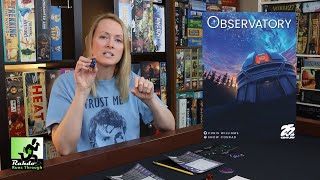



Observatory Deep Dive
What the Community Thinks About Observatory
Observatory has captivated the board gaming community with its elegant blend of spatial puzzle-solving and theme. Reviewers consistently praise its ability to engage all players simultaneously while maintaining a relaxing, thematic experience. The game's appeal spans from casual players seeking a cozy roll-and-write to puzzle enthusiasts who appreciate the challenge of managing limited grid space. What emerges across all reviews is a sense of satisfaction, both from completing constellations and from the broader experience of mapping the night sky.
Core Mechanics That Define Observatory
Dice Rolling with Flexible Coordinates
At the heart of Observatory lies the dice roll. Players roll dice (three standard blue dice for everyone, plus a yellow shooting-star die for the active player) to generate coordinates for their grid. The real elegance emerges in how players transform raw numbers into meaningful choices. By selecting two of the three dice to create an intersection point on their 2-to-6 grid, players determine where they can place a star. Critically, all ones are wild, a design choice that multiple reviewers highlight as fantastic. This single rule prevents any roll from ever feeling wasted and gives ones a special flavor that makes them valuable without being overpowered.
Pattern Completion and Constellation Mapping
The second core mechanic revolves around building constellations. Players receive cards depicting constellation patterns (large constellations worth more points and small constellations, called asterisms, on a scaling scoring system). The actual work of the game is fitting these patterns into their personal grid without any constellations overlapping or touching. This spatial constraint becomes the puzzle: players must carefully plan where to reserve space for larger patterns while still making progress toward completion. When reviewers rotate their cards to visualize patterns more clearly, they're engaging with this mechanic directly: the physical challenge of seeing how pieces fit in a confined space.
The Observatory Experience
A Cozy Night Under the Stars
Observatory's theme is not decorative fluff; it shapes how players feel during the game. The constellation cards include flavor text grounding each star pattern in mythology and astronomy, and reviewers actively seek out and enjoy reading these descriptions. One reviewer noted a spiritual connection to the act of gazing at constellations, finding that the game captures something meaningful about looking up and seeing wonder. The aesthetic of mapping stars on a personal sheet, the slow accumulation of patterns, and the quiet decision-making all combine to create what players experience as a fundamentally cozy activity, whether played solo in 30 minutes or with a group.
Simultaneous Engagement Without Downtime
A standout aspect reviewers emphasize is that Observatory keeps everyone active throughout. Even when it is not your turn to roll the dice, you have decisions to make with the shared dice results. The active player rolls all the dice, but every other player immediately begins selecting their own combination from the three blue dice. This simultaneous action means you are never sitting idle, always thinking ahead about which dice to claim and how they fit your strategy. For roll-and-write games, which can sometimes feel like long waits between turns, this is a meaningful distinction that multiple reviewers explicitly appreciate.
What Makes Observatory Stand Out
The Ones-Are-Wild Design
Reviewers consistently single out the decision to make all ones wild as a brilliant small rule that has large impact. Instead of ones being the worst possible roll (as they typically are in many games), they become the most flexible tool in your arsenal. This transforms the psychology of the roll. Players never feel trapped by bad luck because a one can be anything they need. Multiple reviewers phrase versions of the same insight: ones prevent the game from ever feeling pointless.
Asterisms and the Scaling Reward System
The asterisms, small constellations marked with an A, introduce a clever scoring escalation. Completing one asterism yields one point, two asterisms yield three points, three yield six, four yield ten, five yield fifteen, and six yield twenty-one points. This scaling mechanic means that pursuing small constellations becomes increasingly lucrative as you complete more of them, creating a strategic tension with the large constellations that offer fixed higher values. Reviewers note this balance between the two constellation sizes as sophisticated design that opens multiple viable paths to victory. Additionally, completing asterisms often grants immediate bonuses (free stars, research marks), providing a nice feedback loop of reward and momentum that keeps players engaged.
Potential Drawbacks
Abstract Spatial Challenges
The game's abstract nature can create friction for players who struggle with spatial visualization. Reviewers note that it is easy to miscount squares or misalign a star, requiring players to actively rotate their cards to verify patterns or rotate constellation cards themselves to match their intended placement direction. For some, this problem-solving is part of the appeal; for others, it introduces occasional moments of frustration. Counting errors are possible and can force mid-game corrections, which some players experience as a minor disruption to flow.
Limited Thematic Narrative
While the astronomy theme resonates strongly with players who love constellations, the game offers minimal narrative arc or storytelling beyond the flavor text on cards. Players are not progressing through a campaign or uncovering a hidden plot; they are abstractly mapping stars. For players who prefer games where theme drives a narrative forward, this lack of story spine may feel like a missed opportunity. The theme is evocative and atmospheric, but it remains largely decorative rather than integrated into win conditions or player progression.
If You Enjoy Observatory
Reviewers consistently mention Stargazers as the natural companion game. Like Observatory, Stargazers engages players with a celestial theme and a contemplative pace. The games share an appreciation for gentle mechanics and the satisfaction of building patterns, though Stargazers takes a tile-laying approach rather than a roll-and-write framework. If you love the spatial puzzle-solving of Observatory and want to explore how a similar theme can be expressed through different mechanics, Stargazers offers a natural next step.
What Reviewers Are Saying
I really like whether it's on um like when it's on other players turns that you are still active. It's not like you're just waiting for everybody to go. you're still interactive and playing during the whole time even while everybody's rolling.
— Ryan and Bethany
I love roll and write. Yeah, I just the theme is what like the box cover I think sort of I'm a sucker for box covers. It sort of brought me in. I like this this observatory telescope like oh that's cool to me.
— Tantrum House
It's an easy game to pick up and play it can be played with one to five players and it takes about 30 minutes to play.
— Let's Table It