


Blind Jack Deep Dive
What the Community Thinks About Blind Jack
Reviewers treat Blind Jack as a light, number-driven party game from Blue Orange Games that is best suited to group nights and New Year's Eve. Ryan and Bethany Board Game Reviews describe it as blackjack meets trivia, and they like that the answers are always numbers from zero to nine rather than facts that only specialists would know. Where There's A Wilz, There's a Play lists it among the New Year's Eve staples in its collection and says the group has enjoyed it enough to keep it on the shelf.
The enthusiasm is not universal. In the full Ryan and Bethany review, one host calls the game just okay and a pass, a title they would not pick up again, while the other host liked it a little more. Both agree it is an interesting mix of mechanisms, with push-your-luck tension layered over trivia, and both say it is not something they would reach for off the shelf on a regular basis. The overall tone is warm but measured: reviewers respect the design and the laughs it produces, while being candid that it is more of an occasional pick than a favorite.
Core Mechanics That Define Blind Jack
Blackjack-Style Push-Your-Luck Guessing
The central engine is a race toward 21 that reviewers compare directly to blackjack. On a turn, a player draws a card whose question faces the other players while its answer stays hidden. The group then guesses a number from zero to nine, and the guesses build a running total. Players keep drawing and adding guesses, deciding when to stop before crossing 21. In the Ryan and Bethany review, a player who busts scores nothing, while a player who stops under 21 waits until everyone is done and then the closest total without going over wins. Since you keep the running total in your head, the tension comes from weighing each new card against the risk of going over.
The running total is tracked with small cubes that sit along the edge of the box, which is a detail that Ryan and Bethany single out. The cubes record your guessed amount at each point in the game rather than a conventional score, so the score tracker doubles as a reminder of what you have already committed to.
Trivia Categories With Number Answers
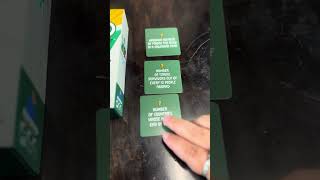
The trivia layer is built on numeric questions. Ryan and Bethany point to prompts such as the maximum number of Friday the 13ths in a calendar year, the number of countries whose names end in "stan," and how many people in the world lack internet access, all answered with a number from zero to nine. Because the game is all number based, players do not need to know capital cities or other specific facts to participate. The rulebook also includes a statistics guide on its back page that lists how many cards carry each number and the average card value, which one host noted could let a player who plays often start to game the system.
The Blind Jack Experience
Forgiving Trivia With Ballpark Tension
Reviewers repeatedly stress that you do not need to know the trivia to be competitive. Ryan and Bethany explain that a player who is off by a lot on every card will feel it in the final total, but a player who can ballpark each answer will average out well, because a low guess on one card is often balanced by a high guess on another. In their short sample round, the guesses were a few numbers off on a handful of cards, yet the player still finished close to the target with a total of 16. Wilz adds that the questions are usually random enough that most people will not know the answers, so guessing is part of the fun and the group can simply take a best estimate together.
Open-Ended Suspense Without a Set Stopping Point
The push-your-luck side is what keeps the Wilz group engaged. The channel notes that there is no defined stopping point, and one player stopping does not end the turns of everyone else. Players can keep drawing for as long as they want, which turns each turn into a personal gamble. The group has gone bust, has been very low, and has seen a rare exact landing on 21, and that unpredictability is what makes the game feel like a classic blackjack table. Wilz also describes the experience as a good late-night game, since the questions are family friendly and the group can continue long after more demanding titles have wound down.
What Makes Blind Jack Stand Out
A Score Tracker Built Into the Box
Ryan and Bethany praise the restraint of the design. Rather than adding extra components, the game uses cubes that slot into the edge of the box to track each player's guess total. They appreciate that this keeps the table clear and avoids adding pieces the game does not need, which makes it quick to set up and easy to store.
Variety of Categories That Feels Fresh
Reviewers highlight how widely the questions range. Ryan and Bethany say the trivia covers many different categories and topics that players would not expect, so a category that does not suit one player is likely to be followed by one that does. Wilz values the size of the deck, noting that the box holds multiple stacks of cards and their group had not made it through even half of one in a year. With so many questions and a long gap between plays, the group often forgets the answers, which makes each session feel like a new game.
Potential Drawbacks
Teams Feel Unnecessary
The rules describe a team-based game in which players confer with their partners to maximize their collective score. Ryan and Bethany question whether that structure is needed. They point out that the game could easily be played one versus one versus one, and they feel that discussion about a number is occasionally helpful but does not require teams. For groups that prefer individual play, the team framing can feel like an extra layer that adds little to the experience.
A Base Game That Feels Short
Ryan and Bethany say the base game ends up feeling a little too short. The rulebook's Super Blind Jack variant addresses this by playing several rounds back to back, and a player who lands exactly on 21 wins automatically, which the reviewer described as awesome and rare. That variant gave one host more trivia to enjoy, but even with it the reviewers agree that Blind Jack is not the kind of game they would choose for a game night off the shelf. It is a fair example of a game that works well as an occasional pick but may not sustain frequent play for everyone.
If You Enjoy Blind Jack
The most direct comparison in the transcripts is Blackjack. Ryan and Bethany frame Blind Jack as blackjack with the cards turned into trivia guesses, so players who enjoy the risk of approaching 21 without going over will find the same push-your-luck pull here. Reviewers who like the trivia side point to numeric-answer trivia as a natural next step, and Ryan and Bethany note that they have other numeric trivia games they would play over this one. For a party with a bluffing streak, Where There's A Wilz, There's a Play lists Bass Awards among its New Year's Eve games, a trivia and bluffing title where the goal is to pick the wrong answer, which offers a similar sense of playful guessing around a shared table.
What Reviewers Are Saying
"You don't have to know the trivia, you just want to be in the ballpark. Use what ideas you have about it and try to get close."
— Ryan and Bethany Board Game Reviews
"Check out Blind Jack if you like trivia with a little bit of push your luck."
— Ryan and Bethany Board Game Reviews
"You get to keep going for as long as you want. So there's no defined stop."
— Where There's A Wilz, There's a Play