


Bretwalda Deep Dive
What the Community Thinks About Bretwalda
Bretwalda has earned consistent praise from board gaming reviewers as a sophisticated area-control experience that delivers on both mechanical depth and thematic appeal. The overwhelming consensus frames it as a standout title that combines accessibility with substantial strategic complexity. Reviewers particularly emphasize that the game succeeds in creating memorable, engaging play even for players who don't achieve victory, a hallmark of well-designed competitive play. The enthusiasm ranges from "fantastic dudes on a map game" to recognition of its position among the best board games released in recent years, with reviewers finding it captures something special in how it balances competing factions across a historically inspired setting.
Core Mechanics That Define Bretwalda
Bidding and Auction Mechanics
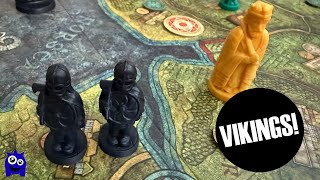
Bidding sits at the heart of Bretwalda's decision-making framework and appears repeatedly as one of the most praised systems. Players bid gold and ally markers to control where Vikings attack and how neutral units move across the board. The mechanic goes further than simple auction systems: by winning the bidding phase, a player gains the strategic advantage of placing enemy forces to disadvantage opponents while potentially protecting their own territories. This creates a dynamic layer of proxy warfare that reviewers found genuinely innovative. As one reviewer noted, the bidding system allows players to choose where enemy forces land and then manipulate neutrals and Danes to go after their opponents, creating situations where "you are fighting wars by proxy in a lot of this game which is very fun." This transforms bidding from a dry resource-allocation exercise into a political tool that shapes the entire board state.
Combat: Dice
Combat resolves through custom dice rolls where different unit types roll different colored dice (white, yellow, red) with varying strengths. This system delivers both tactical depth and narrative excitement. Reviewers highlighted the satisfaction of the combat system, particularly how the mechanics create cinematic moments where underdogs can succeed and well-prepared assaults can falter. The dice create a layer of swingy probability that makes each battle feel consequential but not entirely predetermined. Lordship cards add another dimension, allowing players to influence dice outcomes or trigger special effects during combat. This combination ensures battles generate memorable stories rather than simply resolving as mathematical calculations.
The Bretwalda Experience
Board Evolution and Visual Storytelling
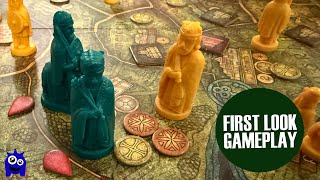
One of Bretwalda's most satisfying elements is watching the board transform over the course of play. Players construct buildings, place development tiles on their faction boards, and gradually reshape the medieval map. Reviewers consistently praised this aspect, noting that the game delivers a visceral sense of territorial expansion and civilization building. The physical evolution of the board mirrors the strategic progression, with churches (abbeys) accumulating through religious control and various structures emerging as factions invest in development. This tangible sense of growth and change keeps players engaged with the board state throughout a three-year campaign.
Tension and Dynamic Shifting Fortune
The seasonal cycle introduces harsh penalties and sudden reversals that create emotional peaks and valleys. Winter arrives with food shortages that can devastate unprepared factions, potentially wiping out entire armies through starvation. Vikings arrive in summer, pillaging territories and disrupting carefully laid plans. These events mean that advantage is never guaranteed: a leading player can find themselves suddenly vulnerable through bad harvests or strategic enemy placement of raiding forces. Yet reviewers found this volatility engaging rather than frustrating, noting that the game remains fun even when you're losing, with plenty of opportunities for comebacks and shifting fortunes throughout the campaign.
What Makes Bretwalda Stand Out
Historical Theming with Authentic Atmosphere
Bretwalda captures the Dark Ages Britain setting in ways that feel earned rather than pasted on. The game rules, from seasonal cycles to the role of Vikings, emerge from the historical context rather than existing separately from it. The artwork and components reinforce this aesthetic consistently. Reviewers emphasized the "beautiful medieval artwork" and noted that the theme "feels authentic and historically flavored," creating an immersive experience where the mechanics and setting reinforce one another. The four factions represent real Anglo-Saxon kingdoms competing for supremacy, and the inclusion of Viking raids and religious control through abbeys roots gameplay in actual historical tensions of the era.
Tremendous Depth With Accessible Learning Curve
Despite its complexity, reviewers found Bretwalda remarkably teachable and approachable. The core action system is straightforward (players take four actions per round across four seasons), yet the interactions between those actions, the development tile bonuses, lordship cards, and bidding dynamics create extraordinary depth. Reviewers praised how the game avoids overwhelming new players with its rule set while still offering experienced players tremendous opportunity for strategic expression. One reviewer noted it "captures the 4X feel very well" and "beautiful components, a tremendous amount of depth. I love the creativity behind this one," highlighting how the production quality and visual clarity help convey the systems without requiring extensive rulebook reference.
Potential Drawbacks
Rule Edge Cases and Occasional Clarity Issues
Zilla Blitz's detailed gameplay walkthrough surfaces several edge cases where the rules require careful reading. The summer plague mechanic, neutrals controlled in the autumn neutral-movement phase, and specific timing questions around when certain abilities trigger can occasionally create confusion. One reviewer specifically noted that "edge cases and rule clarifications can be tricky" and highlighted that the rules contain elements that are "really easy to miss," particularly the special faction abilities printed on player boards that appear nowhere else in the rulebook. These are minor issues that experienced players quickly internalize, but they can create momentary friction during first plays.
Winter Phase Severity and Resource Scarcity
Winter arrives with harsh penalties that can swing the game dramatically. Players must feed their armies or watch units starve, and failing to harvest enough food during warmer months creates real hardship. While reviewers found this thematically appropriate and strategically interesting, the mechanic's severity means that poor planning in fall can leave a faction devastated going into the final season. The game's complexity and the number of competing decisions mean that newer players sometimes underestimate food needs, leading to catastrophic losses. This isn't a flaw so much as a feature that demands respect, but it means the margin for error in resource planning is genuinely thin.
If You Enjoy Bretwalda
Players drawn to Bretwalda's blend of area control, economic management, and proxy manipulation will find similar satisfaction in Game of Thrones: The Board Game, which shares the bidding-for-position mechanics and political negotiation elements. Those captivated by the asymmetric faction powers and the way each kingdom feels distinct might explore Hood: Troubles in Sherwood, another Fallingx Games title that delivers on asymmetric faction abilities and area control. Both games share Bretwalda's commitment to thematic asymmetry and the sense that your faction's unique abilities and starting position create genuinely different play experiences.
What Reviewers Are Saying
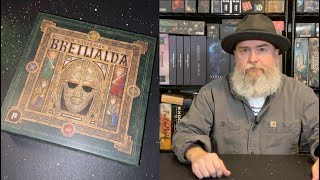
"The game is a dudes on a map game. And you know, as far as that goes, it it delivers. It gives you what you want with the with the feeling of trying to move and take over places and conducting wars and raids and stuff like that. So, it it really works on that level. But first of all, the production is just fantastic. I think it's a beautiful box. I think the artwork here is just this beautiful medieval artwork."
— The Discriminating Gamer
"I'm a big fan of Brett Walda. I think it is just a fantastic dudes on a map game. I've really really enjoyed it. And again, that's a mark of a good game even when you're losing and you're still having fun, right?"
— The Discriminating Gamer
"I'm a big fan of 4X games on and in and on on the PC where you get to expand and conquer different lands and explore. This game captures that feel very well. It's got some Eurob blend elements in it certainly. So, it's not 100% a war game, but it is about war and the four factions are going at each other. Beautiful components, a tremendous amount of depth. I love the creativity behind this one."
— Zilla Blitz