






A Wayfarer's Tale: The Journey Begins Deep Dive
What the Community Thinks About A Wayfarer's Tale: The Journey Begins
The board gaming community has embraced A Wayfarer's Tale as a roll-and-write with genuine substance. Reviewers consistently praise the game for delivering what feels like a meaty, engaging experience, far more sophisticated than the genre's typical light fare. The Hunger Gamer placed it alongside Hadrian's Wall and Twilight Inscription in terms of mechanical depth: "this is one of those roll and wrights that has some real meat some real heft to it." What sets the game apart is how it balances exploration and consequence without feeling overwhelming. The Dungeon Dive reviewer found that the game "does scratch that fantasy adventure itch just a little bit," suggesting the theme, charting unknown lands and discovering towns, genuinely lands with players. Solo players have found particular value; the solo campaign offers eight scenarios with evolving challenges rather than generic difficulty scaling.
Core Mechanics That Define A Wayfarer's Tale: The Journey Begins
Dice Drafting and Companion Activation
At its heart, A Wayfarer's Tale uses shared dice rolls to drive individual choice. The active player rolls four dice (three white, one red adventure die), and all players simultaneously select any two dice to sum into a value. This value then activates one of five companions (the Coachman, Merchant, Sailor, Guide, or Adventurer) each with distinct movement rules. The Coachman requires equal-or-greater rolls to progress along grassland and mountain routes; the Adventurer climbs and descends peaks with higher-then-lower dice sequences; the Sailor moves through water with doubles. This system means every die roll offers multiple valid paths, but your options are constrained by what the dice allow and what your companions still need to unlock. It's a puzzle where you're trying to read the board state, anticipate bottlenecks, and make the most efficient use of shared randomness.
Map Exploration and Path Constraints
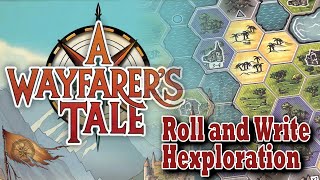
The game board is a hexagonal map divided into terrain types (mountains, grasslands, deserts, forests, water). Players must follow continuous paths from discovered towns, branching only when they reach a new settlement. This rule creates the core tension: you can't freely roam. You either extend your current exploration, dead-ending yourself without access to new regions, or backtrack to a town and start a fresh direction. As you explore, you'll land on gems (gaining victory points equal to your die roll), monsters (losing points), treasures, and taverns (which unlock new paths and draw special cards). Reviewers appreciated how "you kind of have this you're moving around the board and like oh I'm stuck here well I'll just go back to the town and go a different direction from there," turning constraint into navigation puzzle.
The A Wayfarer's Tale: The Journey Begins Experience
Adventure and Exploration Feel
The game successfully captures the flavor of charting unknown territory. The vibrant, saturated map art, praised as genuinely beautiful, evokes the sense of discovering new lands. Reviewers noted the "great art, vibrant colors and it just really pops on the table." The theme isn't window dressing: traveling to towns, collecting treasure, and facing monsters all feed into how you score, making your exploration meaningful. The solo campaign reinforces this by unfolding across eight scenarios on progressively more complex maps, each with unique conditions to overcome. There's a cozy, satisfying quality to planning an efficient route, executing that plan across multiple turns, and watching your map fill with discovered regions.
Accessible Depth with Real Decisions
A Wayfarer's Tale lives in the space between "easy to teach" and "meaty to play." New players can grasp the core loop in one round (roll dice, pick two, activate a companion, move) but the game rewards planning. You must decide when to pursue a high-value treasure (requiring a big die roll), when to play defensively to avoid monsters, and when to pivot if the dice don't cooperate. The Hunger Gamer captured this: "the game gives you just enough rope to hang yourself with," noting that players can absolutely sabotage their own game through poor positioning or over-commitment. That blend of simplicity and consequence keeps the game engaging across repeated plays.
What Makes A Wayfarer's Tale: The Journey Begins Stand Out
Production and Component Organization
A Wayfarer's Tale's insert design is exceptional. The game ships with a custom tray featuring a ribbon pull, organized compartments for cards, cubes, and other bits, and space that keeps everything accessible without needing plastic bags. One reviewer, who built a reputation reviewing game components, specifically called it a "runner-up" for best organizational insert in modern games, praising how "the box is packed to the rafters, but in a good way," and noting it "makes me want to pull out this game more because I know how easy it's going to be to get into this game." This kind of thoughtful physical design, making the game quick to set up and teach, directly increases how often it hits the table.
Multiple Map Variety and Replayability
The game comes with four maps of increasing complexity, each with different terrain distributions and scoring conditions. This directly addresses the "roll and write fatigue" many players feel: you're not playing the same layout every time. Additionally, the tavern expansion and modular rules (Fortune Teller tokens, Storm cards) add layers without bloat. Solo players have the campaign mode, where scenarios unlock new rules and challenges progressively, ensuring the game evolves over multiple plays rather than becoming static.
Potential Drawbacks
Dice Luck and Dead Ends
A Wayfarer's Tale is a dice game, and dice can betray you. Multiple reviewers noted that you can find yourself unable to activate the companions you need, especially in solo mode. As one reviewer explained: "there are definitely times when I was completely unable to get one of my companions dice requirements even using the third dice even using reroll tokens," leading to forced suboptimal moves or outright game loss. Unlike some heavier roll-and-writes that shield you from catastrophe, A Wayfarer's Tale lets you fail, which some players love and others find frustrating. The game can end with you stuck: unable to progress, unable to pivot, unable to score enough points to win solo scenarios.
Map Readability and the Pen Requirement
The maps are visually beautiful, saturated colors and lovely illustration, but that beauty can work against legibility when you're writing on them. One reviewer noted the challenge: "as beautiful as these maps are it's hard to see what you're drawing in fact I had to move to using a Sharpie on it because when I was using pencil I couldn't see what I was doing." This is unusual for roll-and-writes, most of which encourage pencil for easy erasing. A Wayfarer's Tale strongly prefers permanent marker, which commits you to your decisions and makes mistakes costly. That can add tension intentionally or feel punishing, depending on your play style.
If You Enjoy A Wayfarer's Tale: The Journey Begins
If A Wayfarer's Tale resonates with you, consider these comparison titles from its own critical peer group:
- Hadrian's Wall: Reviewers cited this directly as a peer in terms of mechanical heft and combo depth. Both are roll-and-writes with real decisions and no guaranteed win.
- Twilight Inscription: Another deep roll-and-write that abstracts a larger game into sheets and dice. If you enjoyed the scope and strategy of A Wayfarer's Tale, Twilight Inscription offers similar intellectual weight.
- That's So Clever: For players drawn to the puzzle aspect of combining dice into meaningful routes, That's So Clever delivers pure dice-combo satisfaction without the exploration theme.
- Terraforming Mars: The solo campaign structure and the idea of building toward specific endgame goals echo Terraforming Mars. Both reward long-term planning within a single play session.
- Tambo: Survival on the Savannah: Like A Wayfarer's Tale, Tambo uses hexagonal terrain, area majority, and exploration, though with different mechanics. Both offer colorful, thematic map-based play.
What Reviewers Are Saying
It's beautiful. This rich purple, that teal. I mean, the artwork here, just amazing. And the feel of these cards, the feel of these cards is amazing.
— Tabletop Tolson
I adore the art. The artist Tristan is probably one of my favorite board game illustrators, and this just it just looks really good, from the character art to the maps. I mean the maps are really, really pretty. It's a beautiful game.
— The Hunger Gamer
They have some images of what the player sheets look like and I find them compelling. You've got a hexagonal map that it looks like you're going to be exploring on. The art in general is just a style that I really like.
— Getting Games