


Crunch the Numbers Deep Dive
What the Community Thinks About Crunch the Numbers
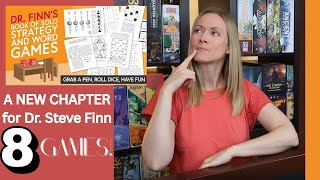
Crunch the Numbers is one of eight solo puzzles in Dr. Finn's Book of Solo Strategy and Word Games, a slim print-and-play collection from Dr. Finn's Games. Reviewers tend to talk about the whole book first and then single this game out as the dice-and-numbers entry in an otherwise word-heavy and strategy-heavy lineup. Its reception is warm but measured: it is clearly a clever, well-made puzzle, though few reviewers name it as a favorite.
Kimberly, Tabletop Tolson read the game directly from the book and treated it as a fast, replayable pick-up game. Kimberly was enthusiastic about the book as a whole, calling Dr. Finn's move to print-and-play an affordable way to get their designs into players' hands. Rahdo Runs Through gave the game the most analytical attention, comparing it to Sudoku and praising its sharpness while being candid that it was not a personal favorite. Danielle, DaniCha came at the book from the angle of portability, the kind of thing to bring on a trip or into a waiting room. Danielle's overview of Crunch the Numbers was brief and focused on the layout of the book rather than on a full playthrough.
Taken together, the community sees Crunch the Numbers as a satisfying number puzzle that rewards careful thinking, with a shared emphasis on how little it takes to play.
Core Mechanics That Define Crunch the Numbers
Dice-Driven Number Grids
At its core, Crunch the Numbers is a dice puzzle played on paper. Kimberly described the goal as filling three grids of numbers so that the rows and columns meet as many objectives as possible, and listed the mechanics as a number puzzle, an abstract design, and dice manipulation. Rahdo Runs Through put it more vividly, describing the game as a dynamically generated Sudoku puzzle that is driven by dice. Each roll gives you numbers to place, so the grid you build is shaped by luck as much as by planning. The book as a whole tops out at four dice per game, which keeps the setup to a pencil and a handful of dice. Because the book is published by Dr. Finn's Games and written by Dr. Finn, the same minimal kit covers every title in the collection.
Arithmetic Crunching Against Objectives
The "crunch" in the title is the work of checking your grids against the objectives. Reviewers describe the challenge as sharp and clever rather than brutal, because each placement has to serve several rows and columns at once. Rahdo Runs Through called it really clever to crunch those numbers, and Danielle described the game as math-based, which is a fair summary of the arithmetic-and-logic feel. Where a Sudoku player hunts for the one correct digit, this game asks you to balance objectives that all pull in different directions, and the dice decide what you have to work with on any given turn.
The Crunch the Numbers Experience
Quick Portable Puzzle Satisfaction
The feeling reviewers return to most often is how easy this game is to fit into a day. Danielle pitched the whole book as something to bring on vacations, quick work trips, or into a waiting room, since you need only a writing utensil and four dice. Kimberly echoed that sentiment, calling the games fun and fast and noting that each one takes roughly 15 to 20 minutes. Because the sheets can be photocopied, sleeved, or torn out, players can replay Crunch the Numbers again and again. Rahdo Runs Through described playing the sheets with a pen inside plastic sleeves, which makes the game feel like a reusable puzzle pad rather than a one-off page.
Yahtzee-Style Familiarity With a Sudoku Twist
For dice lovers, the game feels immediately familiar. Rahdo Runs Through framed the audience as people who love dice and love Sudoku, or who have a friend that would happily play Yahtzee with them. That mix is the emotional hook: the rolling and the rush of a good turn feel like a dice game, but the grid-filling satisfaction of a logic puzzle gives the experience a different texture. Rahdo also pointed out that the only strictly solo game in the book is Cosmic Run Mission One, so Crunch the Numbers can be shared. That makes it a natural choice for someone who wants to crunch numbers alongside a partner who would rather not tackle a puzzle solo.
What Makes Crunch the Numbers Stand Out
A Sudoku and Dice Hybrid
The clearest praise in the community goes to the design itself. Rahdo Runs Through called the game basically a dynamically generated Sudoku puzzle that is dice driven, and tied that idea to Yahtzee and to the newspaper puzzle habit many people already enjoy. Few reviewers see the book's games as a sequel to anything, but this one earns its comparison because it borrows the satisfaction of filling a grid without requiring the same pencil-and-eraser patience. Kimberly similarly described the game as clever and enjoyable, and noted that players can keep coming back to it.
Print-and-Play Accessibility
Another strength reviewers highlight is how the game is delivered. Kimberly noted that buyers can download the PDFs immediately, so there is nothing to wait for, and that the book makes it easy to photocopy pages or tear them out for smaller play sessions. Danielle pointed out that the book includes a QR code and website for dice, so you do not need a dice bag at all if you are traveling light. Both reviewers framed this as an affordable way to get Dr. Finn's designs to a wide audience, and Kimberly called the shift from boxed games to print-and-play a really great move.
Potential Drawbacks
Not Everyone's Favorite Puzzle
Crunch the Numbers does not win over every reviewer. Rahdo Runs Through was open about the fact that it was far from their favorite game in the book, even though it worked really well and was sharp and clever. The reviewer is clearly a fan of the designer and the format, so this reads as a matter of personal taste rather than a flaw. Players who lean toward spatial games like Pen Pals or city-building games like My Perfect City may find the grid-filling less exciting by comparison.
Book Format Trade-Offs
Rahdo Runs Through and Danielle both raised concerns about the physical book, though neither complaint is specific to Crunch the Numbers. Rahdo Runs Through said the only real problem is the form factor, wishing the games had come in a box with traditional packaging so they could sit on a shelf with other roll-and-write boxes, while acknowledging that the lower price is why the format exists. Danielle noticed that the game sheets are printed on only one side, leaving many left-hand pages blank, and suggested thicker paper with double-sided printing would have made the book shorter. Players who prize tactile components should know that this is a book of sheets, not a boxed game.
If You Enjoy Crunch the Numbers
If Crunch the Numbers appeals to you, Yahtzee is the obvious next step. Rahdo Runs Through explicitly connected the game to Yahtzee, and the two share the same core loop of rolling dice and making the most of what you get. Yahtzee rewards you for scoring categories from a roll, while Crunch the Numbers asks you to lay those rolls into grids that have to satisfy several objectives at once. Players who enjoy Yahtzee's push and pull over which dice to keep will likely find the same kind of tension here, just with a more puzzle-like, Sudoku-inspired structure. Reviewers also framed the book as a roll-and-write collection, so fans of that genre will feel at home with the pencil-and-dice workflow.
What Reviewers Are Saying
"This one is basically a dynamically generated Sudoku puzzle for lack of a better term that is dice driven. And so, this is the perfect game. It was far from my favorite, but it worked really well and it was really sharp and really clever to crunch those numbers."
— Rahdo Runs Through
"These are fun. These are fast. And you can play them multiple times."
— Kimberly, Tabletop Tolson
"You just need a writing utensil and four dice. So very, very portable."
— Danielle, DaniCha