




Coast Watchers: Allied Field Intelligence in the South Pacific, 1942-1943 Deep Dive
What the Community Thinks About Coast Watchers: Allied Field Intelligence in the South Pacific, 1942-1943
Reviewers across the wargaming community greeted Coast Watchers with enthusiasm bordering on reverence. The consensus centers on one thing: Vulco Runi has tackled a long-standing weakness in wargaming head-on. Hidden information and hidden movement have historically been underexplored territories in board wargaming, and reviewers recognize that this design fills a genuine gap. One reviewer called it "a fresh new look at hidden information and hidden movement in wargaming," while another emphasized the game's ability to capture "an element of World War II that sounds fascinating" in a way that hasn't been done before. The asymmetric tension running through Coast Watchers, where one player controls the Allies seeking intelligence while the other commands Japanese forces trying to remain hidden, resonates across channels as something wholly different from traditional wargaming experiences.
Beyond mechanics, the physical presentation earned consistent praise. Reviewers highlighted beautiful artwork grounded in actual historical photography, thoughtfully designed components including wooden blocks and carefully laid-out cards, and an impressive scenario suite: 15 situations plus 4 full campaigns give players substantial campaign content alongside quicker scenario plays. For solo enthusiasts, the fact that Runi designed robust solitaire systems for both sides simultaneously addresses a growing expectation in modern wargaming.
Core Mechanics That Define Coast Watchers: Allied Field Intelligence in the South Pacific, 1942-1943
Hidden Movement Through Deductive Reasoning
At the heart of Coast Watchers lies a deceptively simple but profound mechanic: one player moves in secret while the opponent deduces position through accumulated clues and careful logical reasoning. Instead of physical screens or hidden logs, reviewers noted that the system relies on wooden blocks and card play to manage the asymmetric information. The twist that reviewers found captivating is that neither side enjoys perfect knowledge. As a reviewer explained, the layers of uncertainty run deep: "You don't know if the Japanese know where you are. You're trying to stay hidden and trying to find out where... there's so many layers, right, of unknowns here." This isn't just about hiding your units; it's about operating in genuine fog of war, where commanders struggle to know the state of their own forces as much as they chase information about the enemy.
Card-Driven Intelligence Operations
The game synthesizes card play with the hidden-movement core to model the gathering and dissemination of intelligence. Cards represent allied activities, Japanese assets, and operational decisions, each encoding historical flavor alongside mechanical function. Reviewers emphasized how the cards layer onto the deduction system, creating a hand-management puzzle layered atop the asymmetric cat-and-mouse chase. The card deck acts as a randomizer for both players' capabilities while keeping theme front and center. One reviewer praised the "hand management and some card play that is just super clever," noting that the mechanical elegance serves the historical simulation simultaneously.
The Coast Watchers: Allied Field Intelligence in the South Pacific, 1942-1943 Experience
Tense Asymmetric Cat-and-Mouse Pursuit
Playing Coast Watchers means inhabiting a fundamentally unequal relationship. The Allies hide and report; the Japanese hunt and deceive. Reviewers repeatedly called out the "tension" created by this asymmetry, with one reviewer describing "an asymmetric cat-and-mouse" dynamic where neither side holds a dominant advantage. The experience hinges on inference: what does the opponent know about your position? What can they deduce from your actions? What information has been accidentally revealed? This constant second-guessing and bluffing transforms the game into a psychological duel as much as a tactical one.
Immersive Historical Solitaire Engagement
For solo players, the solitaire modes for both sides unlock a different kind of experience: commanding forces while grappling with genuine uncertainty about your own army's state. Reviewers noted that the solitaire design reflects real historical command challenges, where generals issued orders to units whose positions they could not confirm and received outdated intelligence. Rather than treating the solo opponent as an afterthought, Runi invested substantial design effort into ensuring that both the Allies and Japanese sides work equally well solo. One reviewer expressed this excitement: the game delivers "robust and functional and awesome soliter mode and also great two-player gameplay," capturing both the competitive and introspective sides of wargaming.
What Makes Coast Watchers: Allied Field Intelligence in the South Pacific, 1942-1943 Stand Out
Addresses a Historical Weakness in Wargaming
Reviewers were candid: wargaming has historically skipped over hidden information as a design challenge. Most wargames give players nearly omniscient knowledge of the battlefield, reducing the cognitive load of commanders who, in reality, operated in profound darkness. One reviewer stated plainly: "So much hidden information, which is an aspect I feel of board wargaming that is not usually covered or covered very well, if it is covered at all." Coast Watchers doesn't just acknowledge this gap; it builds an entire design around closing it. The game treats the gathering and dissemination of intelligence as the central strategic question, a shift that captures a neglected dimension of Pacific warfare.
The First Game in an Ambitious Series
Reviewers recognized Coast Watchers as the opening chapter in what Vulco Runi calls the Recon Series. The first entry focuses on the South Pacific and coastwatcher intelligence operations; future games will tackle the Battle of Verdun (Draken) and Vietnam (Masher). This series positioning matters because it signals Runi's commitment to exploring hidden information across different historical domains. For reviewers, it promised not just one excellent game but the beginning of a systematic investigation into how wargaming can model the fog of war more authentically. One reviewer expressed this anticipation: "extremely excited" because the design tackles "innovative potential, capturing an element of World War II that sounds fascinating and for the robust dual nature of its solitaire mode" simultaneously.
Potential Drawbacks
Dense Rulebooks and Component Complexity
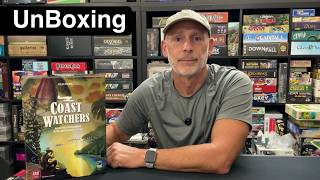
A reviewer opening the box encountered a thick rulebook accompanied by a separate playbook and solitaire instructions booklet. This material bulk reflects the system's depth; rules are detailed and examples are extensive. While reviewers acknowledged that GMT Games generally produces clear rulebooks, the sheer volume signals that learners should expect a substantial investment before the game flows smoothly. Players new to hidden-movement wargames may need multiple readings and a practice scenario to internalize how information flows.
Component Uncertainty in Early Copies
One reviewer noted curiosity about how certain tokens and wood pieces would be finished in the final production run, touching on typical manufacturing questions for GMT Games releases. While the reviewer expressed confidence in GMT's quality standards, the acknowledgment suggests that buyers of early copies should inspect components with the understanding that finish details might vary across print runs.
If You Enjoy Coast Watchers: Allied Field Intelligence in the South Pacific, 1942-1943
If Coast Watchers resonates with you, you're drawn to wargaming that privileges hidden information and solitaire design. GMT Games has built a reputation for systems that reward careful reading and cerebral play; their entire catalog of designs by luminaries like Mark Herman and Volko Ruhnke reflects this philosophy. You likely appreciate wargaming that explores asymmetric conflict and emergent narrative rather than pure mechanical optimization. Consider exploring the broader Recon Series as it expands, since Runi has signaled an intent to apply this hidden-information system to other historical theaters. More broadly, if you value solitaire wargaming with robust solo systems and enjoy games where deduction and information management matter as much as tactical positioning, the wargaming designs of GMT Games and small publishers committed to solo play will be your natural home.
What Reviewers Are Saying
Whereas the coastwatches, you're trying to find out where the Japanese are. You don't know if the Japanese know where you are. You're trying to stay hidden as a Japanese. You're trying to stay hidden and trying to find out where. I mean, there's so many layers, right, of unknowns here.
— Zilla Blitz
Coast Watchers takes you into the World War II intelligence action across South Pacific. And looking at this, this game looks cool. It looks unique and interesting. I can't wait to give this a try.
— The Discriminating Gamer
It's a hidden block hidden movement game, but there's no actual moving on the board. It is strictly a bunch of blocks that are hidden, and it's deductive reasoning as well as hand management and some card play that is just super clever. There is nothing out there like it.
— Heavy Cardboard