



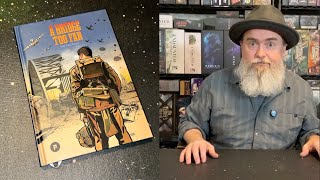

A Bridge Too Far Deep Dive
What the Community Thinks About A Bridge Too Far
A Bridge Too Far is a book-based solitaire game from PHALANX that puts you in the boots of a Polish paratrooper during Operation Market Garden in September 1944. The most detailed opinion comes from a single reviewer, Cody Carlson of The Discriminating Gamer, who reviewed the game in one video and then returned to it in a later list. This is one reviewer's in-depth perspective, not a broad consensus, but it is a strongly positive one. The reviewer gave the game a nine on their personal scale and placed it 16th on their top 30 games of 2025 list in a separate video, where it was the only book game on the list.
The game also came up briefly in a monthly update from Zilla Blitz, who received a review copy and described it as a fun, mini adventure that brought back memories of childhood choose your own adventure books. That segment was an arrival preview rather than a considered verdict, so the praise and criticism below rest mainly on The Discriminating Gamer.
Core Mechanics That Define A Bridge Too Far
Narrative Choice
The book is organized as numbered sections, and the reader moves through the story by choosing what the paratrooper does next. Cody Carlson described the common decision points directly: you can choose to take part in a fight, flee, or hide, and each choice sends you to a different section. Designer José Luis Barca built the branching around the real Polish Parachute Brigade. The reviewer noted that outside of the player character and a few civilians, nearly every character in the book is a real historical figure, and that the British characters are also based on actual people. Because the choices lead to different outcomes, the reviewer described the game as one that lets you live through the history rather than just read about it.
Dice-Based Attribute Tests
The book is more than a choose your own adventure, and reviewers pointed to the dice as the feature that separates it from a plain gamebook. Your character has three attributes, body, mind, and will, which you assign points to at the start. At key moments the book tests one of these attributes: you roll a number of dice equal to the points you have in that attribute, and at least one die must meet the difficulty stated in the test. A success sends you to one section and a failure sends you to another. The reviewer also noted that you bring your own dice to the table, and that items, diary notes, and gains and losses are tracked on a character sheet, which the reviewer described as affecting the final score.
The A Bridge Too Far Experience
Living Through the History
Reviewers consistently describe the game as an immersive historical story. The Discriminating Gamer said that the game "really reminds" them of Choose Your Own Adventure books from childhood, and that the book placed them inside a famous operation. The reviewer said they loved learning the history and that the book gives a sense of being present for the events, with the story moving from the first paragraph of the parachute drop onward. The feeling is less that you are playing a wargame on a map and more that you are a soldier making decisions in the moment.
Tension and Moral Weight
The reviewer also described the experience as one of pressure and difficult decisions. Operation Market Garden gives the story a constant sense of danger, and the book asks you to make choices about fights and about how to treat others. Cody Carlson summarized this by saying the book has the player "getting in fights and making moral decisions left and right." The dice tests add a layer of uncertainty to those choices, because a well-planned decision can still fail on a bad roll.
What Makes A Bridge Too Far Stand Out
Multiple Paths and Replay Value
The most frequently praised quality in the reviews is the range of routes through the book. Cody Carlson said the game has a lot of different paths and that this gives it decent replay value, which matters for a solitaire gamebook that is largely played once per route. The reviewer also said that the choices always seem valid, so that no option feels like a trap, which helps each path feel like a genuine story rather than a single correct route.
Shared Play and Approachability
Cody Carlson also played the book with a family member, reading the sections aloud while the other person made every decision. That experience shaped how the reviewer judged the book, and they described it as a great time with a lot of fun. Compared with War Story from Osprey Games, the reviewer felt A Bridge Too Far was a little simpler and more approachable, which makes it easier to bring to a new player or to a shared reading session.
Potential Drawbacks
Neither reviewer raised a sustained criticism of the game, and the points below are the mildest concerns that appear in the transcripts rather than complaints that were prominent in either video.
Setup and Bookkeeping
The game asks for more than the book itself. Cody Carlson pointed out that you need to bring your own dice, and that the character sheet, item list, and diary notes all have to be kept up as you go. The reviewer used a printed copy of the character pages to keep notes on a separate sheet of paper. For players who want to pick the book up and go, this bookkeeping is a real cost even if it is part of the experience.
Lighter Than Heavier War Games
The reviewer described the game as simpler than War Story, and as a book that is more approachable than a traditional war game. For players who want a deep, detailed simulation of combat, this lighter approach may feel like a limitation. The reviewer's view was that the simpler system is an advantage for story-focused players, but the trade-off is that the dice and attribute system provides less tactical depth than a full wargame.
If You Enjoy A Bridge Too Far
The closest comparison reviewers made is War Story from Osprey Games. Cody Carlson said that the two share a storydriven design, but found A Bridge Too Far to be a little simpler and more approachable. Both games are narrative experiences built around choices and historical settings, so players who enjoy the story-first approach of War Story should find a similar appeal in A Bridge Too Far. The reviewer also drew a link to the Choose Your Own Adventure books of childhood, which is the most direct genre comparison in the source material.
What Reviewers Are Saying
"I had a ball. There's so many different paths you can go down. So you got some decent replay value here as well."
— Cody Carlson, The Discriminating Gamer
"But it's not just a choose your own adventure because you need dice. Because as you're going through, you're going to have challenges and you're going to have combat."
— Cody Carlson, The Discriminating Gamer
"I would read it to her and she'd make all the decisions. And it was so much fun. We had a great time with it."
— Cody Carlson, The Discriminating Gamer