



Rolling in Wonderland Deep Dive
What the Community Thinks About Rolling in Wonderland
Rolling in Wonderland is a dice drafting game from Borogove Games set in the world of Alice in Wonderland. Reviewers who have spent time with it describe a light, quick game that packs a surprising number of decisions into each turn. Reviewers tend to come away enthusiastic, while noting real trade-offs in how chaotic and broad the experience feels.
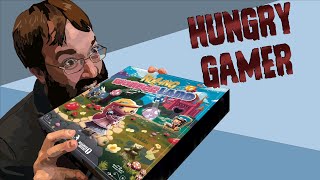
The Hungry Gamer channel offers the most detailed account. Its first impressions video was recorded during a teaching session with the publisher on Tabletop Simulator. The host found the rules intuitive for experienced players, noted that turns move quickly, and said the game was taught and played in roughly an hour. The host called the session delightful and said it turned a difficult day around. A later monthly picks video from the same channel reports that a deluxe edition was sent after the preview, and that the game was waiting on the table for a future session.
Grant Lyon, Grant's Gamerecks, included the game in their retail roundup and noted that it is a reimplementation of an earlier title that never received a full retail release in North America. Grant Lyon praised the artwork and focused on the drafting choices, which they described as a constant tension between wanting a particular die and committing to a whole group of dice from one space. Across these discussions, the consensus is that Rolling in Wonderland is a clever, charming design that rewards attention. The open questions center on whether its randomness and breadth will hold up over many plays. Hungry Gamer explicitly framed the early opinions as based on a single play, and said a full review would require several more sessions.
Core Mechanics That Define Rolling in Wonderland
Dice Drafting Around the Board
Dice drafting is the central system. Each round, players roll their dice and place them onto spaces around the board based on the faces and colors showing. Players then take turns drafting from those spaces until every player has drafted six dice. The space where a die is taken determines what it does. The Mad Hatter draws cards based on how many dice are drafted. The White Rabbit advances along its rabbit hole track based on the number and colors taken. The Cheshire Cat activates one of four abilities depending on the exact colors and number of dice available. Alice offers contracts that score for matching dice colors, and the Queen of Hearts governs troop placement for area control. The Caterpillar advances a track that grants points and additional actions.
Hungry Gamer described the system as dice drafting that also functions almost like worker placement, since each space offers a different payoff. Grant Lyon highlighted how taking every die from one space forces a decision about how many dice a player can afford to commit in a given round. Hungry Gamer also noted that every game plays out differently because the dice shake out differently and other players draft in their own ways. Borogove Games built the board around that variability.
Jabberwock Area Control
The second core system is area control anchored by the Jabberwock. Each round, the Jabberwock attacks a region of the board, and players with troops there earn points for first and second place. The attacks continue until every region has been hit, which takes six rounds. Hungry Gamer observed that because the Jabberwock attacks every turn, players keep scoring opportunities and maintain some influence on the board throughout the game. The host regarded this as a clever piece of design, because a player who was not closely tracking area control is not left with nothing when the final scoring arrives.
The Rolling in Wonderland Experience
Whimsical Chaos on the Table
Reviewers describe a feeling of dice-driven unpredictability that suits the source material. Hungry Gamer observed that players are left at the mercy of the dice, and said this fits the Wonderland theme. The host said they enjoy dealing with chaos, since a bad roll becomes a question of how to respond. Grant Lyon framed the dice choices as the heart of the game, and the host of the first impressions video described rolling and placing dice as a large part of the appeal. The same chaos can frustrate players who prefer predictable outcomes, a point the Hungry Gamer host raised directly.
Quick Decisions With Room to Think
The second feeling is brisk turns paired with meaningful choices. Hungry Gamer described the game as quick and easy to play, yet full of interesting options. The first impressions covered decisions such as whether to pursue secret objectives, whether to chase Mad Hatter cards, and how to spread troops across the Queen of Hearts region without making a hidden objective obvious. The host noted that taking four dice could be a clear value for a particular character, but that the most obvious option was not always the best one. That tension between a clear target and a better long-term play is what keeps the turns engaging.
What Makes Rolling in Wonderland Stand Out
A Visually Striking Table
Hungry Gamer praised the color on the board as stunning and singled out the White Rabbit, the Caterpillar, the Cheshire Cat, and the Mad Hatter as favorite characters. Grant Lyon also said they love the artwork. The host explained that the deluxe edition replaces a rigid board with a neoprene play mat and custom card-based soldier pieces, and that the prototype components suggested a polished final product.
Accessible Rules With Layered Strategy
Both channels stress how approachable the game is. The Hungry Gamer host found the rules easy to pick up and easy to teach, and noted that turns do not drag even when the table is still learning. Grant Lyon summarized the game as one for players who enjoy rolling a bunch of dice or dice drafting, which points to the core loop as the main draw. The result is a design that can be explained quickly while still offering choices about where to place, draft, and commit dice.
Potential Drawbacks
Chibi Art Divides Players
Hungry Gamer noted that the chibi art style appears on Alice and on the playable characters who are pulled into Wonderland, and that some players strongly dislike it. The host said they prefer the art of the other characters and wished the playable ones were drawn in that more detailed style. The host framed the matter as a matter of taste, noting that players either like the style or do not. For players who dislike the look, this is a concrete reason to hesitate.
Breadth Over Focus and Limited Dice Mitigation
Hungry Gamer described the game as a broad swath of Euro mechanics, which the host enjoyed but which may not suit players looking for a tightly focused experience. The same review pointed to limited ways to soften the dice. Mushrooms can change the face of a die or move it elsewhere, and some rerolls are available, but the host said there is not much mitigation overall. Players who need to control variance will find less of it here. The host also wished the asymmetric character powers were stronger, since they are currently minor.
If You Enjoy Rolling in Wonderland
Players drawn to the dice-rolling core may enjoy Mountain Goats Legacy, which Hungry Gamer described as a riff on Can't Stop built around chucking dice, adding them up, and advancing goats up a mountain. Grant Lyon's roundup suggests Seventh Seal for players who like rolling dice and then assigning them to attack or block, though that title is a solo boss battler rather than a multiplayer drafting game. For players who enjoy dice used in a competitive, skill-based setting, Grant Lyon also highlighted Mystic Curling Club, where dice are slid and tossed toward central rings with spells adding a layer of control.
What Reviewers Are Saying
"Because they have the Jabberwocky attacking each turn, there are those points every single turn that you are trying to grab and hold on to. And by doing that, that means that you're still putting some of your influence out on the board, which means that you're not getting smashed at the end if you weren't really paying attention to the area control. And I think that's a very, very clever little bit of design."
— Hungry Gamer
"It's about drafting dice, and you have to draft all of the dice from a spot. So, you're like, man, I really wanted a dice from that spot."
— Grant Lyon, Grant's Gamerecks
"So this is a game that you are trapped by the chaos of the dice, which again fits for Wonderland. And I am someone that loves dealing with the chaos."
— Hungry Gamer