



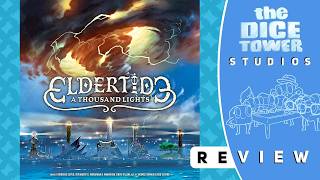

Eldertide: A Thousand Lights Deep Dive
What the Community Thinks About Eldertide: A Thousand Lights
Eldertide: A Thousand Lights, published by Esper Game Studio, is a civilization game in which rival seafaring houses sail a storm-threatened archipelago and rebuild a network of ancient lighthouses. Reviewers agree that it is an original design with striking production, but they land in different places on whether it works for them. The Dice Tower's panel offered a mixed verdict. Its reviewers praised the core ideas and the sense of freedom on the board, yet they were blunt about a rulebook that makes the first session harder than it needs to be, and they raised concerns about components and scoring. Their overall recommendation still leaned toward playing it, with the caveat that the second game is where the design begins to make sense.
Board Stupid was considerably more enthusiastic. Its hosts described the game as a beautiful worldbuilding product and stressed that it plays lighter than its theme and systems might suggest. Pair of Dice Paradise introduced the game as the first entry in a planned trilogy, describing leaders of five once mighty seafaring families trying to reclaim their homeland from a devastating supernatural storm. The consensus across these discussions is that Eldertide is a distinctive, rewarding game for players who can get past an awkward start.
Core Mechanics That Define Eldertide: A Thousand Lights
Chi Spending as Movement, Action, and Initiative
The engine that reviewers return to most often is the chi track. Each round, players secretly commit a chi amount, and that single number does several jobs at once. It determines how far a player's ship can travel, since moving through other ships or into damaged ports costs extra chi. It also sets the strength of the action taken on the destination space, so spending one chi produces a modest reward while committing three or five unlocks stronger effects. The Dice Tower's reviewers noted that the same number decides turn order, so a player may overspend simply to act first. Esper Game Studio built the game so that every movement is also a resource decision, and reviewers consistently treated that as the design's most original feature.
Pick-Up-and-Deliver Trading Across Storm-Damaged Ports
Board Stupid described Eldertide as a pick-up-and-deliver game in which players buy goods in one place, carry them to another, and sell them for points. Trade is only part of the loop. The storm moves across the board, switches places with ports, and damages them, and a damaged port must be repaired with tool tokens before it can be used again. Beacons built in two halves protect an area from future storms and grant a choice of bonus tiles. Reviewers described a board that keeps shifting, so routes that worked early in a game may be unusable a few rounds later.
The Eldertide: A Thousand Lights Experience
Ambitious Compression Into Ten Rounds
Reviewers repeatedly described a feeling of accomplishing far more than the game's length seems to allow. The Dice Tower's panel observed that a session of roughly ten rounds still lets players pull off a surprising amount, particularly through bonus actions, lighthouse benefits, and the option to take a level one action at any adjacent space. Returning to the capital is central to this feeling. Players can refill their chi, convert resources into buildings, and gain tools in a single turn, which one reviewer described as a reset turn that still does a lot. Those moments of accumulated power are what make the short game feel satisfying rather than rushed.
A Shifting, Living Archipelago
The second prominent experience is a world that refuses to stay still. Board Stupid highlighted the way the storm disrupts routes and can strand a ship that has run out of fuel, which the hosts found genuinely fun. The Dice Tower's reviewers appreciated that buildings and islands move around over the course of the game, creating a constant need to re-plan. Reviewers consistently framed this instability as the reason the game feels alive, even when it frustrates a player's carefully laid plan.
What Makes Eldertide: A Thousand Lights Stand Out
Storm Damage That Pulls Players Toward Trouble
The storm is the design element reviewers discussed most, and their view of it shifted from first impression to appreciation. The Dice Tower's panel initially described the storm as potentially arbitrary, since a die roll determines its direction. They then concluded that its purpose is not punishment. Damaged islands flip to a damage side, but the repair reward for fixing them is substantial, and the more often an island is hit, the more desperate its people become, so they offer more help. One reviewer called this one of the favorite things about the game, because the damage gives players a concrete reason to go somewhere and fix it.
Production and Artwork
The physical presentation drew praise from both The Dice Tower and Board Stupid. The Dice Tower's reviewers called the components very pretty and singled out the screen-printed acrylic, while Board Stupid described the production as absolutely beautiful and highlighted the anime and manga styling of the characters and ships. Even The Dice Tower's reviewers, who criticized the ship sizes, agreed that the artwork and materials are a strength of the package.
Potential Drawbacks
A Rulebook That Makes the First Game Harder
The most consistent criticism is the rulebook. The Dice Tower's reviewers said the rules were the weakest part of the game, noting that questions about asymmetric powers were not answered clearly and that the answer was sometimes absent or buried in an unexpected section. They also observed that a first play is often a player's worst play, which can discourage a second game. One reviewer pointed out that the designers could have made the first impression easier, especially for the person teaching the game. Reviewers also mentioned that a balance change had been published only in the online living rulebook, so players who rely on the printed rules may use an outdated version.
Oversized Ships and Scoring Disconnected From Play
The Dice Tower's panel found the player ships too large for the board, which causes them to block the view of spaces and forces players to move them constantly to see what lies beneath. The reviewers felt that a smaller ship would have worked just as well. They also questioned the scoring, which they found disconnected from the actions that create the most satisfying feedback. One reviewer said they would rather build up their island than sell goods for points, but the time limit pushes players toward early market sales. Asymmetric powers were another concern, since one reviewer felt some factions were so specialized that players had to follow a predetermined path to get value from them.
If You Enjoy Eldertide: A Thousand Lights
Players drawn to the blend of a limited action budget, shifting boards, and a strong sense of geography may enjoy Pacted, which Board Stupid described as a three to four player game in which each faction has different ways to influence a board and grows its power through that influence. Players who want a compact, tense, interactive game may also enjoy Opera Mania, which Board Stupid praised for its nine-round structure, its collaborative cathedral-building theme, and its worker placement system that makes every action consequential.
What Reviewers Are Saying
"Honestly, that's the bottom line is that the rules need to be better. I don't know if it needs to be more blind play testing. I know it's a small publisher, but that needs to be something you focus on because that's going to be the first interaction with your game that people are going to have."
— The Dice Tower
"I actually had the pleasure of playing it last year and it was really really fun. Much lighter game than you might imagine as well. Very playable."
— Board Stupid
"Elder Tide: A Thousand Lights is pitched as the first game of the Elder Tide trilogy. Here, leaders of the nation's five once mighty seafaring families aim to reclaim their homeland from a devastating supernatural storm."
— Pair of Dice Paradise