
Game Info
Year
2026
Players
2-6
Age
8+
Playtime
30 min
Complexity
1.5/5
Collection
Ratings
Creator Score
Mechanic profile
Not enough video data yet
Vibe profile
Not enough video data yet
Description
A party game of deduction where players guess the order of ducks arranged in a row by other players and reveal cards strategically
Featured Videos

![[Kickstarter Preview] Ducks in a Row Gameplay Overview | DaniCha](https://i.ytimg.com/vi/EZFfHaCflA8/hqdefault.jpg)
Ask a Rules Question
Images
GID0453445.jpg

GID0453445_thumb.jpg
All mentions
Browse transcript mentions, sentiments, pros/cons, mechanics, topics, quotes, and references.
Total mentions: 6
This page: 6
Sentiment:
pos 5 ·
mix 0 ·
neu 1 ·
neg 0
Showing 1–6 of 6
Video 4wmzOSibprw
Chairman of the Board Top List at 2:40 sentiment: positive
video_pk 84886 · mention_pk 216571

Click to watch at 2:40 · YouTube ↗
Overall sentiment (raw)
positive
Pros
- Well-boiled down formula staying true to a simple structure.
- Enjoyable and has a lot of potential.
- Reaches a wide audience; deduction fans will enjoy the challenge, and casual players can wing it.
- Looks lovely, is fast, and fits a niche.
- Carves out its own place by being sillier and faster.
- Works in the game's favor to go off a feel rather than concrete evidence at times.
Cons
- End game triggering mechanism was a little bit off.
- Rounds ended abruptly sometimes.
- Secret cards can provide too much concrete information, making deduction a no-brainer.
- Some small details could have been ironed over.
Thematic elements
Comparison games
none
Mechanics (from transcript analysis)
- Action card drafting — Players play action cards to gain information about the duck order.
- Deduction — Players use clues to deduce the correct order of duck cards.
- Party Game — Described as a hybrid deduction party game.
- Set Collection — Players try to replicate the conductor's display of ducks by placing their ducks in the same order, aiming for the longest uninterrupted run.
Video topics + discussion points
No key topics recorded for this video.
Quotes (from this video)
- So, automatically I was starting off on a kind of a handicap really and it was very difficult for me to fight my way through those dice to try and build those patterns.
- But there is a nice degree of um of kind of logical reasoning and a deduction going on here.
- The game is is very enjoyable.
- It looks lovely. It's fast.
- This is pretty standard fair. There's a lot of games out there like this where you're just collecting your currency and then cashing them in to um against contracts to get you points.
- I loved how simple the turn system in this game is.
- This game kept it so clean and easy to understand, but kept the deduction part of the game really juicy.
- This is definitely one of the best ones that I've played.
- Be aware this game is barely a board game, although it is a game you play on a board.
- So think of it more of a storytelling game, more of a role-playing adjacent game than a traditional, you know, board game where you're making tons of decisions. More of a choose your own adventure if you want to put it that way.
- So, you know, the game is a mish mash of random encounters, but the stories you can tell over the course of the game are really enjoyable.
- So for me, this is almost like a time piece game that I'll keep for the rest of my life.
References (from this video)
No references stored for this video.
Video EZFfHaCflA8
Rules Teach at 0:03 sentiment: positive
video_pk 78546 · mention_pk 191341

Click to watch at 0:03 · YouTube ↗
Overall sentiment (raw)
positive
Pros
- Very cool multiplayer game, works well in a large group.
- More fun with at least three players and up.
- Adorable looking game.
- Very clever with the duck names and cards.
Cons
none
Thematic elements
- Ducks
Comparison games
none
Mechanics (from transcript analysis)
- Deduction — Players use clues from cards played to deduce the order of ducks in the conductor's line.
- Hidden Information — The conductor hides their card order, and some card effects are secret to the player who plays them.
- Push Your Luck — Players can declare they have all their ducks in a row for bonus points, but risk getting no points if incorrect.
- Set Collection — Players collect cards and try to arrange their own ducks in a row to match the conductor's sequence.
- Variable player powers — Each player uses one of seven special duck cards, each with unique names that might be relevant to card effects.
Video topics + discussion points
No key topics recorded for this video.
Quotes (from this video)
- So, every player has one of each of those special ducks.
- So the conductor obviously having the word duck in that spelling will lay out their seven cards in a row from left to right in any order of their choosing.
- This is considered a secret card.
- Essentially, when you're a guessesser, if you don't have the screens, you'd be able to just hold your cards in the hand just like this to prevent other people from seeing it. But you'll be able to order your cards the way you want into your hand.
- When a guesser draws a goose card, they have to immediately reveal it to the table. And basically, they they've been gooseed.
- So, basically, it's the highest uninterrupted chain of ducks that matches the conductor in their line.
- If you are wrong though, if you if you say that you had all your ducks in a row and it's actually not all in a row that the way that the conductor has it, you'll actually get no points.
- I think it's a very uh cool multiplayer game.
- I think it's an adorable looking game. It's very very clever with the the duck names of these cards.
References (from this video)
No references stored for this video.
Video F1OT1AYSyCE
Discussion at 4:50 sentiment: positive
video_pk 78545 · mention_pk 191336

Click to watch at 4:50 · YouTube ↗
Overall sentiment (raw)
positive
Pros
- Got a lot of promise
Cons
- A few little tweaks I would have put into the game
Thematic elements
- ducks
Comparison games
none
Mechanics (from transcript analysis)
- action selection — Players play action cards that give different actions, like asking the conductor questions about the duck positions.
- Deduction — Players try to work out the order of ducks hidden behind a player's screen.
- Pattern Building — Players use information to mirror the conductor's ducks.
Video topics + discussion points
No key topics recorded for this video.
Quotes (from this video)
- This one is going to be a bit shorter and I've only got nine games or expansions to talk about.
- So, it sounds really tight. Uh it sounds clever and you know, by all accounts, it's getting very good reviews.
- It was one of the last kind of check boxes that I wanted to play before making my uh definitive top 10 games of 2024.
- So, you know, with games like Forest Shuffle, I think more is always more because you can create new combos and so on.
References (from this video)
No references stored for this video.
Video XeVHMRu7oFM
Top List at 0:00 sentiment: positive
video_pk 78544 · mention_pk 191331
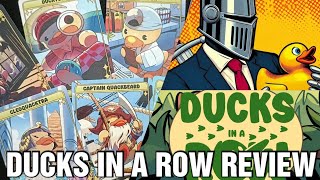
Click to watch at 0:00 · YouTube ↗
Overall sentiment (raw)
positive
Pros
- Boiled down to a very simple formula: play an action card, get more information, and try to work out the order.
- Enjoyable and has a lot of potential to reach a wide audience.
- Deduction fans will enjoy the good amount of information to work out under pressure.
- Accessible to those not into stuffy, pure deduction games due to the ability to 'wing it'.
- Fits a niche in the saturated deduction genre by being sillier and faster.
- Works in the game's favor by sometimes going off feel rather than concrete evidence.
- Looks lovely, is fast, and is very enjoyable.
Cons
- The end game or end of round triggering mechanism was a little bit off.
- The game rounds ended abruptly sometimes.
- Secret cards can provide very strong information, making it a no-brainer if drawn frequently.
- The host suggested giving players one piece of concrete information at the start as a variant.
Thematic elements
Comparison games
none
Mechanics (from transcript analysis)
- Card Drafting — Players play action cards to gain information.
- Hidden Information — Secret cards provide direct answers only to the player who asked.
- Hybrid Deduction Party Game — The game combines elements of deduction and party games.
- Set Collection — Players try to replicate or mirror the conductor's display of ducks by placing their ducks in the same order.
Video topics + discussion points
No key topics recorded for this video.
Quotes (from this video)
- It is a hybrid deduction party game. So, kind of a weird mix of game types there.
- There's good a good degree of um of kind of logical reasoning and a deduction going on here. But there is a nice degree of memory as well because you have to remember the clues that you had asked earlier so that you can orientate your ducks accordingly and sometimes things can even move which can throw an extra spanner in the works.
- I actually did like how well this game was boiled down just staying true to that you know very simple formula just playing an action card getting more information and trying to work out that order before the timer runs out.
- For me, I think the game could have brewed a little bit longer by shuffling in that end of round card lower in the deck rather than it just being random in that deck. I just thought the game or the rounds ended abruptly sometimes.
- With a lot of deduction games, you'll often ask something and everybody else will get a small bit of information. And this game does that really well, but this game also comes with these secret cards where you'll ask something and you'll get a direct answer that only you know from the from the conductor.
- Because of the the random drawing of the cards if you keep on drawing those secret cards it's kind of a no-brainer that that's what you're going to be playing. Um because why wouldn't you take concrete information over more vagueness.
- Apart from the endgame trigger um that the secret cards, I thought the game was very enjoyable. I think it has a lot of potential and also to to reach a wide audience actually.
- But at the same time, people who aren't into that stuffy nature, that pure, you know, 100% concrete information that deduct games require, they might actually enjoy this one because you can kind of wing it and sometimes do well.
- Deduction games have really blown up in the last few years. There are so many to choose from. And yes, there's a lot of crossover between them, but Ducks in a Row kind of carves out its own little place in that genre by being a little bit sillier and being a lot faster and a bit more kind of going off a feel rather than concrete evidence at times, which I actually think works in this game's favor.
- And with that variant, I would happily play this one any time and yeah, wish them all the best with the campaign.
References (from this video)
No references stored for this video.
Video Yb4HtXH7vrE
Brains On Games Review at 0:00 sentiment: positive
video_pk 42358 · mention_pk 128541

Click to watch at 0:00 · YouTube ↗
Overall sentiment (raw)
positive
Pros
- Accessible and quick to teach; suitable for families and mixed groups
- Whimsical duck artwork and non-standard square cards add charm
- Deep enough to be surprisingly strategic, with meaningful choices each turn
- Replayability through many suit combinations and deck-building variations
- Tight interaction: opponents’ actions can significantly shape your options
Cons
- Prototype is in flux; rules and balance are still being tweaked
- Balance between suits and discards could limit viability if not refined
- Non-standard card shapes/sizes may be awkward for some players
- Drawing from the orange deck and hidden-card reveal can create confusion during playtesting
Thematic elements
- ducks and pond/row management with market-like card manipulation
- tabletop prototype discussion during crowdfunding phase; casual play in home environments
- light, whimsical, strategic
Comparison games
none
Mechanics (from transcript analysis)
- balance and deck construction — With multiple suits available, players seek a balance in suits to maximize scoring potential while avoiding dead cards in their row or pond
- blockade and legality rules — Playing a card can block other players from placing certain values into their pond or row; if a smaller value is placed before a larger value, higher-value plays may become illegal
- Deck Building — With multiple suits available, players seek a balance in suits to maximize scoring potential while avoiding dead cards in their row or pond
- end-of-round calculation and scoring — After a round ends when a player runs out of cards, you multiply the pond/row values by counts in your row and subtract cards housed in the duck house; first to reach the target score ends the game
- Memory — Players infer opponents' possible holdings by observing revealed cards and face-down choices to anticipate scoring opportunities
- Memory and deduction — Players infer opponents' possible holdings by observing revealed cards and face-down choices to anticipate scoring opportunities
- orange deck draw露 — Playing an orange card lets you draw a card that is hidden from other players and placed onto a pond card to modify its value; this may alter end-of-round scoring
- row/pond placement with directional rules — Cards can be played to your picnic table (row) or to the pond (middle); pond cards must descend while row cards ascend, creating cognitive constraints
- Simultaneous action selection — Players secretly choose a card to play, then reveal; the lowest value goes first and affects the order of play within a suit
- Simultaneous Actions — Players secretly choose a card to play, then reveal; the lowest value goes first and affects the order of play within a suit
- suit-based abilities — Each suit has a special ability that triggers when a card of that suit is played; one, the orange suit, ties into a central orange deck and card-drawing mechanic
Video topics + discussion points
No key topics recorded for this video.
Quotes (from this video)
- Ducks in a Row is a clever card land
- It's a light game
- surprisingly strategic
- The rules were changing
- I think this is final thoughts. This is more like first impressions
- There is replayability because there are so many suits and you can mix and match different ones
- This is a game for between two and six players
References (from this video)
No references stored for this video.
Video fKMEkpHOgmY
Game Night Picks - Pair Of Dice Paradise Game Trivia at 18:36 sentiment: neutral
video_pk 41314 · mention_pk 125358
Click to watch at 18:36 · YouTube ↗
Overall sentiment (raw)
neutral
Pros
none
Cons
none
Thematic elements
Comparison games
none
Mechanics (from transcript analysis)
- pattern/collection — players collect or draft items themed around birds in a light strategy format.
Video topics + discussion points
No key topics recorded for this video.
Quotes (from this video)
- All viewer submitted all the time.
- We are nothing if not rules followers.
- We will each start with 10 chips. I say we could roll this d20 and let fate determine how much of our chips we wager.
- This is such a chaz way to play this game.
- I rolled a four, everyone. A big four.
- Habitatus. Habitats. It was the annoy hedgehog.
- Falcon's Perch. You know, it just feels right.
References (from this video)
No references stored for this video.
Transcript Navigation
Showing 1–6 of 6