






Tearable Quest Deep Dive
What the Community Thinks About Tearable Quest
Tearable Quest divides reviewers in a fascinating way: those who embrace its novelty celebrate it as a uniquely joyful party experience, while others find its appeal wears off quickly after the initial thrill fades. Board Game Garden's Jenna immediately recognizes the game as "very unique and something different from what you typically see in games," while Ryan and Bethany spent their entire play session giggling. However, BoardGameCo's Alex Rad placed it near the bottom of their list of most disappointing games of the year, not because the game is broken, but because the execution of its central puzzle never quite delivers the satisfaction Alex Rad hoped for. Rahdo Runs Through's Ruel found it engaging in first play but struggled to find reasons to return to it afterward. The pattern suggests Tearable Quest works best as a memorable novelty experience rather than a game with long-term appeal, though players with patience for precision challenges and younger audiences may find more lasting enjoyment.
Core Mechanics That Define Tearable Quest
The Tearing Mechanic
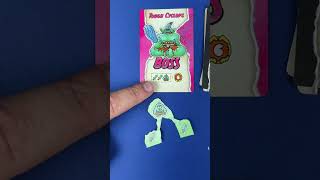
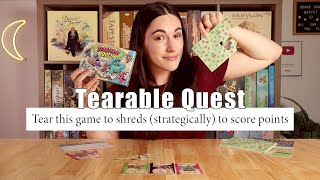
At its heart, Tearable Quest asks players to do something board games rarely permit: physically tear their game sheets. Published by Allplay, the game tasks players with tearing specific icons out of a sheet to match the requirements printed on monster and weapon cards. Unlike many games that invite destruction through optional house rules, tearing here is the entire point. Board Game Garden's Jenna emphasizes that "you are combining that physical fun with the mental fun of trying to achieve these different quests while also having to really pay attention to the ripping of pieces." The paper stock is crucial to this mechanic's success. Ryan and Bethany praised the component choice, noting it strikes an elusive middle ground: "It's not cheap and flimsy where everything's tearing, but it's also not like that thick cardstock where it's like, why am I even doing here, I can't tear anything out." Board Gaming Ramblings called the experience "very silly and very difficult, very fun" in their hands-on session at Spiel.
Real-Time Precision Under Pressure
Each round runs against the clock, with players racing to tear the exact symbols they need. This is where the game's challenge truly reveals itself. The mechanics are deceptively simple: look at what the card demands, find those icons on your sheet, tear them out. But precision is unforgiving. As Rahdo Runs Through's Ruel discovered during play, "you have to be very precise in this game because one little tear that if you don't tear off the exact thing you need, you don't score any points or you don't get the weapon that'll kill the monster." Jenna reinforces this by explaining that bonus treasures on the reverse side only count if they're completely intact, and curses will damage your score even if only partially torn. The game offers players a kind of backward compatibility: you can only advance one piece of your sheet to the next round, forcing strategic choices about which section to preserve for future opportunities. This constraint creates moments of genuine tension as players weigh whether to risk breaking their sheet in pursuit of high-value objectives.
The Tearable Quest Experience
Joyous Chaos and Laughter
What unites the positive voices is the emotional tenor of play. Ryan and Bethany reported finding themselves "giggling the entire time," to the point of saying they had never laughed throughout an entire game before this one. The silliness is intentional: watching someone's paper suddenly break or seeing a perfectly planned strategy collapse when a critical tear goes wrong creates shared moments of absurdity that feel inherently fun. The game succeeds at lowering the stakes just enough that failure becomes entertaining rather than frustrating, even during the high-pressure timed rounds.
A Physical Toy Experience
Beyond mechanics, reviewers describe Tearable Quest as a toy in the best sense. The physical act of tearing, the sensory feedback of paper being carefully separated, and the tactile management of increasingly fragmented sheets create an embodied experience rare in modern board gaming. Board Gaming Ramblings found this aspect surprising enough to call it one of the biggest surprises they played at Spiel. There is genuine pleasure in the destruction that is permitted, invited, and rewarded. This tactile element accounts for some of the game's appeal to younger audiences; the guest on Rahdo Runs Through's episode noted that they would have loved this game as a child who enjoyed tearing things up.
What Makes Tearable Quest Stand Out
An Unprecedented Mechanic in Tabletop Space
No mainstream board game before Tearable Quest made destructive paper tearing its core mechanism. Jenna searched their experience and found the closest comparison in Clip Cut Parks, which uses scissors for a similar cutting-and-write experience, but that game's precision puzzle rewards methodical planning rather than frantic action. Tearable Quest's real-time pressure and the irreversibility of tearing make it something entirely new. The boldness of this design choice alone makes the game memorable. Ryan and Bethany reflected on what they'll need to do once the game's supply of sheets runs out, predicting they are going to want to introduce the game to a lot of people until the sheets are gone.
Inclusive Player Count and Accessibility of Rules
The game plays a wide range of players, a range that sounds impossible until you understand the mechanics. Everyone receives the same sheet and works through it simultaneously under the same timer, with scoring happening at the end of each round. There are no complex turn sequences or hidden information systems to teach. Jenna explains the setup and rules in a way that makes it clear why teaching this game is effortless: reveal a boss, reveal monsters, start the timer, tear what matches the card, score what you successfully isolated. The simplicity means new players are playable within minutes and the game scales naturally from intimate gatherings to large party events.
Potential Drawbacks
Limited Replay Value and Staying Power
The consensus weakness across multiple reviewers is that the novelty factor, while powerful, fades quickly. Ruel played it several times and found that each time the novelty wore off a bit more, admitting Ruel still pulls out Clip Cut Parks on occasion but didn't feel Tearable Quest had enough of a puzzle to it. Alex Rad ranked it among their disappointments, having expected it to have more legs, concluding that while it is definitely a different kind of experience with the toy factor games sometimes need, the execution simply lacked staying power for Alex Rad. The game's success depends on players who are intrinsically motivated by the sensory and social experience of the tearing itself, not by building mastery or discovering hidden depth.
Precision as a Barrier Rather Than a Feature
Ruel identified a potential accessibility issue, cautioning that players with dexterity issues may find this game difficult to enjoy. The icons on the sheets are printed close together, and the requirement to isolate them perfectly under time pressure may be genuinely difficult or frustrating for players with fine motor challenges. Additionally, Alex Rad noted that the precision requirement felt more like a chore than a puzzle, describing it as an exercise in rapid-fire tearing that, given Alex Rad's own professional familiarity with precision work, did not reward the mental challenge they were looking for. Players seeking a puzzle game may find themselves frustrated that the barrier to scoring is manual dexterity rather than strategic insight.
If You Enjoy Tearable Quest
Jenna positions two games alongside Tearable Quest for players drawn to its blend of physicality and time pressure. Draalter shares Tearable Quest's commitment to making physical manipulation central to the experience, rewarding players for careful hand management. Sausage Sizzle, also referenced by Jenna, carries the same upbeat, real-time energy that makes Tearable Quest memorable. For those specifically interested in the cutting-and-writing space that Tearable Quest inhabits, Clip Cut Parks from Renegade Game Studios, mentioned by Ruel, offers a similar use of manual dexterity through scissors rather than hands, paired with polyomino-style puzzle objectives, though with more staying power for players who enjoy puzzle mastery. The key commonality is that all three games prioritize the physical pleasure of the mechanic alongside abstract objectives, treating the tactile act of creation or destruction as equal to the strategic outcomes.
What Reviewers Are Saying
"I do want to mention that this is a game that is very unique and something where you're kind of combining that physical fun with the mental fun of trying to achieve these different quests while also having to really pay attention to the ripping of pieces."
— Jenna, Board Game Garden
"I don't think I've ever laughed throughout an entire game before, but I was definitely giggling the entire time we were playing this. It's just so funny trying to get this certain thing and it not working out, or it does work out, or I think I'm going to try something different, but then I'm racing against the clock and this is just so silly."
— Ryan and Bethany
"You have to be very precise in this game because one little tear that if you don't tear off the exact thing you need, you don't score any points or you don't get the weapon that'll kill the monster."
— Rahdo Runs Through