









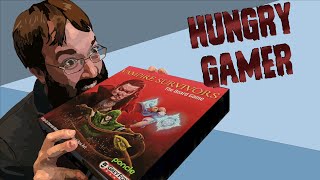


Vampire Survivors: The Board Game Deep Dive
What the Community Thinks About Vampire Survivors: The Board Game
Reviewers come to Vampire Survivors: The Board Game from different directions, but most land in the same place. Published by Grey Fox Games and designed by Emerson Matsuuchi, the game is a cooperative deck builder that tries to capture the feel of the video game it is based on without copying its real-time action. Hungry Gamer came in knowing nothing about the video game and called the game a real hit after a single play, saying they would have bought it on the spot at a convention demo. Man vs Meeple approached it as a fan of the video game and described it as a love letter to that source. TheGameBoyGeek reviewed it as a board gamer who has never played the video game, and their verdict is more measured. They find the design streamlined and thematically coherent, but they are not sure the genre suits them. Board Game Co covered it briefly within a late pledge roundup, expressing real interest in Matsuuchi's work while admitting they were unsure whether a board game could capture what makes the video game compelling.
The shared consensus is that the game is quick to learn, tense without feeling unfair, and rewarding when players find strong combinations. Where reviewers disagree is on how much the game depends on luck and how much enjoyment depends on already loving the source material.
Core Mechanics That Define Vampire Survivors: The Board Game
Dual-Use Cards: Instant Effects and Persistent Slots
Nearly every card in the game can be used in one of two ways. Its instant effect resolves once and sends the card to the discard pile, while its persistent effect occupies one of the two slots on a player's board and stays in place until replaced. TheGameBoyGeek described this as one of the best decisions in the design, noting that a simple choice about whether to milk an ability or cash it in "actually adds a lot of depth to the game." Hungry Gamer highlighted the same tension, pointing out that players constantly decide whether a card is more valuable as a one-time strike or as an ongoing modifier. Man vs Meeple added a practical warning: a card placed in a persistent slot is no longer in the deck, so players who love a card's instant effect may choose not to park it there. Because cards held in hand carry over between turns, players can save a useful card for a larger turn, which reviewers said gives the hand management real weight.
Scrolling the Battlefield
Movement in the game is not a simple walk across a grid. Light sources scattered across the map can be pushed through a scroll action, which shifts every other light source one space in the opposite direction and can push enemies off the edge of the map back into their coffin tray. TheGameBoyGeek explained that scrolling, which mirrors the side-scrolling feel of the video game, is how players bring rewards such as health chickens and currency into range while also repositioning the threats. Man vs Meeple called it the most interesting adaptation of the video game's movement into a physical format, since the enemies do not move on their own and the player's scrolling is the main way to shape the battlefield. Hungry Gamer also noted that enemies arriving in stacks from each side make the scroll a useful defensive tool as well as an economic one.
The Vampire Survivors: The Board Game Experience
Building Pressure That Stays Manageable
Reviewers consistently describe a sense of rising danger that never tips into hopelessness. Hungry Gamer said the tension "just built, built, built," and that even when they thought a round was lost, their group found a way out. TheGameBoyGeek described the feeling as always being in trouble while still having a good chance to win, and they said that balance is what makes the game satisfying. Enemies arrive from every side, and the level one, two, and three enemies grow stronger and more numerous as the game goes on, so the pressure is structural rather than random. The result is a game where a bad turn rarely ends the experience, and reviewers often describe the moment of surviving a near-collapse as the high point of a session.
Explosive Combo Turns
The other feeling reviewers return to is the payoff of a well-built turn. Man vs Meeple compared these moments directly to the video game, where a screen full of enemies gets cleared by overlapping weapons. They described chaining several combinations together to wipe out a whole board and then benefit from a healing chicken. Hungry Gamer described the experience of rearranging one weapon's pattern so that it opens a line for the next, which in turn unlocks another attack. Both reviewers framed these turns as the emotional reward for the deckbuilding and hand management that come before them.
What Makes Vampire Survivors: The Board Game Stand Out
Achievement-Driven Unlocks
Every game begins with three achievement cards, and completing them at the end of a session unlocks envelopes containing new characters, weapons, evolutions, and a new map. Hungry Gamer compared this to Slay the Spire, where each run makes the next one richer, and they said a short game length means players see those unlocks quickly. Man vs Meeple said the system feels very much like the video game's progression, and noted that the evolutions, which stay face up between games, give later sessions a different shape. TheGameBoyGeek liked that the core loop remains the same while the options expand, so a newcomer can join a veteran group without being overwhelmed by new rules.
Communal, Talk-Driven Cooperation
Reviewers praise how the cooperative design keeps players talking without any one person running the table. TheGameBoyGeek argued that this addresses a common complaint about cooperative games, where one player dictates everyone's moves. Because each player holds their own hand, makes their own decisions, and shares a communal pool of experience, the group has to negotiate who buys what and when. Lightning bolt cards that can be played on other players' turns keep everyone engaged even when it is not their turn. Man vs Meeple said the group talk is one of the best parts of the game, with players constantly discussing who should take which card next.
Potential Drawbacks
Reliance on the Draw
Several reviewers acknowledge that luck matters. Hungry Gamer said players are very much at the mercy of the draw, with turns where a player has no movement card and no way to mitigate that. Hungry Gamer enjoyed working through those constrained turns, but warned that players who dislike randomness will find this frustrating. Board Game Co raised a related question about how much a card-driven design can hold up across repeated sessions, and Hungry Gamer observed that the core arc is similar from one game to the next. Reviewers agree the game rewards players who enjoy puzzle-like problem solving, but that tolerance for an unpredictable draw is a prerequisite.
Spatial Challenges of Mirrored Patterns
TheGameBoyGeek found that visualizing mirrored attack patterns on the board was harder than expected. They said the advanced rulebook helps explain how mirroring works, but players who struggle with spatial reasoning may need a second opinion at the table. They also noted that the foil on the boss tiles can make bosses harder to read unless the table lighting is just right. Both are minor issues in their view, but they show that the physical translation of a game built on sprites and screen positions requires some effort to read.
If You Enjoy Vampire Survivors: The Board Game
Reviewers consistently point toward a few related games. TheGameBoyGeek placed the game closest to Mechs vs. Minions, another cooperative game where players defend against enemies pressing in from every direction. They described the difference as the shift from real-time pressure to more thoughtful deckbuilding, so fans of one will likely appreciate the other. Hungry Gamer compared the progression to Slay the Spire, and Man vs Meeple drew the same parallel when describing the way each play unlocks something new. Fans of Gauntlet, which Hungry Gamer mentioned as a point of reference for the floor chicken healing, will also recognize the tradition the game draws from. Finally, Man vs Meeple and Board Game Co both noted that Emerson Matsuuchi also designed Metal Gear Solid, so readers who enjoyed that adaptation may want to explore Matsuuchi's other work.
What Reviewers Are Saying
"And because of that, it creates for a ton of fun combos. Really cool combos as you're going through. It's like, ah gosh, I need to get to this guy, but I can't get to him."
— Hungry Gamer
"The communal XP is awesome. It keeps everyone talking and working together without somebody telling everybody what to do."
— TheGameBoyGeek
"There were multiple turns where the board was just filled with enemies. I played my cards in such a way that I was literally able to chain some different combos together. I wiped out the entire board and a couple light sources."
— Man vs Meeple