




One Card Maze Deep Dive
What the Community Thinks About One Card Maze
Reviewers across the board celebrate One Card Maze as a deceptively clever puzzle game that punches far above its diminutive size. The consensus is clear: this is a portable solo experience that quietly delivers genuine mental challenge wrapped in elegant simplicity. What starts as an intuitive concept quickly evolves into a brain-bending spatial puzzle, with reviewers praising both the clever design and the sheer variety of maze configurations available across different card sets. The game has generated consistent enthusiasm in the crowdfunding community, with multiple seasons seeing strong support.
Core Mechanics That Define One Card Maze
Maze Navigation with Card Rotation and Flipping
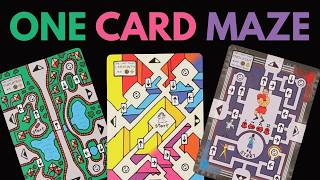
At its core, One Card Maze presents a single double-sided card on which an entire maze is printed. Players navigate from a start point to an exit by manipulating the card itself. The card can be rotated into different orientations using designated spin symbols scattered throughout the maze, and it can be flipped over to access puzzles on the reverse side. This approach to maze design transforms what could be a passive observation experience into an active puzzle where the player becomes the problem solver. The tactile interaction of physically rotating and flipping the card creates an engagement that screen-based puzzles cannot match.
Direction-Based Door System
Every maze in One Card Maze is built around a door system where passage depends on orientation. Doors marked with arrows can only be traversed when that arrow faces upward, or north. Any other direction means the door is locked. This creates a tight constraint that forces players to plan their route carefully, using the rotation symbols to orient the card so open doors align with their intended path. Some mazes layer this mechanic further, particularly in boss battle variants where players must enter a boss chamber multiple times with the card in specific orientations, adding a sequencing puzzle on top of the spatial navigation challenge.
The One Card Maze Experience
Portable Puzzle Satisfaction
One Card Maze shines as the ultimate pocket-sized solo activity. Reviewers consistently highlight playing these puzzles in unconventional moments: on airplanes, at the beach, in doctors' offices, or anywhere a few minutes of engaging entertainment is needed. The games come in wallet-sized packs, and multiple card sets exist, each offering numerous different mazes. This portability is not incidental to the design; it is central to why reviewers feel so positively about the game. The ability to pull out a single card and have a self-contained puzzle experience available immediately makes One Card Maze a natural fit for downtime or travel.
Brain-Challenging Solo Journey
Despite the simple premise, maze difficulty ranges dramatically from tutorial-level introductions to genuinely perplexing puzzles that challenge spatial reasoning. Reviewers describe mazes with names like Labyrinth as so confusing that even experienced players may circle back on themselves, unsure whether they are progressing or retracing their steps. One reviewer noted that after completing a particularly difficult maze, they could not reproduce their solution even if they tried immediately afterward, making each solve feel like a genuine cognitive accomplishment. This difficulty curve means the game appeals both to players seeking a quick mental break and those looking for a puzzle that demands sustained focus and geometric thinking.
What Makes One Card Maze Stand Out
Infinite Replayability Through Variety and Design Clarity
One Card Maze publisher Random Amnesiac has released multiple card sets, each with different themes and rule variations. Standard maze sets come in packs of 18 or more cards with escalating difficulty levels. Beyond basic mazes, some sets introduce boss battles where players must strategically enter a chamber multiple times with the card in precise orientations to defeat an enemy. Others offer multicard campaign experiences where each maze exit directs players to a different card, creating a narrative progression through a series of challenges. The ability to mix and match sets, coupled with the genuine challenge of navigating spatial puzzles, means players often discover entirely new solution paths on replays, even for cards they thought they had mastered.
Tactile, Hands-On Problem Solving
Reviewers repeatedly emphasize the physicality of playing One Card Maze. Unlike digital puzzles, this game demands that players hold a card, rotate it, flip it, and visualize how that manipulation opens or closes pathways. This tactile feedback creates a direct connection between action and puzzle state that feels more satisfying than clicking a button or dragging a cursor. The card itself, with its printed mazes and directional symbols, is immediately readable and never requires referencing external rules once the core mechanics are understood. This simplicity in presentation coupled with depth in execution makes One Card Maze accessible to new players while remaining challenging for veterans.
Potential Drawbacks
Spatial Reasoning Difficulty and Directional Confusion
While reviewers generally praise the challenge, some acknowledge that tracking orientation can be genuinely frustrating. The spatial reasoning required to rotate a card mentally and predict which doors will unlock can overwhelm players who struggle with directional thinking. One reviewer mentioned being "directionally challenged" and finding even moderately difficult mazes nearly impenetrable. Another described the process of solving harder puzzles as something they "have to sit with and really think through," suggesting that for some audiences, One Card Maze may tip from engaging puzzle to unnecessarily taxing brain teaser. The lack of hint systems means players who get stuck must either power through or abandon the card.
Niche Solo-Only Appeal
One Card Maze is explicitly a solo experience, with the exception of a few variant sets that offer multiplayer options. While most reviewers celebrate the portable solo puzzle as a strength, this specialization also limits the game's audience. Those seeking games for game night or casual group play will not find a solution in One Card Maze. The game makes no pretense of being a multiplayer experience, which is by design, but it does mean the addressable market is smaller than games offering flexible player counts. Additionally, the pocket-sized format and pure puzzle focus mean this game does not satisfy players seeking narrative, character progression, or social gameplay elements.
If You Enjoy One Card Maze
One Card Maze will appeal to players who love compact solo puzzle games and seek portable entertainment. Button Shy Games represents a similar design philosophy at the intersection of wallet-sized games and clever mechanical depth. Fans of pure spatial puzzles or anyone who enjoys pen-and-paper maze books will recognize the satisfaction of working through One Card Maze. The game also serves players seeking a break-time activity that requires real thinking, as opposed to passive entertainment. Whether you are a puzzle enthusiast, a travel gamer, or someone who values having a genuine mental challenge available during idle moments, One Card Maze delivers a focused, elegant experience without filler.
What Reviewers Are Saying
"One Card Maze is exactly what the name implies, a maze that exists on a single card. It's pretty clever stuff and a great portable solo activity that can be played in one hand."
— Totally Tabled
"This is a great little solo game system to bring traveling with you. I have played these on the airplane. This is me playing them on the beach in Puerto Rico."
— Favorite Game Friday
"These have infinite replayability for me because I have no idea what I just did to make that happen."
— Totally Tabled