


Reign in Iron Deep Dive
What the Community Thinks About Reign in Iron
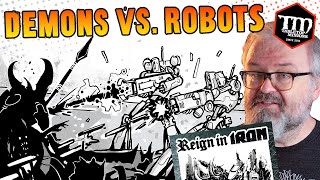
Reign in Iron stands as a bold standalone sequel that doesn't ask players to own or have played the original Reign in Hell. The concept is immediately compelling: demons escaped from their dimension, broke through to Earth, and discovered not humanity but instead something far different, artificially intelligent robots. The resulting conflict between these two radically different forces has captured enthusiast attention as a game that solves real design problems while delivering meaningful player choice in how to engage with it.
Reviewers consistently highlight the game's return to a core idea after Reign in Hell's release: what if these two factions, beings of melee fury and machines of tactical ranged precision, had to confront one another? That asymmetry isn't window dressing. It's the backbone of a skirmish game designed to feel genuinely different depending on which force is commanded and whether the game is played solo, cooperatively, or in direct competition.
Core Mechanics That Define Reign in Iron
Skirmish-Scale Miniatures Combat
Reign in Iron plays across a standard 22-by-30-inch board, the same footprint as games like Kill Team and War Cry, meaning players don't need vast table space or sprawling terrain. Combat uses six-sided and 12-sided dice like its predecessor, but the ruleset has been refined around two fundamentally different unit types. Demons operate exclusively in melee, engaging in close personal violence where every attack is a blade or fist. Robots, by contrast, fight at range with precision-engineered weapons. This design choice creates two distinct tactical languages. Demon warriors cannot hang back and snipe, nor do robot units excel in the brutal close quarters where demons thrive. Each side rewards different positioning, different movement patterns, and different engagement philosophy.
Campaign Play and Emergent Narrative
Beyond single tactical encounters, Reign in Iron builds its strength around campaign play available in solo, cooperative, and competitive modes. A war band persists across multiple games. Units gain experience and improve. Success brings upgrades and new capabilities. Failure costs lives as warriors are replaced when losses mount. This progression creates emergent narratives that no script could predict. One session's tactical decision ripples into the next game's roster, forcing players to adapt, mourn losses, and celebrate hard-won victories. The game includes both quick one-off skirmishes and long-form campaign arcs, letting players choose the depth of narrative commitment they want.
The Reign in Iron Experience
Raw, Dynamic Aesthetic and Brutal Conflict
The artwork by Brandon Gilliam and the cover design create an immediate sense of motion and conflict. Reviewers note the visceral energy; nothing here is static or bloodless. Demons and robots clash in compositions filled with movement and impact. The aesthetic is distinctly dark, fitting a narrative where survival on a post-human Earth means engaging in high-stakes skirmishes with high personal cost. This isn't a game about polite tactics; it's about desperate battles and the raw toll of warfare.
Flexible Miniature Assembly and Solo-First Design
A major strength of Reign in Iron is its miniatures-agnostic design. Players are not locked into one manufacturer's models. Mechs from other game lines work. Robot-themed miniatures from other systems fit perfectly as the robot faction. Demon figures from other collections can be deployed as the demon cabal. This flexibility matters because it respects existing collections and hobby investment. More importantly, the game was built from the ground up with solo and cooperative play, not as an afterthought. Reviewers emphasize this point: Reign in Hell launched without robust solo mechanics. Reign in Iron learns that lesson. Solo players can now command demons against AI-driven robots or vice versa. Cooperative groups can fight together against escalating robot encounters. This design philosophy recognizes modern play patterns where tabletop gaming often happens at home, sometimes alone, sometimes with trusted friends.
What Makes Reign in Iron Stand Out
Asymmetrical Forced Warfare as Deliberate Design Challenge
The decision to make demons melee-only and robots ranged-only wasn't accidental. Reviewers recognize this as a purposeful design constraint inspired by games like Majestic 13, where the challenge lies in balancing fundamentally different force archetypes. Having one faction excel at close quarters violence while the other dominates at distance forces both sides to adapt. Demons must close distance, accepting the pressure of an incoming hail of fire. Robots must manage their sightlines and positioning, aware that allowing melee contact favors their enemies. This constraint creates emergent tactical problems that reward clever play and punish overextension.
Miniature Painting and Hobby Accessibility
Because Reign in Iron doesn't mandate specific models, painters and hobbyists see an opportunity to deploy collections that might otherwise languish unused. A backlog of science-fiction mechs becomes a robot force. A set of demon-themed miniatures gets a second campaign life. This accessibility extends the game's appeal beyond pure mechanics into the broader hobby ecosystem. Players aren't buying all-new models; they're finding new rules and narratives for what they already own.
Potential Drawbacks
Learning the Melee-Versus-Ranged Contrast
The asymmetry that makes Reign in Iron interesting also demands players truly understand their faction's strengths and limitations. New players commanding demons must internalize that ranged combat isn't an option; they'll need to read positioning carefully and time their engagement. Robot players must respect the threat range of melee combatants and not cluster too tightly. This isn't a drawback for experienced miniature wargamers, but it does mean the game has a genuine learning curve around faction identity.
Campaign Commitment and Model Availability
While miniature-agnostic design is flexible, it also places the responsibility on players to source and prepare their own models. There are no bundled starter sets forcing a specific product line. This freedom is liberating but requires initiative: players must own or acquire models, assemble them, and prime them before play. Additionally, campaign play requires real commitment. Losses stick. Setbacks create lasting roster gaps. This narrative weight, while rewarding, means a campaign cannot simply be reset without consequence if it goes poorly.
If You Enjoy Reign in Iron
Players drawn to Reign in Iron typically value skirmish-scale wargaming where individual warriors matter and campaign arcs create lasting narratives. Fans of Kill Team and War Cry who want more robust solo and cooperative options, or those who appreciate games like Majestic 13 that treat asymmetry as a feature rather than a bug, will find Reign in Iron rewards that sensibility. The miniatures-agnostic design also appeals to hobbyists who want to activate neglected collections rather than commit to entirely new model lines. For solo players especially, those who want meaningful wargaming experiences enjoyed at home alone or with friends, Reign in Iron delivers mechanics that were absent from its predecessor, Reign in Hell.
What Reviewers Are Saying
"Now in this new standalone sequel, you don't need to own or even to have played the old game to enjoy Reign in Iron. Hell has finally been brought back to glory and a portal to Earth has reopened. When the demons flooded back through, searching for souls to steal, they found only the children of men, machines of steel and silicon, which among their many qualities completely lacked souls of any kind. The war between the demons and the robots began shortly thereafter."
— Tabletop Minions
"The other concept in this situation of like I have a force that is all melee and a force that is all ranged. That's also kind of a tough design nut to crack. And so that was what I think was a little bit more appealing to Vince, that he wanted to kind of go down that road as well."
— Tabletop Minions
"I think that this adding in single player and co-op into the new game made a lot of sense and so that's why we made sure to do it. I mean basically we've put it into every game since we launched Reign in Hell."
— Tabletop Minions