



Modern Tactics #1: Afghanistan Deep Dive
What the Community Thinks About Modern Tactics #1: Afghanistan
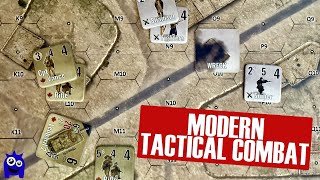
Modern Tactics #1: Afghanistan is a two-player hex encounters tactical combat game from VUCA Simulations, designed by Shane Logan. Zilla Blitz frames it as the first volume in a new tactical combat system meant to cover engagements from the Vietnam War to the near future, with this volume simulating 20 scenarios set in Afghanistan between 2002 and 2011. One player commands US or Canadian forces, sometimes supported by Afghan coalition units, while the other player leads the insurgents. The channel's coverage of the game began as an anticipated title on its most-wanted list, and it was discussed again in later monthly updates, where it was framed as one of the most exciting new tactical releases.
The prevailing view is that the game is an heir to Old School Tactical, the Flying Pig Games system that Shane Logan also helped develop. Reviewers repeatedly describe that lineage as the main reason for their confidence. The reviewer in the overview video says that reading the core rules left them feeling roughly three-quarters of the way to understanding how the game plays, and that Old School Tactical was built to deliver playable tactical combat for players who find other tactical systems intimidating. Enthusiasm is tempered by a clear caveat: the reviews are based largely on rules reading, component inspection, and early impressions rather than long stretches of play.
Core Mechanics That Define Modern Tactics #1: Afghanistan
Line of Sight and Terrain Cover
Line of sight is central to how the game feels on the map. Zilla Blitz notes that the tactical systems within the game include ranged combat, vehicle versus vehicle combat, helicopter rules, and melee, and that these are tied together by a wide range of terrain and line of sight rules that players would expect from a serious tactical simulation. The terrain palette is deliberately dense, with walled compounds, crops, wadi, mines, IEDs, smoke, foxholes, trenches, roadblocks, and wire all shaping where a squad can see and shoot. In practice, this means positioning matters as much as firepower. Units that step into an open hex without cover or a clear sightline become targets, and the Afghanistan-specific compound and urban maps reward players who understand which walls and buildings block fire.
Scenario, Mission, and Campaign Structure
The game is organized around a substantial scenario library. The playbook holds 20 scenarios, with 10 featuring Canadian forces and 10 featuring US forces. Zilla Blitz observes that the scenarios vary considerably in size and scope, from small, quick engagements to larger battles that use the bigger 22 by 34 inch maps. Several scenarios introduce hidden unit rules, and luck cards add an event layer that can disrupt any engagement. Reviewers see this structure as a source of replay value, since each mission places a different force mix, terrain layout, and objective set on the same core rules. The reviewer also points out that playing through the scenarios with a consistent pool of units is how the experience builds depth over time.
The Modern Tactics #1: Afghanistan Experience
Playability and Tactical Feel
Reviewers consistently describe the game as immediately playable. The turn structure represents two to five minutes of real time, so a complete scenario covers roughly an hour or less of actual combat. The core rule book runs 50 pages, but the reviewers stress that most scenarios use only a fraction of the rules, since many missions omit vehicles, helicopters, offboard artillery, or civilians. The player aids are seen as a major strength. Sequence of play, infantry combat tables, vehicle target tables, helicopter combat tables, and a terrain effects chart are all printed on durable vinyl cards, and the data cards for each unit carry the firepower, range, defense, and movement values needed to play. Zilla Blitz describes this as a design that keeps players from diving through the rule book during a game, which is a meaningful quality-of-life point for anyone who has struggled with heavier tactical systems.
Solo Play and Uncertainty
Solo play is where the impulse system draws the most praise. At the start of each turn, each side receives a variable number of impulses based on unit count, scenario conditions, and a die roll, and the sides then alternate activating units until both have spent their impulses. Zilla Blitz argues that this alternation keeps both sides engaged and means that the outcome of any given scenario is never fully predictable. The game does not include a bot system or formal solo guidance, but the reviewer judges it a very playable solo system, scoring it 6.5 out of 10 for solo play. The uncertainty built into the impulse sequence is what the reviewer finds most engaging in a one-player context.
What Makes Modern Tactics #1: Afghanistan Stand Out
The Old School Tactical Lineage
The most frequently cited reason for enthusiasm is the shared design DNA with Old School Tactical. Zilla Blitz calls the system a sweet spot between tactical depth and complexity, and says that Shane Logan's modern version carries over the same scale and rules logic while adding new elements such as helicopters, modern vehicles, and Afghanistan-specific insurgent units like fanatics, bombers, and recruits. Players who already know Old School Tactical are expected to adjust quickly, while newcomers get a tactical system that the reviewer considers one of the most accessible in the genre. The reviewers also note that the name Modern Tactics signals a series, which raises hope that future volumes will extend the system to other conflicts, including Vietnam.
Production Values and Components
VUCA Simulations is praised for production quality that the reviewers find striking. The mounted maps are described as magnificent in person, with the urban map offering dense streets and buildings and the rural map providing wadi, mixed woods, and grape fields. The counters are pre-punched double-sided pieces in two sizes, with the vehicles larger than the infantry. The variety of units is also highlighted, including Bison, Humvee, Leopard 2, Blackhawk, Chinook, and Apache models, along with technicals, trucks, and insurgent fighter squads. Zilla Blitz says the vinyl cards feel great and that the layout of the rules, with clearly delineated sections and abundant examples, supports the learning process.
Potential Drawbacks
Untested Complexity of Modern Combat
The main reservation is whether the system can carry the added complexity of modern combat without losing the clarity that defines Old School Tactical. Zilla Blitz says that while the rules feel polished and the game appears to be one of the most playable tactical combat systems available, the reviewer is still curious how the design will hold up against the extra layers of modern warfare. The reviewer rates the complexity at 5.5 out of 10 and considers that appropriate for a tactical system with this level of detail, but the score reflects expectations based on the rules rather than hours at the table. Players coming in from simpler games should expect a learning curve, even if the reviewers believe it is manageable.
Solo Support and Hidden Units
Solo play is praised, but it is not supported by an automated opponent or dedicated solo guidance. Hidden unit rules appear only in some scenarios, which means that the fog of war is not uniform across the campaign. Players who want a more structured solo experience may need to rely on their own judgment for force composition and insurgent behavior. Reviewers also note that the game sits within a tactical category where the most enthusiastic audience is already committed to the genre, so the title may not appeal to players seeking a light introduction to war gaming.
If You Enjoy Modern Tactics #1: Afghanistan
Players who appreciate the tactical texture of Old School Tactical will find the most obvious connection in this game, since it shares its designer, scale, and core system. Reviewers also point toward other tactical combat titles that reward careful squad management and terrain use:
- Old School Tactical from Flying Pig Games, the direct design lineage for this system.
- Armageddon War from Flying Pig Games, a modern platoon-level combat game whose Taiwan-invasion follow-up was also discussed in the channel's coverage.
- Advanced Squad Leader, the tactical benchmark that the World War II Wargaming Solitaire Toolkit by John Black is designed to support for solo play.
Those who want a modern tactical experience with strong components, a deep scenario library, and a solo system built on uncertainty will find that the reviewers consider this title a strong candidate for their collection. The overall consensus is that the system deserves attention, with the open question being how well its modern-combat extensions perform once the game is played in full.
What Reviewers Are Saying
"Having said that, tactical combat is tactical combat and there are a lot of elements to the game. If I were to give this a complexity estimate, I'd say a 5.5 out of 10, which for a tactical combat system with this level of detail, I think will be outstanding."
— Zilla Blitz
"The impulse mechanic means that you're never quite sure how things are going to play out in any given scenario. And these sorts of alternating systems of gameplay are fun, a lot of fun in solo play."
— Zilla Blitz
"Now I know very little about this game but everything that I know about it makes me want it and that's why it's on the list. It's modern tactical combat in Afghanistan based on the old school tactical system which Shane Logan was involved with the development of back in 2015."
— Zilla Blitz