


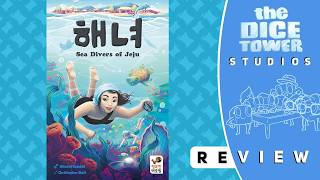



Haenyeo: Sea Divers of Jeju Deep Dive
What the Community Thinks About Haenyeo: Sea Divers of Jeju
Haenyeo: Sea Divers of Jeju arrived at board game tables with immediate visual impact and a challenging press-your-luck system that keeps players engaged across multiple plays. Reviewers praise the game's beautiful production and art design, while also noting that its push-your-luck mechanic can be unforgiving, sometimes rewarding bold plays and other times punishing them harshly. The consensus suggests a solid mid-range experience that shines in its presentation and moment-to-moment decision-making, though it carries some fragility in game flow depending on player choices.
Core Mechanics That Define Haenyeo: Sea Divers of Jeju
The Diving Chain System
At its heart, Haenyeo: Sea Divers of Jeju centers on a deceptively simple but brutal rule: you only collect rewards from the depths you reach if there is an uninterrupted chain of divers from your position back to the surface at depth zero. Each round, players secretly select depth cards for their divers ranging from zero to eleven. The board reveals prizes at each depth, from eggs and sea creatures at shallow levels to pearls at the deepest point. But if another player has not placed a diver at an intermediate depth, your chain breaks and you get nothing. This creates a unique tension where you must partly rely on opponents to help you access deeper resources, yet you also compete directly with them for those same rewards. Tom Vasel noted this similarity to dungeon crawlers where failed rooms below block access to deeper ones, creating a cooperation-but-not-quite dynamic that makes every depth choice consequential.
Managing Oxygen, Eggs, and Score Paths
The shore-side economy runs on eggs as currency. Players track collected sea life, eggs, trash, and pearls on individual sheets. Eggs can be spent to unlock a third diver, dramatically increasing flexibility by allowing three depth placements per round instead of two, or to purchase specific resources or even pearls directly. Pearls become valuable scoring fodder worth substantial points. Meanwhile, the game's scoring tiles shift from round to round, changing which creatures or resources award points at the game's three scoring checkpoints (rounds three, six, and eight). This shifting economy means there is no single optimal strategy; players must read the board and adapt their diving focus constantly, choosing whether to pursue pearls, clean up trash for points, or collect a varied set of creatures to match scoring opportunities.
The Haenyeo: Sea Divers of Jeju Experience
Beautiful Production Meets Tense Decision Space
Reviewers consistently highlighted the game's visual presentation as one of its strongest elements. Artist Christopher Matt's work brings Jeju Island's diving culture to life through colorful, distinctive diver figures. Each diver has its own look, and placing them on the translucent acrylic pegs to represent the diving depths creates a satisfying tactile moment that reinforces the theme of descending into the sea. The scoring tiles change appearance between games, ensuring that no two plays look or feel identical on the table. This layered visual design rewards players for simply looking at the board state, making scoring deliberation feel exciting rather than administrative.
The Emotional Arc of Risk and Reward
The push-your-luck core creates a memorable emotional experience. Reviewers noted that games can swing wildly. Sometimes players score 33 points in a round and sometimes 160; one player kept returning to play Haenyeo repeatedly at a convention, suggesting the quick turnaround and variable outcomes pull people back for one more dive. The core tension, as Tom Vasel framed it, boils down to a single question: is the diver going deep enough to get the rewards needed, or pushing too hard and hitting empty depths? When it works, when your chains line up and you collect premium sea life and pearls, it feels spectacular. When it fails, when gaps break your chain and you surface with nothing, the sting is immediate but fair, since the player made the calculated decision to take that risk.
What Makes Haenyeo: Sea Divers of Jeju Stand Out
The Designer's Signature and Fresh Theme
Haenyeo: Sea Divers of Jeju comes from Hisashi Hayashi, a well-known board game designer, and publisher Happy Baobab. The subject matter itself draws directly from Korean culture, specifically the haenyeo women divers of Jeju Island, known as the Hawaii of Korea. This cultural grounding gives the game thematic coherence; the gameplay loop of diving deep, managing limited oxygen (via the chain mechanic), and surfacing with treasures aligns naturally with the diving profession depicted. The result feels purposeful rather than a generic push-your-luck skeleton dressed in dive-themed art.
Variable Setup Creates Asymmetry
Because the depth cards are double-sided and shuffled each game, and because the scoring tiles rotate, every play of Haenyeo: Sea Divers of Jeju presents a different resource landscape. Players cannot memorize optimal paths or rely on a single strategy carrying them through multiple plays. One game you might focus on trash cleanup for points; the next, you chase pearls. This variability, combined with the round-by-round shifting of scoring emphasis, pushes players to stay engaged with reading the board rather than retreating into pre-solved tactics. It mirrors the roll-and-write genre's appeal of adaptive play within a familiar frame.
Potential Drawbacks
The Fragility Problem
Reviewers identified a meaningful vulnerability in Haenyeo: Sea Divers of Jeju's design: games can collapse into emptiness if the depth chain breaks repeatedly. Tom Vasel described it as slightly fragile, noting that it is easy for players to mess up and get nothing if they misjudge the board state. When multiple players dive deep in the same round but fail to form a complete chain, everyone surfaces empty-handed, erasing a full turn's potential gain. This is not a flaw per se, it is a design choice that emphasizes risk management. Yet for tables that enjoy building and steadily accumulating advantages, rounds of zero rewards can feel frustrating rather than thrilling. Newer players especially may struggle to gauge depth conservatively and end up in negative spirals of unsuccessful dives.
Player Count and Starting Position Luck
The starting player token carries weight because tie-breaker priority gives first pick of shared depths. This means the starting player, who rotates each round, always gets first access to resources if they share a depth with other divers. While the token does rotate around the table, ensuring no single player holds it all game, this can still swing individual rounds. Players sitting in later turn order positions sometimes find premium depths already claimed, leaving them with the remnants. On its own, this is a manageable equity lever; the real fragility arises when poor depth choices combine with unfavorable turn order, creating the occasional player who feels locked out of meaningful scoring.
If You Enjoy Haenyeo: Sea Divers of Jeju
Haenyeo: Sea Divers of Jeju appeals to players who love press-your-luck tension and decisions that hinge on incomplete information. If you appreciate games where a single wrong call can cost you dearly, but where bold plays also pay off spectacularly, this is your game. The roll-and-write scoring system will appeal to fans of Yahtzee or other games where adaptive point-chasing drives decision-making. The variable tile-based scoring each game means lovers of puzzle-like optimization will find something to chew on. However, if your table prefers games where everyone advances steadily and negative turns are rare, or if you dislike the possibility of zeroing out an entire round, Haenyeo: Sea Divers of Jeju's risk-reward balance may not align with your preferences. Its 30-minute playtime keeps it snappy even when rounds go sideways, making it an excellent palate cleanser for gaming sessions that need a breather between heavier titles.
What Reviewers Are Saying
"The little people that you put on, they're beautifully colored. Not only are they different colors, but they each have a different look to them, and putting them on the board on that acrylic plastic, I think, just looks really cool on the board, gives that idea of them diving into the seas."
— Tom Vasel, The Dice Tower
"There have been times I played where all the divers went deep and nobody got anything on a particular round. It's kind of interesting. Am I diving deep enough? Am I going deep enough down to get these things? And that's where this game is tricky."
— Tom Vasel, The Dice Tower
"I think how it looks is fun, how it plays is fun. If you really do push your luck, as in many push your luck style games, you may not do particularly well. But you might."
— Tom Vasel, The Dice Tower