










Lodge Deep Dive
What the Community Thinks About Lodge
Lodge carries a reputation as a competent but divisive spatial puzzle game. Reviewers who embrace its meditative, cozy design speak glowingly of the satisfying tile-placement puzzle and the innovative tilting board mechanism. Going Analog, Where There's A Wilz There's a Play, and kovray all expressed genuine enthusiasm for the game's relaxed vibe and retro aesthetic. Yet Board Games UnLocked delivered sharper criticism, arguing the game lacks the tension and careful puzzle construction found in tighter designs. The split is real: some reviewers found themselves drawn into a calm building experience, while others felt the puzzle never quite tightened enough to feel rewarding.
Core Mechanics That Define Lodge
Tile Placement with Constraint
At its heart, Lodge is a tile-placement puzzle. Drafting room tiles from a central display and placing them on one of four floors to attract matching guests creates the fundamental challenge. Each guest wants a specific color room on a preferred floor, and placing them correctly yields bonus points. What distinguishes Lodge is not the placement itself but the constraint: whichever floor level a player draws from, that tile must go on that same floor in their lodge. This forced pairing of selection and placement prevents the unconstrained optimization that simpler tile-layers allow, introducing a strategic tension that reviewers either appreciated as elegant or dismissed as insufficient.
The Tilting Board Mechanism
Lodge's signature feature is its tilting drafting board. As players take tiles from the central display, gaps open up. When a row becomes depleted or a player triggers a refresh, the entire board tilts forward and all remaining tiles cascade down like an avalanche, refilling the highest tier with fresh tiles drawn from the bag. This physical cascade creates a moment of visual spectacle, and it opens strategic planning: understanding which tiles will slide down and be available next turn adds a layer of foresight that pleased reviewers who saw it as clever and engaging. For those who found the core puzzle loose, though, this mechanism alone could not tighten the experience enough.
The Lodge Experience
Cozy Puzzle Satisfaction
Reviewers drawn to Lodge consistently described it as a fundamentally cozy experience. The retro cabin aesthetic, the manageable decision-making pace, and the fact that players always have multiple viable actions, even when the board doesn't cooperate, created a forgiving, almost meditative gameplay session. kovray found that the puzzle soothed rather than frustrated, allowing for relaxed strategic play. The game rewards careful planning of guest placement and amenity construction but does not punish missed opportunities harshly, keeping the mood light and the failure state unambiguous.
The Amenity Layer and Its Pitfalls
Amenities represent the game's secondary scoring track, offering bonus points for specific lodge configurations: several rooms of one color in a column, a spread of different room colors surrounding a tile, guests adjacent to a specific tile. Board Games UnLocked found these amenities too easy to achieve and insufficiently compelling. With such variety in the amenity selection and so many tiles available throughout the game, players can often stumble into amenity completion without deliberate planning. This looseness in the puzzle, the lack of genuine scarcity or confinement, emerged as the game's central weakness for skeptical reviewers, who felt it allowed players to drift through their lodges without meaningful decision points.
What Makes Lodge Stand Out
The Tilting Avalanche Drafting System
The tilting board is Lodge's most distinctive mechanical contribution. Rather than a simple sliding mechanism or refreshing from a deck, the cascade creates a visual spectacle and strategic layer: players can speculate about which tiles will emerge after the avalanche, and the timing of a refresh becomes a decision point. Going Analog praised this feature explicitly as a clever addition that sets Lodge apart from other tile-layer designs, an elegant mechanical expression of theme, tiles literally tumbling down a mountain lodge.
Retro Cabin Aesthetic and Spatial Clarity
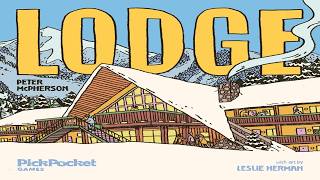
Lodge's art direction evokes a retro ski-lodge fantasy, with warm tones, cozy room illustrations, and guest cards drawn in period style. Where There's A Wilz observed that the cover art alone conveyed the vibe the game was reaching for. kovray echoed this: the retro aesthetic is not ironic or campy but genuinely inviting, reinforcing the cozy emotional tone. The clarity of the visual design also serves gameplay; room colors are distinct, guest preferences are legible at a glance, and the lodges themselves become satisfying visual achievements as players build upward across four floors.
Potential Drawbacks
Loose Puzzle with Limited Tension
Board Games UnLocked's core complaint, that the puzzle feels loose and lacks the sense of confinement found in tighter spatial puzzles like Tiny Towns or Fit to Print, resonates with the game's design philosophy. With a deep tile bag and a generous win condition, players rarely feel forced into difficult choices or face real scarcity. There is always another amenity to build toward, another guest to place. Lodge trades some puzzle depth for a gentler experience, and players seeking a brain-burner will find it more contemplative than challenging.
Amenities That Feel Incidental Rather Than Tactical
Board Games UnLocked noted that amenities, despite their variety, are not exciting and are also easy to do. The abundance of options means players often complete amenities almost accidentally while executing their main strategy of placing guests. This undercuts the promise of a secondary scoring path; in stronger puzzle games, amenities act as genuine pivots or risk-reward choices. In Lodge, they function more as occasional bonuses than as the core of the puzzle, and the incentive margins between competing paths are thin.
Prototype Caveats
Several reviewers noted they played prototype or preview builds, with rules and component quality subject to change. BoardGameCo explicitly flagged this in their preview, and both Going Analog and Where There's A Wilz were working with pre-release versions ahead of a crowdfunding campaign. The final retail product may refine balance or adjust amenity point values, though the fundamental design choices are set.
If You Enjoy Lodge
Players drawn to Lodge should explore Tiny Towns, which applies similarly elegant spatial logic to a tighter, more constrained puzzle. Those who appreciated the cozy tone and manageable pace might also enjoy Everdell, which shares Lodge's warm aesthetic and forgiving gameplay curve, or Feast for Odin, which rewards both focused strategies and graceful adaptation. Charter Stone offers a similarly cozy, laid-back experience where the journey matters as much as the score.
What Reviewers Are Saying
"You're also drafting from this board that's tilted and when enough pieces are taken out of it, the whole thing slides down like an avalanche and then you refill it from there."
— Going Analog
"It made me feel very cozy when I was playing this game and it's super chill. Even though some things don't work out your way sometimes, there's always something you can do."
— kovray
"The amenities, there's a decent variety of them, but a they're not exciting and b they're also easy to do because you're just able, you're not confined to any sense."
— Board Games UnLocked