








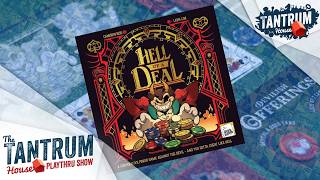
Hell of a Deal Deep Dive
What the Community Thinks About Hell of a Deal
Hell of a Deal has drawn enthusiastic praise from independent reviewers for delivering both thematic coherence and strategic depth. Board Games UnLocked called it the best poker-style board game ever made, awarding it a 9 out of 10. Tantrum House declared the game would likely land in their top 10 games of the year. TheGameBoyGeek, a poker enthusiast since the early 2000s, found themselves pleasantly surprised by how well the cooperative mechanics work. One Stop Co-op Shop praised the balance of mechanical innovation and accessibility. The game generated significant buzz at Gen Con 2026, where it reportedly sold through copies faster than many anticipated.
Core Mechanics That Define Hell of a Deal
Cooperative Texas Hold'em with Soul Currency
Players work together against bosses, using a shared soul chip pool as currency and the game's loss condition. Each round, players are dealt three hole cards instead of two, though only two can be used in your final hand. Each boss has a printed minimum hand they'll make (a straight, three of a kind, two pair) plus two random cards, creating meaningful uncertainty. Betting chips stay in the hand offer different abilities; when you lose, chips flip to reveal penalties. Losing to Nick House or the devil costs four souls per player that doesn't beat them. Run out of souls, and everyone loses immediately. This currency system creates escalating stakes throughout the game.
Cheating Through Favor Cards and Devilish Offerings
Players break poker rules through "favor" cards that might let you make a four-card flush, use three hand cards, or swap cards with another player. Most come with a cost: you gain temptation, which ends the game if two players reach maximum. Players can also bet "devilish offering" chips to reveal boss cards, look at deck cards, swap with players, or grab from the discard. If you lose, bet chips flip to reveal penalties like temptation or curse cards. Curse cards apply one-round limitations (can't use certain suits, can't fold, etc.). This design creates thematic resonance: betting now, paying later forces players to weigh immediate advantage against future punishment. Reviewers noted the system remains strategic without overwhelming players.
The Hell of a Deal Experience
Thematic Immersion in a Devilish Poker Game
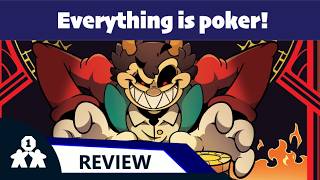
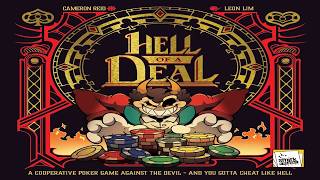
The rubber hose animation style artwork, inspired by Cuphead, gives the bosses whimsical menace. Player mats display poker hand rankings for accessibility, while boss names (Misfortune, Eeny Meeny, Demona) carry thematic punch. Unlike many cooperative games, Hell of a Deal maintains narrative coherence: the cheating isn't a mechanical abstraction but the design's core. The minions and devil cheat; you cheat; the question is whether you can cheat better. This makes the experience feel like playing out a dark bargain with consequences, not just pushing cardboard.
Strategic Pressure in Cooperative Play
Despite being cooperative, the game generates significant table tension. The soul chip pool is shared, but players bet individually; a player's losses eat into the pool and players feel the weight of not letting teammates down. Limited communication (no discussing hidden cards) forces players to infer needs from betting patterns, creating a deduction puzzle layered on top of poker. Reviewers noted the game is stressful because nobody wants their poor decisions to cause group failure. Yet rounds resolve quickly once players know bosses, allowing the team to refocus. Difficulty can be tuned through harder boss variants, balancing pressure with engaging pacing.
What Makes Hell of a Deal Stand Out
Unprecedented Boss Variety and Mechanical Uniqueness
The game ships with 15 named minion bosses, Nick House, and six devil variants, each with distinct abilities. One boss punishes favor cards. Another locks players into their hands if hearts appear. A third uses Blackjack rules. Rather than repeating mechanics, Smirk and Dagger designed each boss uniquely. Every boss has a heated variant for increased difficulty. This ensures no two playthroughs feel identical: minions are randomized, and the final devil varies. The variance creates significant replay value without expansions. For players who find the standard game too easy, heated-boss modes offer tunable challenge.
Elegant Design That Works in Minutes Once You Know the Rules
A full game runs 20 to 30 minutes in practiced hands. This speed comes from ruthless focus: every mechanic serves the core experience. Rounds follow a predictable arc (deal, betting phases, reveal) without cluttered turns. Soul currency is straightforward. Curse and favor cards do one thing each. Cognitive load sits in actual poker decisions, not exception rules. The game is accessible to casual players but offers strategic depth for experienced gamers. Production is polished: quality chips, clear iconography, player mats with hand rankings. Reviewers praised Smirk and Dagger for creating a game that is simultaneously challenging and easy to learn.
Potential Drawbacks
Difficult Initial Boss Setups and Early-Game Frustration
The recommended first-game boss lineup is legitimately hard for new players. Several early bosses have challenging minimum hands or punishing abilities. This can create a demoralization loop: losing opening rounds badly means facing Nick House and the devil severely behind on souls. Tantrum House discovered that swapping in other available bosses for the first few games improves on-boarding. The publisher acknowledges this and suggests easier alternatives on community forums, but the box's default recommendation isn't forgiving.
Significant Luck Dependency and Frustrating Card Outcomes
Hell of a Deal does not fully mitigate poker's luck. While favor cards and devilish offerings offer meaningful tools, sometimes the community board simply doesn't cooperate. If no flushes appear and you need one, or if cards don't combine to beat the boss's minimum, clever play only goes so far. One Stop Co-op Shop noted that while the game's speed makes luck less punishing than longer games, players who prefer skill triumphing over randomness may feel frustrated. This isn't a design flaw (it is inherent to poker), but worth knowing: Hell of a Deal manages luck cleverly without eliminating it. For players who enjoy push-your-luck mechanics and adapting to bad hands, this is part of the appeal.
If You Enjoy Hell of a Deal
Sky Team shares Hell of a Deal's focus on limited communication and partner deduction, though it uses dice. The Gang is a lighter, faster cooperative poker game that plays as a quick filler. Ace of Spades offers a solo-friendly poker game, though reviewers found Hell of a Deal more thematically coherent. Six Up provides another angle on poker mechanics in a lighter package. What these games share is the core appeal: working together, accepting luck's role, and finding clever ways to overcome it.
What Reviewers Are Saying
"He has completely taken the idea of Texas Hold'em and made it an absolute blast to play, of doing kind of essentially a boss battler. Probably more of a boss rush than a boss battler. But normally for this style game, I wouldn't tend to enjoy it. But he has made it work extremely well cooperatively by having an element of randomness, but controlled randomness that Texas Hold'em just has."
— Board Games Unlocked
"This game adds things that I really like in games. So, the cooperative nature of trying to get everyone to win, the strategizing of who's taking which chips. I like that aspect. The different ways to cheat so you can hit those big hands and have those big moments of, 'Yay, we did it.' So I like all of those things about Hell of a Deal, which is why for me, I'm pretty sure that I'm probably putting it into my top 10 games of this year."
— Tantrum House
"Other than that, the game is actually really fun. I enjoy it. I think, again, if you liked the game, or you liked Ace of Spades, I think you're going to like the game. If you didn't like either of those, I don't think you're going to like this game. This is different, but that should give you a good gauge of whether this game is for you."
— TheGameBoyGeek