




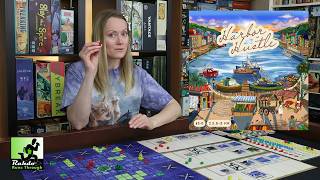

Harbor Hustle Deep Dive
What the Community Thinks About Harbor Hustle
Harbor Hustle has earned consistent praise from board game reviewers for its elegant fusion of economic strategy and thematic authenticity. The game presents a compelling vision of competitive commercial fishing, where players must read market conditions, manage cargo capacity, and decide when to pursue maximum catches versus rushing back to port. Reviewers across multiple channels agree on one thing: Harbor Hustle delivers strategic depth wrapped in mechanics that reinforce the fishing theme without overwhelming players with fiddly components or excessive rules.
Core Mechanics That Define Harbor Hustle
Market Dynamics and Strategic Price Setting
The heart of Harbor Hustle is its market system, where fish values constantly shift based on player actions. Reviewers consistently highlight how market manipulation creates genuine economic tension. Rather than a static price track, the market punishes oversupply: if many players fish yellow, prices crash. This mechanic forces players to constantly pivot their strategies, reading what opponents are chasing and adjusting their targets accordingly. Some reviewers describe this as the most interesting layer of the game because it means there is no single correct fishing strategy. The player who goes for common yellow fish might profit from early-market saturation if they reach port first, while another player targeting rare red fish faces higher travel costs but potentially higher rewards if the market is underfished.
Cargo Management and Fish Weight
Harbor Hustle introduces meaningful weight-based cargo constraints that force crucial decisions during fishing expeditions. Each fish type takes up different cargo space: yellow fish weigh one unit each, blue fish weigh two, green fish weigh three, and red fish weigh four. With starting cargo capacities between 8 and 12 (depending on your captain's abilities), players cannot simply grab every fish they encounter. Reviewers appreciate how this system creates tension: a player with four empty cargo slots can either fill up with cheap, lightweight yellow fish or take a gamble on a single valuable red fish. This mechanic ensures that upgrading cargo hold remains valuable throughout the game, and forces players to consider which fish to prioritize before they ever leave the harbor.
The Harbor Hustle Experience
Constant Pressure and the Race to Port
The most palpable feeling while playing Harbor Hustle is urgency. Because selling first matters (you get better prices and pick upgrades first), every turn involves a calculus between staying out to fish longer and rushing back to undercut your opponents. Reviewers note that this creates genuine tension, especially once a couple of players return to port. Once any two players have sold, the remaining player faces a sunset clause: they get one final turn to fish or explore, then must return. This prevents the game from dragging but also means the player still out on the water feels real pressure to make their last actions count. The day-based structure, with seven days total, creates a sense of escalating stakes as fish populations dwindle and players have upgraded their ships multiple times.
Theme and Authenticity of Fishing Life
Reviewers frequently praise how well the mechanics support the fishing theme. The game captures the decision-space of real commercial fishing: you need money to upgrade your vessel, but every dollar spent on upgrades is a dollar you cannot keep as final victory points. Exploration of new tiles feels risky but rewarding, mirroring the real gamble of venturing into unknown waters. The balance between holding large catches and moving back to market quickly resonates with the urgency of actual fishing operations. One reviewer compared the experience to Deadliest Catch, noting how the weight limit prevents "capsizing" your boat while the constant clock pressure mirrors the real world of commercial fishing operations.
What Makes Harbor Hustle Stand Out
Exploration and Tile Discovery
Harbor Hustle includes a discovery element that keeps the board unpredictable throughout the game. Outer tiles start face-down, and the first player to reach them gets to flip and orient them however they choose. This means early exploration matters strategically: you shape future fishing opportunities for yourself while potentially creating good or bad fishing grounds for opponents. Reviewers highlight the compass upgrade card specifically: it grants two bonus movement points when exploring, turning a third-round purchase into a potential game-changer. The exploration system ensures that aggressive players can take risks seeking new fish populations while cautious players who stay closer to home can still compete by understanding the inner, known tiles better.
Streamlined Action Economy and Fast Player Turns
For a game of this strategic depth, Harbor Hustle moves remarkably quickly. Players take exactly two actions per turn from a simple action set: move, fish, or sell. There is no complex decision tree or special cases that slow down play. Reviewers consistently appreciate the clarity of the rules and the speed of turn resolution. Even with seven days of gameplay, individual turns rarely stall. The market interaction and upgrade phases add strategic meat without complicated bookkeeping, and the sunset clause means no one player can monopolize time by continuously moving and fishing.
Potential Drawbacks
Upgrade Spending Versus Final Scoring
Every dollar spent on upgrades directly reduces final victory points, creating a zero-sum tension that some players may find frustrating. Early-game upgrades like movement or fishing improvements feel mandatory if you want to compete, yet spending heavily on upgrades leaves you with fewer victory points at the end. Reviewers acknowledge this creates interesting decisions but also note that poorly-timed upgrades can feel punishing. Unlike some economic games where spending money cycles back into your score through engine-building, in Harbor Hustle every purchase is a permanent loss of final points. This means aggressive upgraders can find themselves in a trap if they misjudged how powerful their early investments needed to be.
Component Quality and Prototype State
Multiple reviewers note that the prototype components in their preview copies lack polish. Paper money, unremarkable player tokens, and uninspired artwork are mentioned as areas that could improve the table presence and feel of the game. While the rules and mechanics are solid, production quality matters for a game where visual clarity (knowing cargo weights, market values, and fish colors at a glance) contributes to smooth play. Reviewers expect these concerns to be addressed before final release, but they are worth noting for anyone watching the crowdfunding campaign or considering early support.
If You Enjoy Harbor Hustle
Players drawn to Puerto Rico's role-selection and economic engine-building will find familiar strategic satisfaction in Harbor Hustle's upgrade system and market manipulation. Both games reward careful planning and punish poor spending decisions. Those who loved the exploration and spatial puzzle of Azul or tile-placement games will appreciate Harbor Hustle's gradual board revelation and the strategic positioning decisions that come with flipping and orienting new tiles. For fans of economic games with genuine player interaction like Brass or Food Chain Magnate, Harbor Hustle offers a lighter, more streamlined take on market control where fish prices rise and fall based on supply and demand. Finally, players seeking a thematic game with strong narrative immersion, those who enjoyed Everdell or Calico for their cohesive design, will appreciate how Harbor Hustle's mechanics reinforce its fishing theme at every turn.
What Reviewers Are Saying
"In Harbor Hustle players are going to be competitively fishing and also selling these fish to a market. The market is going to fluctuate with the different prices that you're able to sell these fish for, meaning that not only are you trying to fish out these different types of fish, all trying to maneuver around the other boats as well and making sure that they aren't getting the fish before you in certain areas, but you're going to be paying attention to the market and how much you're able to sell these fish for."
— Professor Meg, BoardGameCo
"It's fun. And I mean, you really get into it cuz after the first round or so, I was really keeping an eye on everybody else. It's like, Okay, I need to go over to this place, I can get the most fish I can get back before everybody else."
— Matt, Our Family Plays Games
"The theme goes together because you're hustling, you got fish out there, you're trying to upgrade your boat."
— Starla, Our Family Plays Games