







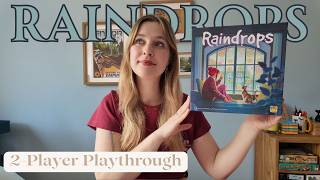

Raindrops Deep Dive
What the Community Thinks About Raindrops
Raindrops has captured reviewer hearts with a deceptively simple premise: watch raindrops cascade down a window, and turn that observation into a puzzle. The community consensus centers on the game's aesthetic charm and mechanical elegance. Grant Lyon from Grant's GameRex praises the theme as the core draw, while Jenna from The Board Game Garden calls the art "daydream vibes in a way with like the lowfi kind of rainy day art" and describes feeling "obsessed" with it. Crimsonboardgames emphasizes the beautiful tiles and window display as key components of the experience. However, reviewers acknowledge that while the theme and presentation are exceptional, the underlying gameplay loop creates some repetitiveness that may limit long-term replayability. The consensus is clear: Raindrops excels at creating a cozy, meditative experience through its thematic execution, though strategic depth is not the primary draw.
Core Mechanics That Define Raindrops
Path Tracing and Tile Collection
The heart of Raindrops is tracing continuous downward paths of matching symbols across the shared window board. On each turn, a player guides their raindrop from the top of the window, moving down or diagonally but never sideways or upward, following a single color or dual-color tiles. This path-finding puzzle is what separates Raindrops from standard tile-collection games. Grant Lyon identifies this as a favorite aspect: "The puzzle of figuring out which tiles you're going to trace your raindrop down. And then every tile your raindrop hits, you get." The mechanics are intuitive but create genuine tactical choices about which colors to pursue and how far to extend a path.
Pattern Fulfillment and Set Collection
Once tiles are collected, players assign them to memory cards, pattern-recognition cards depicting items like sweaters, teacups, and cats. Completing a full pattern by gathering the required symbols scores that card and unlocks bonus objectives. The game rewards set collection: the first player to complete three cards of the same symbol earns bonus points, and collecting one of each symbol (except cats, which score individually) yields even greater rewards. Lightning bolts, revealed when paths reach the window's bottom, provide additional bonus points at game's end. This layered scoring system creates multiple paths to victory, though most reviewers note the pattern-matching layer feels fairly conventional once separated from the raindrop mechanic.
The Raindrops Experience
A Meditative, Cozy Atmosphere
Raindrops evokes a specific feeling: sitting by a window on a rainy day, watching the rain trace patterns you cannot control but can observe with fascination. Reviewers consistently describe the experience as "cozy" and "cute." Crimsonboardgames noted wanting to "wear a sweater" while playing because the game brought such a strong autumnal coziness. The lowfi, rainy-day aesthetic and beautiful component design reinforce this mood. The game is not about competition or aggressive optimization; it is about the satisfaction of finding elegant paths and completing patterns in a visually beautiful space. This meditative quality makes Raindrops feel like a relaxing puzzle more than a cutthroat strategy game.
Satisfying Puzzle Moments
Despite the cozy presentation, Raindrops delivers genuine puzzle satisfaction. The board manipulation options, flipping tiles, swapping adjacent pieces, moving one tile to the top of a row, allow players to engineer elegant cascades that collect multiple tiles at once. Grant Lyon describes the joy of setting up "some pretty epic turns," and the moment a raindrop hits all the tiles you anticipated creates a small sense of triumph. These puzzle-solving moments break up the pattern-matching routine and reward forward thinking. The puzzle is never brutally hard, but it is present enough to engage players beyond pure luck.
What Makes Raindrops Stand Out
A Theme That Shapes Mechanical Identity
What separates Raindrops from countless other pattern-collection games is the cascading raindrop mechanic. Grant Lyon articulates this perfectly: "That cascading raindrop, that's what makes it feel different. That's what makes it feel unique." The constraint that a raindrop must always move downward, never sideways, is a deceptively elegant design choice that forces thematic consistency onto the puzzle. The raindrop mechanic is not just flavor text; it is the mechanical heart of the game. This alignment between theme and mechanics creates an experience where the board feels alive, tiles sliding down under gravity, paths constrained by physics, the window itself becoming a character in the game.
Accessible Art and Component Design
The physical presentation of Raindrops reinforces every aspect of the experience. Reviewers praise the beautiful tiles, the elegant window display, and the overall aesthetic. The game's appearance invites play; it does not intimidate. From designer Fernando Cunha and publisher DV Games, Raindrops joins a catalog (including Koi and Bonsai) known for thoughtful, accessible design. The components do not shout their beauty; they whisper it. This restraint makes Raindrops feel like a warm, inviting experience rather than a showcase of luxury components.
Potential Drawbacks
Limited Replayability and Repetitive Gameplay
Crimsonboardgames expressed concern that "the game would be the same every time" and noted the replayability would be "on the lower end." Once you have played several rounds, the puzzle-solving patterns become familiar. New hands of pattern cards and different board configurations provide some variation, but the underlying loop remains constant. The game is best suited for players seeking a cozy experience rather than high strategic depth or surprising twists across multiple plays. It is a game you pull out occasionally to unwind, not one that evolves dramatically with repeated plays.
Absence of Solo Mode
Jenna from The Board Game Garden expressed disappointment that Raindrops lacks an official solo mode, noting that "the vibes of this really just screamed solo mode to me." While Crimsonboardgames suggested the game could technically be played solo with a single player mat, the game was designed for multiplayer interaction and does not shine in isolation. For solo-focused players, a significant subset of the modern board game community, this is a notable limitation. Some reviewers have experimented with two-handed solo play, but that workaround lacks official support or balance testing.
If You Enjoy Raindrops
Players drawn to Raindrops's meditative theme and puzzle-solving mechanics should explore other DV Games releases, particularly Koi and Bonsai, which share the publisher's design philosophy of elegant mechanics wrapped in calming aesthetics. Both deliver similar experiences: satisfying pattern recognition in a cozy, thematically coherent package. Beyond DV Games, abstract strategy games with accessible themes and beautiful components, titles that prioritize experience over complexity, will appeal to the Raindrops audience. This is a game for players who value mood and presentation alongside gameplay, who enjoy sitting with friends in a relaxed setting without high-stakes decisions.
What Reviewers Are Saying
"That cascading raindrop, that's what makes it feel different. That's what makes it feel unique. The puzzle of figuring out which tiles you're going to trace your raindrop down. And then every tile your raindrop hits, you get."
— Grant Lyon
"I love the art in this game. It definitely gives me daydream vibes in a way with like the lowfi kind of rainy day art. I am obsessed."
— Jenna, The Board Game Garden
"I think it's a really cute cozy introductory game. I think the tiles are beautiful. The window display is beautiful. I do think it's just a little bit repetitive."
— Crimsonboardgames