






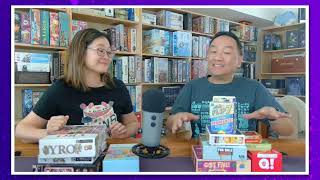




Tally Up! Deep Dive
What the Community Thinks About Tally Up!
Tally Up! is a small tin of dice from Eric Olsen, the designer of Flip 7, and reviewers keep describing it the same way: simple, loud and more gripping than it looks. Chairman of the Board admits the mass-market look set low expectations, then calls it one of the surprises of the year and as good as the push-your-luck classics in that collection. The Brothers Murph put it at number nine on their list of the year's best so far. Going Analog featured it in two different show segments and says they fell in love with it instantly, and Get into games calls it super fast, super fun and super addictive. The one real reservation comes from Board Gaymes James, whose group found the constant addition heavy enough that the companion scoring app felt necessary. The overall verdict is a light party game that does exactly what it sets out to do.
Core Mechanics That Define Tally Up!
Choosing Your Dice
The box holds six dice, and each one has a different spread of point values and stars. A player aid shows the distribution for every die. On a turn, the active player picks any three of the six. Get into games explains that the red die is the risky one with maximum reward, while the purple die is safer but carries lower numbers. Stars are the danger: one star on a roll is fine, but two stars mean a bust. The Brothers Murph point out that any mix is allowed, so a roller can take one dangerous die and two safe ones, though one of the hosts admits to grabbing the dangerous dice every single time because they are worth so many more points.
Everyone Decides: In or Out
The points rolled go into a shared pot, and after every roll each player secretly chooses in or out using a two-sided token. Going Analog walks through an example: a roll of 80, 30 and one star puts 110 points in the pot, and anyone who goes out banks those 110 and waits for the round to end. Anyone who stays in rides the next roll, which adds to the pot. If the roller hits two stars, everyone still in loses the round's points. Going Analog notes that rolling continues as long as even one player remains in, and they have seen single pots climb past 1,000 points. The first player to reach 2,500 points wins, and Chairman of the Board mentions that the target can be lowered for a shorter game.
The Tally Up! Experience
The Up Die
Some numbers on the dice are circled, and each circle triggers a roll of the special bonus die. According to Get into games, that die can add 100 points, subtract 100, double the round's total, or force the roller to add the other dice that were set aside, which scores more points but raises the chance of busting. The Brothers Murph stress that players must commit to in or out before the bonus die is rolled, so a table that stays in can suddenly find itself facing three extra dice. Going Analog sums up the effect: the numbers go crazy and the stakes climb into hundreds of points.
Shouting "Tally Up!"
Three stars on three dice is not a bust. Instead, the first player to shout "Tally up!" earns 200 bonus points, and Going Analog says everybody else still in the round gets 100. Chairman of the Board likens it to a shoot-the-moon rule and loves it because it forces everyone to pay attention. Going Analog tells the same story in both of their segments: a first game where it never happened, then a game where it happened several times and one host yelled it across a convention hall. Board Gaymes James adds that anyone can shout it, even a player who has already gone out.
What Makes Tally Up! Stand Out
No Downtime Between Turns
The in-or-out choice turns every roll into a decision for the whole table. The Brothers Murph love that a turn is never just one player rolling while everyone else waits, because every player is invested in the result. They also note the odd team feeling it creates: the roller wants to push, some players stay in to back them, and the rest react to every roll, even though the game is competitive. Chairman of the Board agrees that players are always engaged even when not rolling, either weighing whether to stay in or watching for a tally up.
A Tin That Travels
Chairman of the Board lists the contents as a few cardboard tokens and some dice in a tiny tin, for two to 10 players aged eight and up, in around 30 minutes, and reports paying about 10 pounds for it. Setup takes no time at all, and the reviewer says it plays well at two but even better with more players. Get into games calls it a wonderful small package that can go anywhere. Going Analog notes that it is a Walmart exclusive.
Potential Drawbacks
Running Totals Need Help
Keeping score is the one friction point reviewers raise. Board Gaymes James played with the scoring app linked by a QR code in the box, and by the end one player said the reliance on the app made it not a favorite. The group agreed the app is not strictly required but that doing the math on paper needs a dedicated math person, and the game has to move fast to stay fun. One player admitted to not keeping up with it during play.
Pure Luck, No Cushion
Chairman of the Board is clear that this is a pure push-your-luck game and that players who find the genre too luck-dependent will not be won over. A bust wipes out the round with no consolation, and the reviewer adds that it is not a two-hour brain burner but simple, silly party fun. For fans of the genre that harshness is the appeal; for players who want control over outcomes it is a reason to skip it.
If You Enjoy Tally Up!
Going Analog and Board Gaymes James both compare it to Flip 7, from the same designer: the same question of whether you got out in time while everyone else busts around you, moved from cards to dice. Chairman of the Board ranks it alongside Can't Stop, Rapido and Circus Flohcati as favorite push-your-luck games. The same reviewer contrasts it with Quacks of Quedlinburg, where a bust is a cushioned blow; players who enjoy Quacks but want harsher, all-or-nothing stakes should find that here.
What Reviewers Are Saying
"I can't really say a bad thing about Tally Up because it stays in its lane and it does what it's trying to do to an extremely high standard."
— Chairman of the Board
"It's not just you on your turn and we're waiting, it's just like I've got I'm invested in what you're doing."
— The Brothers Murph
"It gets ridiculous. The numbers just go crazy and it just becomes like such high stakes. There's like hundreds of points on the line."
— Going Analog