




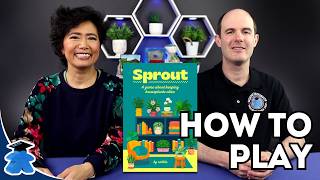



Sprout Deep Dive
What the Community Thinks About Sprout
Sprout has resonated with reviewers as a clever, thematic game that delivers genuine tension through its core push-your-luck mechanic. The game's theme of tending houseplants rather than keeping pets appeals directly to players who love plants, and reviewers consistently praised its bright, colorful presentation. What makes Sprout stand out in the push-your-luck space is how it integrates the risk mechanic with a satisfying resource management layer, creating rounds that feel both exciting and rewarding when they go well. Players appreciate that Sprout captures the bittersweet reality of plant care: sometimes you'll have bad rounds where a bust leaves you scrambling, but the game's design ensures even those moments contribute meaningfully to the overall experience.
Core Mechanics That Define Sprout
Push Your Luck
The nutrient phase is where Sprout's identity crystallizes. Each round, a common pool of nutrient cards is drawn, and players simultaneously choose whether to stay in or exit. The catch: remaining players gain more nutrients but risk busting if any single nutrient type exceeds the round's limit. Once a card pushes a nutrient over that threshold, players who stayed in must lose half their accumulated resources, and half their green thumb tokens flip to wilted plants. Reviewers found this tension to be the engine of the game. The back-and-forth calculation, the temptation to push just a little further, the relief of banking at the right moment, all combine to create engaging moments. By Rabble Games' design, each subsequent round raises the limit slightly, giving late-round decisions their own distinctive flavor of risk.
Resource Management
Beyond the luck element, Sprout demands careful stewardship of four nutrient types (water, sunlight, plant food, and love) plus green thumbs. Green thumbs function as wild resources that unlock flexibility, allowing players to exchange them for any nutrient when needed. The sprout phase lets players spend their banked nutrients to grow plants, each of which grants both immediate points and ongoing powers. Reviving wilted plants costs love, pushing players to make hard choices about recovery versus growth. The genius lies in how the resources create interlocking decisions: Does securing more green thumbs pay off if you're likely to bust? Should you spend love now to revive, or save it for adopting new plants? This layer elevates Sprout beyond a simple push-your-luck exercise into a genuine puzzle of optimization.
The Sprout Experience
Tension and Release
The nutrient phase creates a recurring cycle of tension that drives play. Players face genuine stakes with every new card reveal, knowing their greed might be punished. That tension is real, and some players struggle with it. A few reviewers noted that busting feels genuinely bad: you end a round with minimal resources, unable to act meaningfully in the sprout phase. But crucially, the game frames this as part of the experience, not a flaw. The tension is the point.
Charm of Cultivation
What softens the tension is the theme. Tending houseplants instead of chasing pets gives the game a cozy, relatable foundation. Reviewers noted that the theme has real appeal, especially for plant lovers. Watching your collection grow over five rounds, discovering new plant powers, and building a tableau of beautiful, thematic cards creates genuine satisfaction. The bright, colorful artwork reinforces this: the game looks like you're growing something worth growing.
What Makes Sprout Stand Out
Thematic Integration
The houseplant theme is not window dressing. Every mechanical element ties back: nutrients represent water, sunlight, plant food, and love because that is what plants need to thrive. Green thumbs as wild resources reflect the care you bring to your collection. Wilted plants as penalties mirror the real experience of plant care failing. Reviewers consistently praised how the theme serves the mechanics and the mechanics serve the theme, creating a cohesive whole. The game does not force the theme; it emerges naturally from the rules.
Accessibility with Depth
Sprout plays quickly, with rounds moving swiftly once players understand the nutrient phase. Teaching is straightforward: gather nutrients, decide to stay or exit, then spend what you banked. Yet beneath this simplicity, the decision trees run deep. Should you adopt new plants or revive wilted ones? Which powers synergize? The game rewards both casual play and strategic thinking, letting players engage at their comfort level without either being trivial or exhausting.
Potential Drawbacks
Busting Creates Frustration
Reviewers were honest: busting feels bad. When the common pool exceeds the nutrient limit early in a round, everyone who stayed in takes a hit. Some players end up with so few resources that their turn in the sprout phase feels hollow. This is by design, but it means some rounds can leave you feeling powerless, especially if luck turns against you. A player unlucky enough to bust in consecutive rounds might struggle to rebuild momentum.
Push-Your-Luck Stress for Some Players
The core mechanic creates genuine decision pressure. For players who dislike push-your-luck games, Sprout will not convert them. The decision to exit or stay happens repeatedly, and there is always uncertainty. If decision paralysis or high-stakes choice-making drains rather than excites you, Sprout's tempo might wear on you despite its short playtime.
If You Enjoy Sprout
Reviewers compared Sprout to Planted, another recent game about resource management and growing a garden. If Sprout clicks for you, Planted offers a similar vibe without the push-your-luck element, letting you plan and execute your strategy with less randomness. Both games celebrate cultivation and reward careful stewardship, but Planted emphasizes control while Sprout emphasizes risk and mitigation. For players drawn to games like Push or other modern push-your-luck designs, Sprout delivers familiar tension with a plant-care twist that makes it feel fresh.
What Reviewers Are Saying
"The art is really pretty. There's a big push your luck element at the beginning of each round. It definitely has a little bit of a feel of Planted where you're trying to garner resources so you can get those plants out and be able to score with them. But again, the difference there is that push your luck aspect."
— Let's Table It
"And this is such a fun little game. And it reminded me kind of a little bit of a push your luck aspect of the game push, which is one of my favorite like group card games. Um, where you're flipping cards and then you're kind of pushing your luck and hopefully not uh busting and then you're getting different nutrients for your flowers in order to uh gain victory points for the different flowers."
— The Board Game Garden
"It is a theme that really appeals to us. We really enjoy, you know, plants, house plants. And this one, you are growing and growing your collection and also growing your plants along the way, taking care of them. And it's very bright, colorful, fun."
— Let's Table It