













Wildscape Deep Dive
What the Community Thinks About Wildscape
Wildscape has earned strong praise from board gaming reviewers for its thoughtful design and engaging systems. The community consensus leans toward enthusiasm, with reviewers consistently highlighting the game's strategic depth and the elegance of its core mechanism. Rahdo Runs Through gave the game especially high marks, calling it one of the best implementations of the Mancala mechanism and exploring it as a strong candidate for game of the year consideration. Board Gaming Ramblings, reviewing as a team, landed on 8.5/10 from both reviewers, describing it as "really great stuff" with stellar design despite its length. BoardGameCo's Alex ranked it among the top games from their Dice Eye Retreat experience, praising it as a satisfying, very crunchy puzzle. Reviewers appreciate that Wildscape delivers meaningful strategic choices without resorting to randomness or arbitrary difficulty.
Core Mechanics That Define Wildscape
Mancala-Style Action Selection
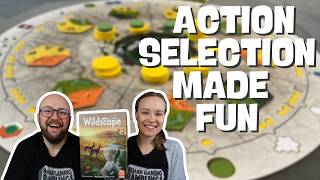
Wildscape's central system is a shared action wheel that works like a Mancala board, a traditional African game mechanism. On your turn, you select any wedge around the circular board to activate. That wedge grants you actions and energy to spend, then the energy tokens you used distribute clockwise around the wheel, making different wedges more or less attractive for the next player. Board Gaming Ramblings notes this is "not really a rondel because the action markers are a rondel or a Mancala," emphasizing that any player can select any wedge at any time; the energy economy is what creates the strategic tension. The genius here, they explain, is that you're never simply chasing the highest energy value. You're weighing what you need right now against what you're leaving for opponents, creating a puzzle that changes every turn.
Tile-Laying and Habitat Building
The other pillar of Wildscape is habitat tile-laying. As you activate action wedges, you spend energy to place woodland, wetland, savanna, desert, and river tiles onto your personal ecosystem. These tiles grow your landscape and create space for herbivores, primates, predators, and snakes. Reviewers emphasize that this spatial puzzle is particularly well-executed. One reviewer noted that compared to other animal-building games like Arc Nova, Wildscape's approach to managing where creatures can live feels natural and rewarding. The tile-laying isn't merely decorative; it's essential to your engine, determining how many and what size animals you can place, which animals score points for you, and which special bonuses you unlock.
The Wildscape Experience
Crunchy Strategic Depth
Reviewers consistently describe Wildscape as a crunchy, deeply strategic game. Board Gaming Ramblings expressed this clearly: "There's a lot of crunchy choices on your turn. I'm thinking, okay, should I go here? There's absolutely the most I can do here. I would like to get some of these cards, but I really want this tile over here." The game forces you to think several turns ahead about which objectives to chase, which animals to prioritize, and how your tile placements set you up for future turns. At the same time, you have to stay flexible because opponents can take the resources or positions you were planning for. This balance of planning and adaptation is what makes the game engaging rather than purely deterministic.
Hopeful Ecological Restoration
The theme of Wildscape sets it apart emotionally. You're not conquering a landscape or extracting resources; you're healing barren land by reintroducing the ecosystems and animals that once thrived there. Board Gaming Ramblings describes the scenario: "In Wildscape, you are in an area of kind of like an alternative world where there's no more nature. There is this mountain in the middle, but the nature around it is all gone, and we have to kind of re-nature that area." This restoration arc feels satisfying as your landscape grows from empty to thriving. The theme integrates cleanly with the mechanics, making every tile placement and animal introduction feel purposeful and meaningful rather than arbitrary.
What Makes Wildscape Stand Out
A Masterful Mancala Implementation
Multiple reviewers single out the Mancala mechanism as exceptionally well-designed. Board Gaming Ramblings states plainly: "The Mancala system works perfectly. I think it's a great use for that mechanism." They reference similar implementations in Trajan and Ostia but argue that Wildscape executes it with clarity and purpose. The mechanism ensures that every action creates consequences for future rounds, keeps all players engaged (you're always thinking about which wedges will be available next), and creates a natural ebb and flow where no single space is always dominant. This is the kind of elegant, economy-driven system that generates hundreds of different games without rebalancing.
Spatial Puzzle Excellence in an Animal Game
Board Gaming Ramblings highlighted the spatial puzzle as a standout achievement: "I have to be honest to say that I've played multiple animal games that revolves around this thing, like you have to have an area this big to place this size animal here. I would say, I think this is a game that I can remember that I think does that in the way that I like the most." When placing tiles and creatures, you're solving a real spatial problem: you need enough contiguous space to house your animals, but size matters, position matters, and leaving room for future expansion matters. The game makes this feel rewarding rather than punishing.
Potential Drawbacks
Length and Decision Load
Multiple reviewers noted that Wildscape can run long. Board Gaming Ramblings observed: "The game can be quite long. We have played two and three players. The box says 30 minutes per player." They report their three-player game took roughly two hours and forty-five minutes with a new player. The cause is clear: the game offers so many meaningful choices that players naturally spend time considering their options. If your group prefers quicker games or plays with players prone to analysis paralysis, this is worth knowing upfront. However, reviewers note the length comes from richness, not from tedious downtime.
Iconography and Rulebook Checking
Board Gaming Ramblings points out that while the iconography is language-independent and well-explained in the rulebook, "the first time you play, you will have to check quite a few times in the rulebook. And I have to say that it does often tend to end up that you check some of the cards anyways even after you play a few times because you want to be 100% sure." This is a small friction point but worth noting if your group prefers minimal rulebook consultation during play. That said, they emphasize the symbols are clear once you learn them, and the comprehensive player aid helps.
If You Enjoy Wildscape
If Wildscape resonates with you, consider these related games. Fans of the Mancala action system should explore Trajan and Ostia, which pioneered similar energy distribution mechanics. If the ecosystem-building appeals to you more than the action selection, Arc Nova and Cascadia both center on creating habitats (though Cascadia is much lighter and faster). For a different take on habitat tiles with a lighter spatial puzzle, Cascadia offers half the complexity and playtime. If you love strategic depth with meaningful player interaction, Istanbul and Keyflower (designed by the same designer, Sebastian Bleasdale) deliver similar kinds of satisfying economic puzzles. For those drawn to the restoration theme, Terraforming Mars offers a longer, more sci-fi take on transforming a barren world into something thriving.
What Reviewers Are Saying
"I think the Mancala system works perfectly. I think it's a great use for for that mechanism. We've seen it like in few games, but just like a personal little Mancala thing in Trajan and Ostia are the ones that comes to mind for me."
— Board Gaming Ramblings
"It's basically think Cascadia. If Cascadia were a much heavier, longer game and not a halfhour long experience."
— BoardGameCo
"There's a lot of crunchy choices on your turn. I'm thinking, okay, should I go here? There's absolutely the most I can do here. I would like to get some of these predator cards that I can get from this action, but I really want this tile over here. And like timing-wise, there's something else that's more important for me."
— Board Gaming Ramblings