




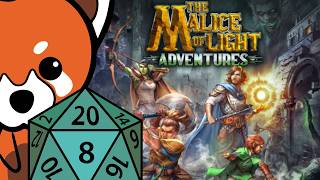
The Malice of Light Adventures Deep Dive
What the Community Thinks About The Malice of Light Adventures
The board gaming community has responded with genuine enthusiasm to The Malice of Light Adventures, the new cooperative fantasy adventure from the Saddler Brothers through their newly formed Twin Tale Studios. Across multiple reviews, there is consensus around the game's ambitious design: it successfully merges hand management and card upgrade mechanics with tactical board movement, creating a puzzle-like cooperative experience that demands player communication. Several reviewers found the core mechanics compelling but noted the prototype showed signs of ongoing balance refinement. One reviewer praised the modular design and the emotional trajectory of escalating difficulty, while acknowledging the game's substantial length. The creative pedigree of the designers, combined with their proven track record in adventure games, has generated anticipation for the final release, particularly since the game draws inspiration from Brady Saddler's own fantasy novel universe.
Core Mechanics That Define The Malice of Light Adventures
Modular Board Layout
Each game of The Malice of Light Adventures is constructed from modular encounter tiles that players arrange differently for every playthrough. The ruleset allows players to tackle three acts in any order they choose, mixing and matching combinations of basic scenarios before a final boss encounter. This creates immediate replayability and strategic depth: which scenario you tackle first affects how prepared you are when you face the boss in the third act. The board itself is more than scenery; physical scheme tokens create dynamic spatial effects that alter movement, blocking passages that become clear only when the schemes are destroyed. Reviewers consistently highlighted this modularity as a key evolution of the Saddler Brothers' earlier work on titles like Street Masters and the Warhammer Quest adventure card game.
Exploding Dice Combat with Flexible Results
The heart of moment-to-moment gameplay is a generous and rewarding dice system where there is no possibility of a complete miss. Every player action uses blue dice, while enemies trigger red dice on your actions. The results are nuanced: you can roll hits (successes), shields (defense), or critical successes that explode, allowing you to roll that die again. There is no purely wasted roll. If you roll only defensive shields, you can bank those as guards for later use. Excess successes beyond what you need for an action feed into a focus resource that mitigates future rolls. This flexibility means that even unlucky rolls contribute to your position, creating a satisfying sense of progression throughout the game. Reviewers repeatedly emphasized that this system avoids the frustration of total failure, instead offering meaningful choices about resource conversion and timing.
The Malice of Light Adventures Experience
Escalating Tension and Growing Threats
The game is structured to deliberately amplify difficulty and danger as players progress. The three acts are not created equal: Act One feels relatively forgiving, while Acts Two and Three present substantially more challenging enemy encounters. Reviewers describe a creeping sense of dread tied to scheme tokens that persist on the board. If players fail to remove peril tokens from these schemes, the villain's corresponding cards level up after each act, growing more potent and dangerous. This creates a cascading threat: ignore peril management in Acts One and Two, and you face a substantially harder boss fight. Death itself carries graduated consequences; in the first two acts, failure has limited permanent impact, but in Act Three during the actual boss confrontation, defeat becomes final. This structural design transforms the game into a crescendo of rising stakes where early decisions have real consequences.
Cooperative Puzzle-Solving Under Pressure
Reviewers consistently describe The Malice of Light Adventures as feeling like a puzzle game disguised as combat. Each scenario presents multiple competing demands: you must fight enemies on the board, manage peril tokens to prevent villain escalation, search for upgrades to make your character stronger, and navigate spatial obstacles created by active schemes. Your turn choices feel constrained and precious. You have a limited number of action cards to play, each with upgrade potential, and you must consciously decide whether this turn is for fighting, exploring, or preparing. This abundance of meaningful decisions requires constant table communication as players coordinate who handles which threat and what upgrades the group should prioritize. Reviewers noted that the game actively reinforces cooperation: discovery tokens that provide stat upgrades benefit the entire party, regardless of who found them, creating incentives for shared success rather than individual gain.
What Makes The Malice of Light Adventures Stand Out
Character Asymmetry and Thematic Growth
Each hero in The Malice of Light Adventures starts with a unique set of three base abilities and can earn relics and talent cards that layer additional context-sensitive effects. A paladin character plays fundamentally differently from a ranger, not just mechanically but thematically; as you upgrade your character with new cards, you reinforce their archetype and role within the team. This allows players to specialize during play without feeling locked into a single strategy. Reviewers appreciated that every character build feels distinct and that the flavor of your character class grows stronger as you acquire thematic upgrades, creating a satisfying alignment between mechanical progression and narrative identity.
Meaningful Modularity Without Excessive Complexity
The Saddler Brothers have deliberately constrained the component count and rule overhead despite the game's depth. The modular nature of scenarios, while creating variety, does not require mastering dozens of distinct card sets or overwhelming decision trees. Reviewers found the core rules accessible after a single teach, with complexity rising organically through play rather than front-loading comprehension demands. This balance between mechanical depth and onboarding accessibility appears to be a deliberate design choice that respects players' time while preserving the puzzle-like richness that makes each scenario feel like a distinct challenge.
Potential Drawbacks
Balance Still Evolving in Development
Because reviewers evaluated a prototype version, several flagged that the difficulty tuning and scenario balance appeared to be undergoing active refinement. Early acts felt markedly easier than later ones, which could be intentional but also suggested the designers were still finding equilibrium. Some reviewers wondered whether casual players comfortable with lighter cooperative games might find the prototype's difficulty curve off-putting. As a pre-release assessment, this should be taken as constructive feedback on work-in-progress tuning rather than a final verdict on the retail product.
Game Length and Replay Friction
The Malice of Light Adventures routinely ran two hours or longer in playgroup sessions, a substantial commitment for a single campaign arc. While some groups relish epic storytelling experiences, others expressed concern about whether the length might discourage repeated plays, especially if players wanted to experience different scenario combinations or face different bosses. Reviewers noted that the prototype contained limited variety in available scenarios and bosses, suggesting that replayability may improve as more encounter content becomes available in the final release. The combination of length and prototype content limitations is worth watching as the game matures.
If You Enjoy The Malice of Light Adventures
Players drawn to The Malice of Light Adventures will find kinship with Street Masters, the Saddler Brothers' earlier design that pioneered the modular encounter system now refined here. Those who love tactical puzzle games should explore Arkham Horror and Marvel Champions, both of which share the cooperative resource-management spiral where threat escalation forces constant prioritization. For players who specifically enjoy the escalating difficulty and boss-fight finale, Marvel Alliance offers a thematically similar structure. The Saddler Brothers' earlier work, Warhammer Quest Adventure Card Game and Heroes of Teranoth, provide direct spiritual predecessors with similar action-card mechanics, though The Malice of Light Adventures adds the tactical board layer. Fans of Alter City, Alter Quest, and Brock City will recognize the design philosophy but should expect deeper board-state management than those titles provided.
What Reviewers Are Saying
"Yeah. And the whole idea here is the game is throwing so much in front of you. And that's what we said at the very beginning that it kind of feels like one of those LCG puzzles that like when you sit down for a scenario, you're like, 'Okay, well, we have to take all the peril. Like, we really don't want this one to level up because that one's good. So, let's focus on this orange one, but we also don't want to let the green one level up. Oh, but I also want to at least upgrade some of these cards and get one relic, but at the meantime, like but I have to use my turns to fight these monsters. So, I it's just there's so much to do and you really really do need to rely on teamwork.'"
— Man vs Meeple
"What also makes this interesting is that death is more forgiving. I mean, there's still consequences in the first two acts. It's only permanent in the third act when you're actually fighting Fendra once and for all. Similarly, you can knock her off the board in acts one and two, but she can come back. However, in act three, what's done is done."
— Liz Davidson, Beyond Solitaire
"This one was mostly good. I liked the core mechanics quite a lot. Uh in the prototype, though, I didn't feel like the balance was quite there yet. And also, the game feels pretty long cuz you got to go through multiple acts and then the boss fight. And at least in my plays, all of that put together could be like 2 hours or more."
— One Stop Co-op Shop