




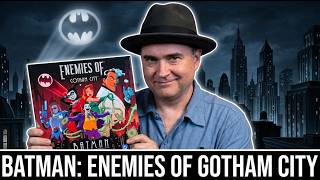

Enemies of Gotham City Deep Dive
What the Community Thinks About Enemies of Gotham City
Reviewers across The Dice Tower, The Discriminating Gamer, and Rolling Dice & Taking Names see Enemies of Gotham City as a thematically immersive, fiercely competitive area control experience that captures the chaos of Batman's rogues gallery fighting for dominance. The consensus is enthusiastic: this is a sophisticated game that rewards careful play while embracing unpredictability and player conflict. The Dice Tower's Tom Vassal describes it as "very strong thematically and it's one of honestly one of the best Batman games out there," while The Discriminating Gamer's Cody Carlson praises its engagement and production, giving it an 8/10. A few voices express caution about game length and price point, but no reviewer dismisses the game outright. Those who champion it most are players who relish area control games with genuine meanness to them.
Core Mechanics That Define Enemies of Gotham City
Area Control with the Arkham Asylum Cube Tower
The centerpiece of Enemies of Gotham City is its dual-layer area control system anchored by the Arkham Asylum cube tower, inspired by but distinct from the caballero tower in the classic El Grande. Each round, players maneuver their character and place goon cubes (representing henchmen) across Gotham's districts, competing for majority control. What makes this system compelling is the cube tower's role as an engine of uncertainty. During the round, cubes you place into Arkham Asylum may become stuck inside the tower, emerging later when players least expect them. This creates genuine tension: players must decide whether to deliberately place cubes into the tower, hoping they will escape at the right moment to boost their position before scoring, or hold them back. The tower injects chaos into even the most carefully planned strategy. Upper Deck's design succeeds because cubes that come out are placed in turn order back onto the board, giving players a brief moment of control over their own fortune.
Card Drafting and Power Card Play
Every player begins with the same hand of power cards representing villainous tactics: movement, placing goons, burning buildings, manipulating the board. Throughout the game, players buy additional power cards from the docks, each offering unique effects tied to their character (a Poison Ivy card might add plants instead of flames, for example). The card economy is tight: you can play only one power card per turn, and once a card is played, it is gone forever. This creates constant decision-making. Do you save your most powerful card for the final round when the highest-scoring district is revealed, or play it now to seize control of a district you might not hold later? Rolling Dice & Taking Names' hosts noted that everyone starts with equal power cards, but drafted cards quickly differentiate the players, and the drafting mechanic feels fresh precisely because every card is unique.
The Enemies of Gotham City Experience
Thematic Immersion: Playing the Gotham Rogues Gallery
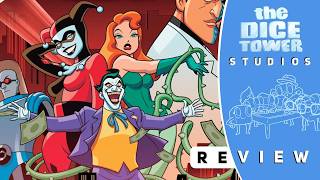
Enemies of Gotham City is grounded in the Batman animated series, the acclaimed cartoon that defined these characters for a generation. You are not heroes or neutral parties. You are the Joker, the Penguin, Poison Ivy, Mr. Freeze, Harley Quinn, Bane, and others, each with distinct abilities and play styles reflecting their comic book personas. Batman himself enters the board each round via event cards, which also determine which district will score and how players gain income. The game forces you to stay thematically engaged: if Batman shows up in your territory, he blocks scoring for that round and prevents you from gaining income, mirroring the canonical tension between the villains and the Caped Crusader. Reviewers emphasized how the thematic trappings are not window dressing. The Dice Tower's vacation video noted casually, "As you can see, I'm the penguin who is getting beat up by the Joker." That friction is the game. The setting makes the area control stakes feel personal.
Chaotic Take-That Tension and Constant Engagement
Enemies of Gotham City embraces confrontation. Players actively interfere with each other using power cards and weapons, burning buildings that benefit them or block others' paths, moving into occupied spaces to force payments, and carefully timing when they place cubes in the tower to catch rivals off-guard. The Rolling Dice & Taking Names hosts remarked that "there's so much player interaction" and "you're constantly engaged with the board," emphasizing that the game does not punish table talk or aggressive play. The back-and-forth energy is relentless: each round brings new event conditions, a currency system that rewards clever positioning, and the ever-present threat of Batman showing up to spoil your best-laid plans. This is not a game for players who prefer solitary optimization. It is a game for players who find excitement in mutual sabotage and the unpredictable momentum shifts when cubes erupt from the tower at the worst (or best) possible moment.
What Makes Enemies of Gotham City Stand Out
Sophisticated Area Control with Real Asymmetry
While area control is not new, Enemies of Gotham City's execution stands out because each villain plays meaningfully differently. Poison Ivy does not set fires like other villains; she places plants that activate different scoring triggers. Mr. Freeze burns with ice, not flames. These asymmetries are not cosmetic. They change decision trees and create unique strategic paths for each player. Combined with the cube tower's randomization, which no amount of optimization can fully predict, the game avoids the feel of a solvable puzzle. Reviewers consistently praised how the game remains fresh across multiple plays.
Production Quality and Thematic Coherence
The Discriminating Gamer spent considerable time unboxing and examining the components, noting the "incredibly high production standard." The dual-layer board with indented slots for buildings, the beautifully sculpted villain minis, the detailed power and event cards, and even the Two-Face coin all reinforce the theme. This is not a game that asks you to imagine atmosphere; the box delivers it. The painted buildings slot into the board's recesses so that they stay in place and the board itself becomes a tactile, three-dimensional representation of Gotham under siege. For players who value tactile play and theme integration, this production standard is not a luxury add-on; it is integral to why the game works as well as it does.
Potential Drawbacks
Price Point and Accessibility
Enemies of Gotham City from Upper Deck carries an MSRP well north of $100, with some retail listings at $150. The Rolling Dice & Taking Names group directly confronted this: for players accustomed to mid-weight games in the $40-$80 range, the barrier to entry is significant. One host noted that for such a cool experience, this game is hard to get to the table because of the price point. The production quality justifies some of the cost, but the price does limit who can access it casually. Players who prefer budget-friendly games or rotate through a large library may find the investment difficult to justify.
Game Length and Pacing
The box lists a playtime of 60 to 150 minutes, but reviewers consistently reported longer sessions with three to five players. Rolling Dice & Taking Names' group played a three-player game that stretched to two hours and did not feel rushed. Tom Vasel suggested dropping an entire round from the game to shorten it. The complaint is not that the game drags mechanically; The Dice Tower explicitly said it did not feel like two hours in the moment because player interaction kept everyone engaged. The issue is logistical: a game that advertises as 90 minutes but consistently plays 120 is a problem for scheduling at game nights or conventions. This is worth considering if your group has strict time windows.
If You Enjoy Enemies of Gotham City
El Grande is the obvious recommendation. Reviewers mentioned it repeatedly as the closest mechanical ancestor. If you do not own El Grande and want a modern take on area control with cubes and randomization, Enemies of Gotham City may feel fresher than hunting down a decades-old classic. However, if you already love El Grande, Enemies of Gotham City offers a distinct enough thematic and mechanical package (especially the card play and asymmetric powers) to warrant serious consideration.
For area control fans who prioritize theme, look at Realm of Reckoning, which several reviewers mentioned as a strong contemporary alternative. For players drawn specifically to the Batman universe, the animated series IP here is worth the premium; this is among the strongest Batman board games available.
If you want chaotic, mean games with take-that mechanics, Enemies of Gotham City scratches that itch with more sophistication than many party games. Pair it with designers known for player conflict and interactive gameplay, and you will find kindred spirits.
What Reviewers Are Saying
"So, this is an area control game with some really good mechanisms... it's still very entertaining and it's very strong thematically and it's one of honestly one of the best Batman games out there."
— The Dice Tower
"I had a blast with it. Now the game itself is um pretty interesting on a lot of levels. It's area control. I always like area control and certainly I love the Batman theme. It's the animated series here. Artwork is beautiful. Minis are good-looking. Uh, and really, honestly, this is a game that just has an incredibly high production standard."
— The Discriminating Gamer
"Batman, meanwhile, is going across Gotham trying to stop you. And if Batman is placed in an area due to an event card that's drawn at the beginning of each round, that means that area is not going to score. So, you may have invested in North Gotham in order to try to win that. But if Batman ends up there, well, too bad."
— Rolling Dice & Taking Names